Princess 72

Seastoke

Well-Known Member
Joined
20 Sep 2011
Messages
13,725
Visit site
There is one in our marina that had a mid ship cleat snapped during last weekend storm, looking at the size of the craft it looked like it was held on with two eight mil or ten mil bolts . I was shocked such a heavy boat should small fixing support , the boat must be 40 ton.
 
If she's the Y72, she's 51 tonne!! She's a big girl.. Pictures can be deceiving but the midship cleat doesn't look particularly big on this vessel
 
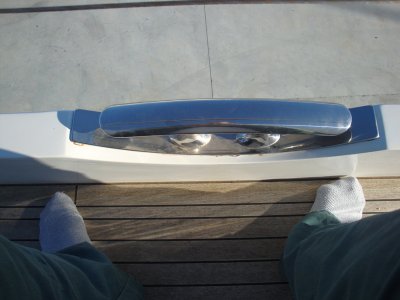
These are the ones on my P67 - I would have thought that the Y72 would use the same ones.
I've always thought that they are fabricated in the Princess factory - but I might be wrong.

DSC01768.resized.JPG

This is a photo of the same style/size of cleats that are fitted to our foredeck - the bolts are bigger than 10mm

Screenshot_2026-01-28_11-24-58.jpg
 
Yes it is that style , you maybe right about bolt size , I would have expected a bigger spread plate . I think the problem is the 72 is very high from the jetty so the tension is a tight angle down so could explain why bolt snapped.
 
There is one in our marina that had a mid ship cleat snapped during last weekend storm, looking at the size of the craft it looked like it was held on with two eight mil or ten mil bolts . I was shocked such a heavy boat should small fixing support , the boat must be 40 ton.
Usually cleats are glued as well as bolted on. Sorry dont mean to sound a smart arse, just watch a "factor tour" YB video.
 
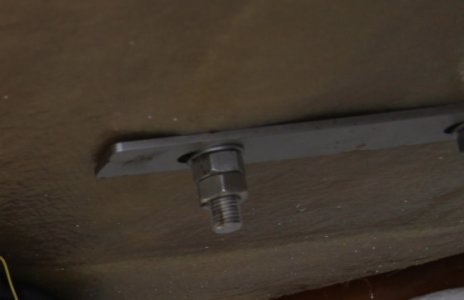
Ok update , so the bolt size was 16 mm , but the failure Was down to the bolt falling out .
Perhaps the bolt did snap which is why it fell out ?
I know there is design guidance on mooring forces but I don't expect every cleat on a boat has to be designed for the weight of the vessel. More likely a wind load analysis would be involved.
A M16 bolt can take about 6 tonnes in tension and 2 tonnes in shear but not necessarily both at the same time. But the design has to take into account all things including the thickness of connected steel parts and the weaker material of the hull. A thin metal spreader plate could well focus load on the bolt and cause a failure .
No doubt the bigger the boat the greater the wind load and all the more critical that mooring lines spread the loads as evenly as possible among the available cleats .
 
Perhaps the bolt did snap which is why it fell out ?
I know there is design guidance on mooring forces but I don't expect every cleat on a boat has to be designed for the weight of the vessel. More likely a wind load analysis would be involved.
A M16 bolt can take about 6 tonnes in tension and 2 tonnes in shear but not necessarily both at the same time. But the design has to take into account all things including the thickness of connected steel parts and the weaker material of the hull. A thin metal spreader plate could well focus load on the bolt and cause a failure .
No doubt the bigger the boat the greater the wind load and all the more critical that mooring lines spread the loads as evenly as possible among the available cleats .
Well I spoke to the prinny engineer , it fell out , why they have to have slotted back plate , which is not good for the washer . Also no spring washer and using two nuts to lock them, yes that does work but a nut and nylons would be better. Hard to lock two nuts in a confined space. Also you would think thread lock , inside the cleat.
 
The nut would not have instantly fallen off....so the cleat might have been loose....and should have been noticed when tying up
 
Who was is it that started the whole "the bolts are 8 or 10mm" line?? 16mm will hold up a flippin mountain. Lets get our facts straight here.
 
Top