Primer for 2 part polyurethane paint

Mikedefieslife

Well-Known Member
Joined
8 Aug 2016
Messages
579
Location
On a boat
Visit site
I've got a can of Jotun Hardtop XP two part polyurethane paint, that I plan to use to paint an area of around 6m2.

The substrate is wood.

I can't quite figure out what type of primer I need. I've been told I need a two part primer by one person. An epoxy primer (really) by someone else, and a then any old polyurethane from a hardware store by another.

Nowhere sells Jotun paint around here, and the datasheet for Hardtop doesn't seem to specify the type of prime to use.
 
One-pack polyurethane is not the right answer.
Either a special purpose primer made for the job or epoxy.
 
I'm in Greece, which isn't the most modern of nations. Hempel is sold here, Epifanes, and a bunch of local stuff.

I can get easily get epoxy primer, though I thought epoxy and polyurethane don't get on together. I'll ask in a third Chandlers tomorrow, see what they say. This simple job is becoming a pain.

That, or perhaps I should just ditch this paint, and buy something local to do the whole job.

It's for a small wooden (mostly wood, some bits of glass too) rear deck, that looked like it was previously painted with incompatible paints before I began sanding.
 
What sort of wood are you painting? I would be cautious unless it is completely encapsulated as any moisture getting in around edges that are uncoated will tend to lift the paint. 2 packs are much harder and less flexible than single pack paints. More durable and better gloss / colour rentention than single pack but also more prone to crack and lose adhesion. You can't use a single pack primer (except something like International Universal Primer) and putting it on direct would not be a good idea. 2 pack poly primer will be best but you can also use an epoxy. Polyurethane will adhere well to epoxy but you need to let the epoxy fully cure and then abrade before putting the polyurethane on. Solvent based epoxy will be better than solvent free but I would leave for 28 days to fully cure before overcoating.
Re our other thread I will now be back late Saturday this week. Beer on Sunday?
 
A not to be identified by me UK supplier to the automotive industry used to make MDF load space floors for a well known type of van. Business exported to Turkey now. MDF coated with a 2 component PU material. All that was required to give adhesion to the MDF, a material which has release additives in it from when it is made and is difficult to bond to , was to coat it with a thin layer of PVA. It had to be dry though.
 
Last edited:
IMG_5246.JPG

The wood was a heavy hatch over the engine. Super heavy. The 40x50cm piece is over 10kg. Craziness.

I sanded it down and painted with the Jotun Hardtop XP, using 50% thinned down mixture as the initial base coat. It's super hard, and sands down to a smooth glossy finish even with 180 grit.

Probably too smooth and too glossy for an area that will see foot traffic. As such I'm going to abandon two part poly altogether. My tin was old anyway.

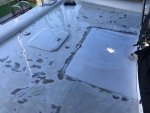
The rest of the deck you can see is glass coated, but I've found noticed good 40x40cm area of delimitation. I can even see the water underneath. Even though that deck is non-structural, I need to get it sorted really before proceeding further.

I think I'm now going to go with International Interdeck. It's a single part poly paint, but is low shine, and is supposed to offer some grip. Anything like awlgrip with griptex, or kiwi grip etc.. is out of the question as I find such finishes far too rough. Even the badly worn flaking old paint offered sufficient grip for me in a decent seaway.


Beer on Sunday?

Sure thing. I'm free afternoon and early evening.
 
Top