Preventing a log paddle wheel from fouling?

Opinions differ.

Ours is accurate to within a % or two.

We will have to agree to disagree about holes in the hull. I know some people can be quite paranoid about through hull fittings (I'm not suggesting you are.) but I think there's a much bigger risk of running into a container and getting a big crack that would be impossible to stop. If a through hull fitting shears off then a softwood bung sorts it out very quickly and easily.

Wonder how many people still have their wooden bungs in the plastic bag they were bought in, hidden away in some deep drawer, instead of the correct sized one being tied to the skin fitting they were meant for?
 
Wonder how many people still have their wooden bungs in the plastic bag they were bought in, hidden away in some deep drawer, instead of the correct sized one being tied to the skin fitting they were meant for?

Well, I can hold my hand up to that one. Having owned a cruising boat for nearly 30 years and never even come close to losing a skin fitting, the packet has gone deeper and deeper into the locker it is stored in. If and when a skin fitting did fail it would not be much of a problem to stuff something into the hole while I found the plugs, and think of all the nuisance I have saved over the years by not having half a dozen wooden plugs dangling around on bits of string.

The only plugs I have ever used, not necessarily for emergencies, have been old wine corks. We keep a couple handy for when they are needed. They can be squeezed with mole grips or pliers to fit smaller openings.
 
Only way I've found to keep it clear is take it out and replace with the blank if not moving for >24hrs.

Very useful for analysing currents - reads low @ speeds <4.0 knots and high at speeds >6.8 knots. Like a swung compass it's easy enough to set up the accurate point and have a table of divergence. As those are the 80% distribution points of speeds on my boat, I expect no more.
I've found a trailed log no more accurate and far more problem to deploy and replace the spinners.
 
When I did a search on the forums for this topic I noticed that a poster said they painted watered down antifouling on to the paddle wheel. Has anyone else tried this.

Are there any other useful suggestions?

I seem to remember seeing on some boats that they use a kind of grease on props and wondered if anything like this had been tried on a paddle wheel log or would that make it less sensititve.

Thanks in advance for any suggestions!

Raymarine say to paint some antifouling on it, but all that does with my eroding antifouling is get your hands blue when you take it out weekly and clean it - and eject the mini-shrimps that have found it a nice place to live, and stop it turning. Re accuracy: with a nice clean paddlewheel you can get very good accuracy (Raymarine have a function on linked instruments that lets you set it to match GPS speed which of course you need to do in dead still water) but it drifts slower over days or weeks afloat as the paddle gets stickier.
 
Well, I can hold my hand up to that one. Having owned a cruising boat for nearly 30 years and never even come close to losing a skin fitting, the packet has gone deeper and deeper into the locker it is stored in. If and when a skin fitting did fail it would not be much of a problem to stuff something into the hole while I found the plugs, and think of all the nuisance I have saved over the years by not having half a dozen wooden plugs dangling around on bits of string.

The only plugs I have ever used, not necessarily for emergencies, have been old wine corks. We keep a couple handy for when they are needed. They can be squeezed with mole grips or pliers to fit smaller openings.

We use old corks to block up the cockpit coaming drains when they are on the wrong side of a tack but a champagne cork scuppered my attempts to pump the bilges when it was sucked into the valve and blocked it completely. Luckily we were only sinking at our normal steady rate so no harm done but it took me a while to work out what was wrong with the pump.
 
Last year I gave the impeller a couple of coats of silicone spray before immersing it. It seemed to keep working for a few weeks longer than usual. This winter I have given it a quick spray every time I thought about it, so probably 10 or a dozen coats. We shall see if it keeps going any longer than last year.
 
Modern transducers are so easy to retract for cleaning that it is hardly worth worrying about. I just smear a little silicone grease on. Even my dreadful old Navico transducer on my last boat wasn't much trouble, apart from the fact that it attracted weed like mad. With no flap, I could replace it and only admit a few cupfuls of water, with the Raymarine it's only a trickle.
 
Wonder how many people still have their wooden bungs in the plastic bag they were bought in, hidden away in some deep drawer, instead of the correct sized one being tied to the skin fitting they were meant for?

What's the correct size? Big enough to hammer in the hol eif the skin fitting disintegrates as a whole or big enough to hammer through the flange if just the tail comes off?
 
What's the correct size? Big enough to hammer in the hol eif the skin fitting disintegrates as a whole or big enough to hammer through the flange if just the tail comes off?

Mine are in their plastic bag, The Kipper ain't gonna sink whilst I get them out, especially with a towel stuffed in the hole. As JD has said, you need two sizes at each sea clock, best just have a bag of them, all sizes, one place to go for what you need; plus I do a very thorough check each year.
 
I antifoul the log transducer a couple of times a year. Only takes a few minutes - remove the paddlewheel from the housing and paint each separately. Works fine.
 
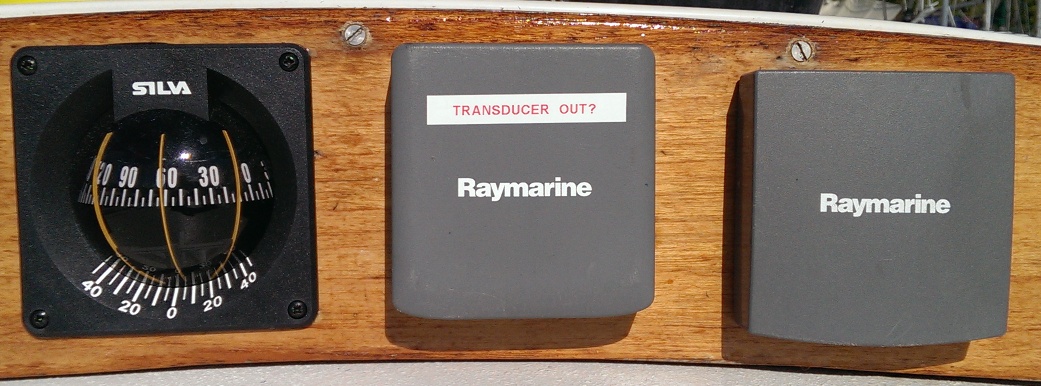
I use one of these:-


Instrument%20Covers.jpg


:D
 
A fellow club member applied some kind of metalic based paint (presumably copper) to his paddle wheel/housing in the hope that it would prevent fouling, unfortunately it interfered with the magnetic field that the log relies upon to calculate the speed of the paddle wheel's rotations and so rendered the whole thing useless :eek:
 
Wonder how many people still have their wooden bungs in the plastic bag they were bought in, hidden away in some deep drawer, instead of the correct sized one being tied to the skin fitting they were meant for?

With humble apologies to sideshowbob for the thread drift :)

I bought a new boat last year and among the list of a million lines of chargeable extras was "wooden bungs". The cost was ridiculous compared to a £10 or so plastic bag so I was ready to scream and shout about being ripped off. To my surprise and delight the commissioner had done a fantastic job of very neatly attaching the right size bung adjacent to every skin fitting. In this new context, not bad value for money. Something that I'd probably never had done.......just kept it on the "must do" list.

Back to the OP. I don't put anything on my paddle wheel. The best practice is to use the boat regularly. If it's fouled, try beating in a F6 wind over tide, that'll probably clear it. Next option, give it a quick brush over when diving under the hull mid season. The easy option is to take it out, put the bung in its place, give it a good clean (toothbrushes were made for this) and put it back in. With plenty of rags around, it's no big deal.

Out of interest, I check and recalibrate mine once or twice per season. I don't understand why some don't like them. With simple maintenance I've found them to be very reliable and I like to be able to read my speed over water separate from GPS over ground.
 
I certainly agree with you; paddlewheel logs are about as much use on a boat as a spacehopper for foredeck work !

Nasty big hole in the hull and too inaccurate for navigation even on the odd blue moon when it's working; I still have my trail log to supplement gps, but I can't understand why simple modern trail logs aren't available.

Probably because only a few grumpy old farts like me would want to by one.
The majority nowadays will spend hundreds on the latest digital gadget but wont spend the necessary amount on the simple back ups.
I’m still looking for a working and complete walker.
 
Well now we are onto bungs.
I do have wooden bungs on strings attached to each and every through hull.

The interesting bit might be figuring out what I did with the hammer:)

I do know a certain older vessel which I wont name to protect her modesty which went around for quite a while with a broom handle sticking through the bottom until she could be hauled a fixed permanently.
 
The majority nowadays will spend hundreds on the latest digital gadget but wont spend the necessary amount on the simple back ups.
I’m still looking for a working and complete walker.

My shinny new boat has an incredibly powerful array of digital gadgets. The first three warranty items were 1. dead batteries, 2. dead digital gadget, 3. another dead digital gadget.

I also have a complete and working Mk 3A Walker Log :encouragement:
 
I bought a new Walker. Shortly afterwards I then bought a replacement impeller after something ate it, then another one, then another. After that I left it in the box and used to throw things overboard and measure how long it took them to travel the length of the boat. Then I got an RDF and forgot all about navigation ;-)

The current boat has a VDO turbine log which under-reads by about 30%...

How do I know? The GPS has tidal and current information, so I can work out the speed through the water from SOG & current! Ha!
 
Top