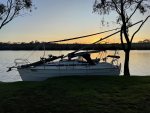
Practicality of owning a trailer sailer - is the extra effort worth it?

I agree with Chiara’s Slave and I have been trying to promote the use of larger trailer sailers for extended cruising as an alternative to either being locked in one sailing location or needing to do very extended offshore travels to reach alternative destinations to cruise.
Now with a previously non sailing partner not yet able to stand her share of watches and anyway with a general dislike of lonely long watches, lack of sleep and suffering adverse weather offshore I believe driving your yacht on trailer between distant locations to cruise is a viable alternative to long ocean passages.
It’s just a balance getting a trailer sailer large enough to live on for extended periods whilst light enough to tow and easy enough to launch, rig and retrieve even single handed if required.
Careful attention to your yacht selection and its systems for rigging and launching can achieve this and make a huge difference to your overall enjoyment.
I have watched so many struggle with mast raising and general rigging and launching causing them to abandon trailer sailers yet it’s all a matter of a combination of initial yacht design and developing appropriate handling systems.
My own yacht also acts very acceptably as an on land caravan whilst in transit with relatively low height access to the swim platform and an opening rear cockpit seat.
I have also modified it so that the cockpit remains completely unobstructed and the bimini can be deployed whilst the mast is down in it’s carrying position.
I personally have sacrificed the performance sailing aspect of a prior trimaran and other speedsters for comfort, super low draft and huge carrying capacity substituting over 700 kgs of water ballast with around 500kgs of low placed cruising supplies leaving my design hull immersion unaffected.
In a big blow I can still generate extra stability by filling this and losing some speed. 8337554B-CABA-4A34-A18D-9A1CA2DAC3A3.jpeg
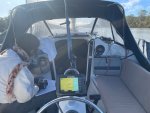
 
Horses for courses, sailing versus accommodation. Both are comparatively large trailer yachts that are practical for rigging and launching, Its good that 2 such diverse designs can do much the same job, and in fact look so similar on paper yet so different!
 
Here is A-frame in action on large polish yacht (33 feet):

Our 24 foot trailabke yacht had a 32 foot fractional rig. I engineered a simple gin pole arrangement with secondary shrouds. This was combined with a raised crutch with a roller on top at the stern to help lift the mast to head height.

I could raise and lower and stow our mast single handed on the water or on the trailer. Ensuring complete control of the mast at all times is possible with a little thought and without resorting to massive tabernacle hinges and A frames. The gin pole was made from a carbon fibre windsurfer mast and doubled as a genoa pole when sailing.

There are plenty of you tube videos showing how these are used.
 
Our 24 foot trailabke yacht had a 32 foot fractional rig. I engineered a simple gin pole arrangement with secondary shrouds. This was combined with a raised crutch with a roller on top at the stern to help lift the mast to head height.

I could raise and lower and stow our mast single handed on the water or on the trailer. Ensuring complete control of the mast at all times is possible with a little thought and without resorting to massive tabernacle hinges and A frames. The gin pole was made from a carbon fibre windsurfer mast and doubled as a genoa pole when sailing.

There are plenty of you tube videos showing how these are used.
Think I am replacing your secondary shrouds with the A frame? Tube is 25mm, so not a heavy swop. Reckon no need for a gin pole if the rear crutch is high enough. I have some spare Harken two speed winches, one could be dedicated to mast lifting.
 
“Our 24 foot trailabke yacht had a 32 foot fractional rig. I engineered a simple gin pole arrangement with secondary shrouds. This was combined with a raised crutch with a roller on top at the stern to help lift the mast to head height.

I could raise and lower and stow our mast single handed on the water or on the trailer. Ensuring complete control of the mast at all times is possible with a little thought and without resorting to massive tabernacle hinges and A frames. The gin pole was made from a carbon fibre windsurfer mast and doubled as a genoa pole when sailing.

There are plenty of you tube videos showing how these are used.
[/QUOTE]”

My Imexus uses a basically identical system to that shown in the video. The AFrame is actually very light made out of the same diameter stainless tube as the life line stanchions and unobtrusive when laying parallel to the foredeck when sailing.
It’s even slightly kinked to clear the mooring cleats.
Baby stays mounted exactly at mast base height provide continuous sideways tension keeping the mast centralised during lowering even in a sideways chop.
The multi purchase block system mounted on deck and integrated into the tip of the AFrame interlock with a pin when the mast is up taking all tension off the mast raising lowering line which comes back to the cockpit via a jammer and the cabin top sheet winch which allows relatively easy mast raising. (slight 15yo daughter capable) The deck fitting has several different tension holes allowing easy mast angle and tension adjustment.
Mine is set so I can lower partway for bridges/powerlines without removing the main making traversing these obstacles particularly easy.
There is an extra line to the end of the bowsprit shown here just added as extra security as we left the mast partially lowered overnight in a very short span between two bridges.
3EEBD06D-156B-4FF9-8530-D5DC5DF06156.jpeg
 
Some comments intimate that the A frame will stop the mast from swinging sideways when partially raised or lowered. This is not so. The mast can still swing sideways because the mast head is a long way from the fixed point of the A frame. (length of fore stay) You must either guide/ support the mast by hand or for heavy mast have stays in some form that pivot in line with mast pivot so staying tight right through traverse. ol'will
 
Some comments intimate that the A frame will stop the mast from swinging sideways when partially raised or lowered. This is not so. The mast can still swing sideways because the mast head is a long way from the fixed point of the A frame. (length of fore stay) You must either guide/ support the mast by hand or for heavy mast have stays in some form that pivot in line with mast pivot so staying tight right through traverse. ol'will
Absolutely correct and if you read my comment above you will note my manufacturer system has baby side stays mounted exactly at the height of the mast base.
An alternative solution to deal with conventional side stay locations is to have a braced solid bar up to the mast base height and conventional side stays from this point on. This solution was used by even very large yachts in Western Australia to to the need to lower their masts to navigate the two low bridges over the Swan River at Fremantle.
 
Corsair tris don’t use an A frame, but do have their inner shrouds fixed in line with the mast pivot. A successful trailer sailer must have every part of it’s design helping to make life easier at the launch site. there are multiple routes to the mast raising issue, depending maybe partly on rig size. They just need to work.
 
@Chiara's slave # 40.
Yes she is. She is also what I want, can afford and can handle as a rather old man.
As usually with boats the choise is a compromise balance between different wants: more launching work for more comfort and better sailing performance versus quicker launch but more spartan accommodation.
The main issue with a small open boat is having to come back by night. Many rig a tent for boat camping but I am too old for that.
My brother's Cornish Crabber 22 overcomes this boundary but she needs a Land Rover to tow , a crane to unload from the trailer (we used to launch his previous Shrimper from the trailer) and we are stll devising a system to step the mast on our own.
 
Top