Pontoon Bashing

I use a bow fender when entering a marina berth, as follows:

1. Nudge gently forward until the fendered bow is pressing against the main walkway.​
2. Leave the engine running slowly in ahead gear.​
3. Hold the tiller over towards the catway with a shockcord loop (kept permanently rigged either side for that purpose).​
4. Leisurely step onto the catway, pausing only to nonchanlantly light one's pipe and wave an acknowledgment to the cheering onlookers.​
5. Make fast the shore lines.​
6. Engage neutral and stop the engine.​
7. Adjust shore lines and fenders a/r.​
8. Plug in the power cable.​
The only difficulty can be persuading well-intentioned people that there really is no need for them to tire themselves out trying to push the bow off the walkway. They don't do any harm but having them repeatedly shouting "À l'arrière, monsieur! À l'arrière!" gets a bit wearing.
Done proper:
 
They certainly do not park oil tankers, container ships or cruise liners at speed, so why do some people think pulling into a berth quickly and applying reverse is what the way it should be done. I normally berth bow in, but sometimes I berth stern in, my aim is to do it singlehanded and to brake my boat using a spring. I might be close to 6 tons in weight but it is very possible in all weathers.
It's necessary if you decide to go stern to in a berth when a brisk wind is blowing straight into it. You will need speed or you will lose the bow. Loadsa modern yachts with a scoop stern do this routinely in many marinas around the Atlantic. It takes practice.

I practice that from time to time perhaps also to demonstrate it can be done. However, without a request I will normally say bash that and go bow to, as you say with handy spring. In 20 plus knots of wind, even giving big welly astern may not be enough to stop a heavy yacht. I enjoy the challenges!
 
Done improper:

What I love always about Capn Ron is that at the days end he was a great teacher.
He taught confidence and self reliance and that we do it for the sheer joy of being alive😎

Some one on here said Capn Ron is a standard part of teaching charter skippers !
 
Guy I knew taught for the lamented Southern Sailing School under John Goode, he had dried out at Newport IOW and thought the boat was secured, gre so he and the students went ashore, when they got back they found it had fallen. He felt he had to report to John and promised the boat was OK, John's reaction was far from annoyance was "Did you get any photo's? They'd be great for an article I'm writing"

Goode said that if boats were used for training you expected occasional damage and hence used older boats for training and employed an excellent bosun who was both experienced at and very good at repairs. He also once noted that his instructors were like slaves approaching Cleopatra with bad news and seemed to expect to be slaughtered for bringing bad news. They were very reluctant to tell him of any damage and one episode went along the lines of
"-Sorry John, we had an accident",
J: Go on,
-Well, we were practicing berthing in Cowes"
J: Yes, so what happened?
-Well it's caused some damage",
J: OK. what?"
- The main fell into the cockpit and one of the crew stepped onto it but the throttle was under his foot and I'm afraid we've hit the dock",
J; and?
- well there's a bit of a hole in the bows
J: How big is it"
- Well, we're in Cowes and from the forward berth you can see Lee on Solent and Beaulieu entrance",
J: Thank you, finally what I wanted to know - You'll need another boat to finish the course. I'll get bosun to bring one over and return this one for repair.
 
Guy I knew taught for the lamented Southern Sailing School under John Goode, he had dried out at Newport IOW and thought the boat was secured, gre so he and the students went ashore, when they got back they found it had fallen. He felt he had to report to John and promised the boat was OK, John's reaction was far from annoyance was "Did you get any photo's? They'd be great for an article I'm writing"

Goode said that if boats were used for training you expected occasional damage and hence used older boats for training and employed an excellent bosun who was both experienced at and very good at repairs. He also once noted that his instructors were like slaves approaching Cleopatra with bad news and seemed to expect to be slaughtered for bringing bad news. They were very reluctant to tell him of any damage and one episode went along the lines of
"-Sorry John, we had an accident",
J: Go on,
-Well, we were practicing berthing in Cowes"
J: Yes, so what happened?
-Well it's caused some damage",
J: OK. what?"
- The main fell into the cockpit and one of the crew stepped onto it but the throttle was under his foot and I'm afraid we've hit the dock",
J; and?
- well there's a bit of a hole in the bows
J: How big is it"
- Well, we're in Cowes and from the forward berth you can see Lee on Solent and Beaulieu entrance",
J: Thank you, finally what I wanted to know - You'll need another boat to finish the course. I'll get bosun to bring one over and return this one for repair.
An excellent school and John Goode's early death was a great loss to sailing.

I did my Day skipper practical with his Southern Sailing School and it was one of the most enjoyable weeks I have ever spent. The instructor, Charles (I can't recall his surname), was really good and kept us students (four of us) continuuall busy.


He told us an amusing story about John Goode:

On Charles' first training course he had the misfortune to have as one of his students, a rather self-important army officer. On day 1, this man refused to do his share of the domestic chores so Charles, being new to the job and unsure of what to do, phoned John Goode for advice.

John told him to bring the boat back to the base. On arrival, John stepped on board, handed the army officer a cheque for the full amount of his course fee and told him to pack his bag and clear off.
 
Last edited:
Every course I've ever done asked for feedback - if the students are writing "I'm not sure we actually know how to park a boat, Jimmy ended up at 45 deg and the instructor provided no advice" it will be much more impactful than than some member of the public saying "I don't think you are teaching this properly". On the other hand if they are doing it nicely on day 5 and can look back at how bad they were on day 2 perhaps that is good for students?
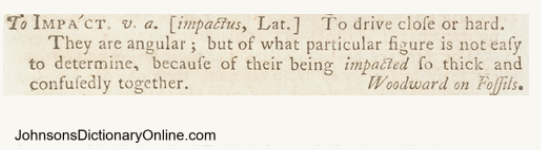
Impactful... :ROFLMAO:
 
My pet hate------Use of "impact" and it's derivatives when "effect" is the correct word. I know I am fighting a losing battle in the modern "OMG" world of hyperbole.
More usually ‘affect’, I prefer ‘have an impact on’, since I try to avoid American verbal laziness.
 
Impactful... :ROFLMAO:
I didn't even intend the pun. If I did I would have made sure you all knew - with itallics or a winky face not the annoying "no pun intended" which is 99% of the time untrue.
My pet hate------Use of "impact" and it's derivatives when "effect" is the correct word. I know I am fighting a losing battle in the modern "OMG" world of hyperbole.
I might suggest they are subtly different: two things can achieve the same effect but one can have more of an impact; the imagery of the latter implying a sudden or dramatic change.
More usually ‘affect’, I prefer ‘have an impact on’, since I try to avoid American verbal laziness.
Now arguments about affect v's effect I can get on board with, but I'm not so insular to care about alleged Americanisms, especially where they are widely used both sides of the pond and have been since before I was born!
 
I didn't even intend the pun. If I did I would have made sure you all knew - with itallics or a winky face not the annoying "no pun intended" which is 99% of the time untrue.

I might suggest they are subtly different: two things can achieve the same effect but one can have more of an impact; the imagery of the latter implying a sudden or dramatic change.

Now arguments about affect v's effect I can get on board with, but I'm not so insular to care about alleged Americanisms, especially where they are widely used both sides of the pond and have been since before I was born!
Disagree. Use of "impact" when describing the boat bashing the pontoon would be fine but not for affecting the school and it's policies. IMHO of course!
 
Guy I knew taught for the lamented Southern Sailing School under John Goode, he had dried out at Newport IOW and thought the boat was secured, gre so he and the students went ashore, when they got back they found it had fallen. He felt he had to report to John and promised the boat was OK, John's reaction was far from annoyance was "Did you get any photo's? They'd be great for an article I'm writing"

Goode said that if boats were used for training you expected occasional damage and hence used older boats for training and employed an excellent bosun who was both experienced at and very good at repairs. He also once noted that his instructors were like slaves approaching Cleopatra with bad news and seemed to expect to be slaughtered for bringing bad news. They were very reluctant to tell him of any damage and one episode went along the lines of
"-Sorry John, we had an accident",
J: Go on,
-Well, we were practicing berthing in Cowes"
J: Yes, so what happened?
-Well it's caused some damage",
J: OK. what?"
- The main fell into the cockpit and one of the crew stepped onto it but the throttle was under his foot and I'm afraid we've hit the dock",
J; and?
- well there's a bit of a hole in the bows
J: How big is it"
- Well, we're in Cowes and from the forward berth you can see Lee on Solent and Beaulieu entrance",
J: Thank you, finally what I wanted to know - You'll need another boat to finish the course. I'll get bosun to bring one over and return this one for repair.
I learnt masses from John G9ode when I was training and then assessed as an instructor. Top bloke.
 
Now arguments about affect v's effect I can get on board with, but I'm not so insular to care about alleged Americanisms, especially where they are widely used both sides of the pond and have been since before I was born!
I can't remember 'effect' being used in the sense of 'affect'. To effect something normally means to make it happen, or bring into effect, normally applied to a verb or verb clause. To affect somebody or something is to have an effect on them, usually a person or something concrete, such as "El Nino affects our weather", or for Americans "impacts our weather".
 
I can't remember 'effect' being used in the sense of 'affect'. To effect something normally means to make it happen, or bring into effect, normally applied to a verb or verb clause. To affect somebody or something is to have an effect on them, usually a person or something concrete, such as "El Nino affects our weather", or for Americans "impacts our weather".
I don't allow impact in place of affect in my publication. But that's because I don't like it and I run the style guide. We have relaxed on prepositions at the end of sentences, which were previously something up with which we would not put.
 
Top