
Polishing Gelcoat - Blue Specks in Ivory Gelcoat

KevinT1

Well-Known Member
Joined
23 Nov 2011
Messages
594
Location
Home Noss Mayo, Boat Yealm
Visit site
I'm polishing my Hallberg Rassy 36 topsides and have problems with Blue specks in the Ivory Gelcoat - but only on the horizontal surfaces that have been exposed to the sun and weather

I can get the "shine" back into the Gelcoat, but whilst the Blue specks reduce slightly they do not go away ( I have used 3m Perfect-it Fast Cut on a Lambswool bonnet, )
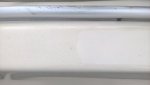
2015-05-08 14.07.24.jpg

The picture shows the cockpit surround with one area that had a label on it and has no "Blue Specks", alongside an area that is affected

Any advice gratefully received please - would rather not resort to using wet and dry

( one comment I had from a professional valeter in the marina was that he had seen it before and they hadn't been able to remove it fully ).

Thanks

Kevin
 
Last edited:
I'm polishing my Hallberg Rassy 36 topsides and have problems with Blue specks in the Ivory Gelcoat - but only on the horizontal surfaces that have been exposed to the sun and weather

I can get the "shine" back into the Gelcoat, but whilst the Blue specks reduce slightly they do not go away ( I have used 3m Perfect-it Fast Cut on a Lambswool bonnet, )

View attachment 51667

The picture shows the cockpit surround with one area that had a label on it and has no "Blue Specks", alongside an area that is affected

Any advice gratefully received please - would rather not resort to using wet and dry

( one comment I had from a professional valeter in the marina was that he had seen it before and they hadn't been able to remove it fully ).

Thanks

Kevin

Have you tried rubbing it with a solvent just to see?

I would try meths, then white spirit, then petrol, then acetone or whatever you have around.

Richard
 
Have you tried rubbing it with a solvent just to see?

I would try meths, then white spirit, then petrol, then acetone or whatever you have around.

Richard

I haven't, but will check tomorrow with Acetone ( carefully ), but I'm not hopeful as :
a) It is in the gelcoat, not on the surface and I have put some effort into buffing it with the cutting compound
b) It affects all horizontal areas of the superstructure - from the foredeck area to the aft cabin.

Kevin
 
I'm polishing my Hallberg Rassy 36 topsides and have problems with Blue specks in the Ivory Gelcoat - but only on the horizontal surfaces that have been exposed to the sun and weather

I can get the "shine" back into the Gelcoat, but whilst the Blue specks reduce slightly they do not go away ( I have used 3m Perfect-it Fast Cut on a Lambswool bonnet, )

View attachment 51667

The picture shows the cockpit surround with one area that had a label on it and has no "Blue Specks", alongside an area that is affected

Any advice gratefully received please - would rather not resort to using wet and dry

( one comment I had from a professional valeter in the marina was that he had seen it before and they hadn't been able to remove it fully ).

Thanks

Kevin


Proceed with caution, I think you might be going through the gelcoat in that section, polishing certainly won't help.

Very difficult to tell for certain without looking in person, any chance of an even closer picture from say a few inches away?

I suspect the label was covering what looks to me like a poor gel coat repair, note the different colour gel coat and the mis-shaped edges, a label would have been sharper.

What sort of size an area is affected?

With a repair right next to it I would suggest that whoever flatted the repair smooth went into the surrounding gel a bit too deep and has exposed the underlying fibres. If this is the case you would need to add more gel.

Tony
 
Ah, I see from re-reading your post it affects a much bigger area, certainly a gel coat flaw then.

Possibly too much air in the gel or not enough coverage, can also be too much catalyst when mixed.
 
Last edited:
The gelcoat on the horizontal surfaces of my 1990 HR352 was full of microscopic cavities, which collected dirt. I found that pressure washing helped to clean it, followed by waxing to try to fill the tiny holes. What year is your HR36?
 
I had a similar problem when trying to remove some old Capt Tolleys Creeping Crack Cure, which had dried and nothing would budge it. I also had specks that I'd pretty much given up on. In the end I tried meths and a magic eraser sponge and, with a bit of not too hard rubbing, both the Capt Tolleys and the specks were completely removed.
 
The gelcoat on the horizontal surfaces of my 1990 HR352 was full of microscopic cavities, which collected dirt. I found that pressure washing helped to clean it, followed by waxing to try to fill the tiny holes. What year is your HR36?

Thanks Pete - She's from 1998 - I'll try the pressure washing option as we'll.
 
Ah, I see from re-reading your post it affects a much bigger area, certainly a gel coat flaw then.

Possibly too much air in the gel or not enough coverage, can also be too much catalyst when mixed.

Thanks for your comments Tony, what is odd is that it only affects the horizontal surfaces as soon as you drop down the adjacent vertical or slopped surface then the gel coat is ok. If it were too much air or catalyst then wouldn't I see it there as we'll?

Kevin
 
Thanks for your comments Tony, what is odd is that it only affects the horizontal surfaces as soon as you drop down the adjacent vertical or slopped surface then the gel coat is ok. If it were too much air or catalyst then wouldn't I see it there as we'll?

Kevin

Which is what made me think that it is something that has settled on the surfaces (blue antifoul dust?) and that solvent might remove it.

Richard
 
Again it's hard to say for sure without looking up close, there are so many possibilities of what is on the table here.

You could experiment a little and see how deep the flaws are, might not be all the way through the gelcoat.

The pinholes could well only be in the top 1 or 2% of the gelcoat, if feeling brave you could try and sand past them with a small test square inch.

It doesn't look as though a pressure wash is going to help here IMHO, certainly no dis-respect to the suggestion, I think that may work on larger holes, what you have here 'the pores' seem to be too small for a pressure washer to be effective.
If you were looking to refurbish this without removing any of the gel you would need to get all the dirt and wax out of the pores for certain. Acetone and a brush springs to mind but that is going to be an epic task if as you say it is on a very large area.

Once you do root out the cavities so to speak, why not mix up some gel coat and thin it with Styrene, then using a spreader fill the pores, it would be a long term fix as apposed to a short term.
We are in the same town, so would be happy to mix the gel colour for you and add the styrene to get a suitable viscosity, you'd just have to add catalyst at the boat.


All this is is irrelevant until you test a small area mind, this would be my first task if it were mine, at least you would know for sure what you were dealing with and how deep they penetrate into the gel.
 
Thanks for your comments Tony, what is odd is that it only affects the horizontal surfaces as soon as you drop down the adjacent vertical or slopped surface then the gel coat is ok. If it were too much air or catalyst then wouldn't I see it there as we'll?

Kevin

Yes, you are right.

A bad batch of gel just doesn't sound right, unless of course it was mixed and applied in stages.

Desperate to see a closer pic. How sad am I?

So it is only in areas that are facing the sun?
 
Last edited:
Yes, you are right.

A bad batch of gel just doesn't sound right, unless of course it was mixed and applied in stages.

Desperate to see a closer pic. How sad am I?

So it is only in areas that are facing the sun?

Yes it's on the topsides and in particular on the starboard side that currently ( in Northney ) is on the east side. Prior to us buying her she was on a swing mooring in Strangford Lough so I can't see that the aspect and sun are as relevant.

I don't remember seeing it before and the boat has been in the water over the winter and nobody else nearby has a similar problem

I'll take a better camera with me tomorrow and get more detailed pictures ( previous picture was from my phone ) and try using Acetone to clean it and try wet n dry on a small sample area.

Thanks

Kevin
 
If by chance it is A/F dust, I had a similar problem when a boat nearby had its hull sand blasted when it was poorly tented. The yard accepted responsibility and got a professional in to clean up which proved very difficult. After trying just about everything else, he tried an ammonia based household cleaner and this did the trick. It might be totally useless in your instance, but may be worth a try as at least it won't do any harm.
 
Top