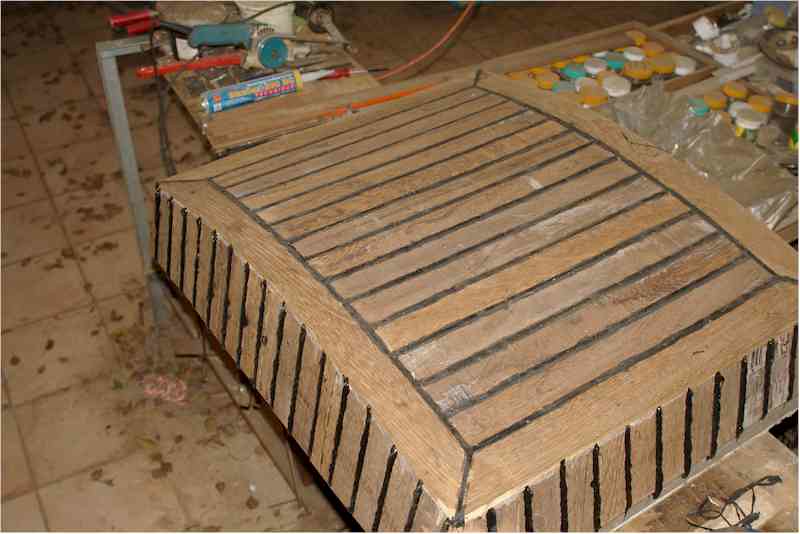
Plywood - Epoxy - Teak sandwich

Sea-Fever

Well-Known Member
Joined
27 Jun 2017
Messages
691
Location
Port Solent
Visit site
The "teak strips on ply" cockpit panel failed last year. The black caulking had detached in places and the teak strip had come away, mostly with the top layer of ply still attached.

This got me thinking that when, or if, a ply substrate becomes wet the ply itself may fail before the glue that sticks down the teak does.

By way of experimental replacement I have some new marine ply which i have covered in woven glass fabric which has been epoxied in a lovely flat layer. Once green, but not fully cured, I will reapply the teak strips with some more epoxy. In this manner i hope for the following;

1. The layer of epoxy reinforced with glass fabric will keep water out of the surface of the ply, even if new caulking fails.

2. Reinforcing the epoxy with glass will resist the natural expansion of teak to be glued on top and prevent those expansion forces being transferred to the ply....unlike a flexible adhesive.

Time will tell if this system works....the main factor that forced my choice between epoxy and flexible stick down was that I stupidly cut the marine ply so that the grain of the top layer of ply was running in the same direction as that of the teak...therefore I suspected the teak would eventually expand enough to push the top layer of ply free from itself.

Anyway. I'm only posting this because I'm sitting here waiting for it to cure.

Another cup of tea needed. Temperature is quite low today.
 
This is my hatch garage that I glued strips of iroko on to WBP plywood with sikaflex corking between the strips.

I used polyurethane wood glue to stick the strips on to the ply.

What is most important is the glue of the plywood must be water proof.

35953141171_b99e7f32dd_c.jpg


35953135991_d3dea93a3d_c.jpg


36086070695_216b038233_c.jpg


36086071365_6eaec37a60_c.jpg


I also did my floor boards in the same way with iroko and jacaranda wood strips
 
Very good. The ply I sourced stated it was marine grade but I have my doubts. It wasnt quite Robbins prices shall we say....I'm trying to keep costs in line with the type of MAB I have. It's not really a NOB.
 
Very good. The ply I sourced stated it was marine grade but I have my doubts. It wasnt quite Robbins prices shall we say....I'm trying to keep costs in line with the type of MAB I have. It's not really a NOB.

To protect the ply you need to seal the edges/end grain.

I used penetrating epoxy on all edges and still do. Painting wet on tack until it stops soaking in.
 
Two choices. Most common is to bed on a flexible sealant/adhesive such as Sika or Saba and caulk with the same. No need to epoxy the ply first, except you might want to deal with the end grain unless that is being sealed by for example the panel being recessed. The second is to go 100% epoxy, gluing down with slightly thickened epoxy and grouting with thickened epoxy coloured with graphite powder. I have used both methods successfully. The former is better for larger exposed areas and thicker "4mm+" strips where some movement might be expected. The latter does not allow movement and is better with thinner veneers. I did all the cockpit seats on a wooden boat using the epoxy method in around 1992 and all still sound after nearly 30 years.

Whichever you choose, particularly if recycling old strips, the bonding faces need to be completely clean and degreased to ensure a good bond.
 
Two choices. Most common is to bed on a flexible sealant/adhesive such as Sika or Saba and caulk with the same. No need to epoxy the ply first, except you might want to deal with the end grain unless that is being sealed by for example the panel being recessed. The second is to go 100% epoxy, gluing down with slightly thickened epoxy and grouting with thickened epoxy coloured with graphite powder. I have used both methods successfully. The former is better for larger exposed areas and thicker "4mm+" strips where some movement might be expected. The latter does not allow movement and is better with thinner veneers. I did all the cockpit seats on a wooden boat using the epoxy method in around 1992 and all still sound after nearly 30 years.

Whichever you choose, particularly if recycling old strips, the bonding faces need to be completely clean and degreased to ensure a good bond.

Thanks for the input. Yes I'd heard of both methods. This is really a trial using recycled teak just to see how it fares.

Here's a close up of the ply with epoxied glass fabric. Obviously I'll trim the cloth down and seal the edges after....i don't think I can bend that fabric successfully round the edge of the ply.....
 
I have been designing ,welding and fabricating steel for over 50 years and doing cabinet making longer that, stated at school before I went into Engineering.
 
Youtube channel, 'Acorn to Arabella', is about making plywood from scratch this week.
(It's a channel about some friends making an Atkin Ingrid ketch, starting from cutting the trees down onwards.
It is much better than the Tally Ho channel for actual boatbuilding content)
 
Now you have done it you might as well carry on and use epoxy for the teak unless the teak is really thick (6mm+) as there is little chance of movement. Above that thickness perhaps Sika is better. However, as I suggested this is way OTT in terms of stopping the ply from delaminating as it simply will never get wet if your caulking is good and you seal the edges.

Your photo suggests the ply is already screwed and glued to GRP. Is that right?
 
Now you have done it you might as well carry on and use epoxy for the teak unless the teak is really thick (6mm+) as there is little chance of movement. Above that thickness perhaps Sika is better. However, as I suggested this is way OTT in terms of stopping the ply from delaminating as it simply will never get wet if your caulking is good and you seal the edges.

Your photo suggests the ply is already screwed and glued to GRP. Is that right?
Not quite, I'll post a proper pic at some point....this is a section of ply from the cockpit floor which is screwed on to two hardwood 'runners' which create a void underneath the panel where the engine access hatch is located (centre cockpit, Westerly 33, so the cockpit floor is directly over the engine bay).

The ply panel (about 2' x 3') is removable...in fact it isn't attached in any way to the boat. It just sits there. God knows what would happen to it if the cockpit got flooded....but it weighs a ton.
 
Ok I get the picture now. Assume the ply is 12mm+. Suggest you frame it in solid teak flush with the bottom of the ply and above the top to the depth of your teak strips. Edges now sealed and panel stable. You could epoxy the bottom of the ply, but Danboline or equivalent would be OK. You can get good teak mouldings from www.kjhowells.co.uk for the framing. Then lay your teak strips using either Sika or epoxy sika is probably easier as it is better for getting a good UV stable caulking.
 
Top