
Plumb bow stupidity

Phil Bolger designed very simple boats. Many for home construction.
Those are his best-known designs but he designed a huge range of boats, power and sail, from tiny to huge, in carvel, clinker, GRP, steel, aluminium and more.
The maximum hull speed of any boat is mathematically related to its waterline length. That's not Bolger's personal opinion, it's just the reality of the matter. And at speeds below the maximum, wave-making resistance is still related to waterline length.
 
Those are his best-known designs but he designed a huge range of boats, power and sail, from tiny to huge, in carvel, clinker, GRP, steel, aluminium and more.
The maximum hull speed of any boat is mathematically related to its waterline length. That's not Bolger's personal opinion, it's just the reality of the matter. And at speeds below the maximum, wave-making resistance is still related to waterline length.
Of course, but it's not the only factor. In light winds you need a low wetted area to reduce drag. Wide flat hulls with long wsterlines have drag. Large sail area will help overcome drag in light winds. To carry large sail area you need a tall mast and a keel that has sufficient righting moment. Large mast and keels need to be strong and strength needs weight or exotic material such as carbon.
In heavy conditions going to weather a light boat can struggle to punch through waves. A plumb bow with its rather blunt front end can offer more resistance and may not help. It's a complicated subject with many compromises made by the designers. I was simply pointing out that waterline length alone doesn't make a fast boat
 
Of course, but it's not the only factor. In light winds you need a low wetted area to reduce drag. Wide flat hulls with long wsterlines have drag. Large sail area will help overcome drag in light winds. To carry large sail area you need a tall mast and a keel that has sufficient righting moment. Large mast and keels need to be strong and strength needs weight or exotic material such as carbon.
In heavy conditions going to weather a light boat can struggle to punch through waves. A plumb bow with its rather blunt front end can offer more resistance and may not help. It's a complicated subject with many compromises made by the designers. I was simply pointing out that waterline length alone doesn't make a fast boat
When designing my little sailing boat I went round and round the dimensions for use on our waters.
Plumb bow for water line length, though it turns to almost horizontal on entering the water.
Narrow beam to reduce drag. The Norfolk Broads are a low wind area especially between trees and houses. Draft is restricted by the shallowness of the broads, 3ft max draft was selected.
Then you need a short ish span of keel as you spend all your time tacking up the rivers.
Then true bulbs and wings are a no no due to the amount of river weed and lillys , so getting weight down in such a limited keel is a problem.
It all comes to one heck of a compromise...
 
Works beautifully in that swimming pool. We see a lot of those hinged doors set at 45deg here in the Caribbean as the anchorages can be pretty choppy. Sunsail in Antigua had a pile of the platforms in a heap that had failed presumably due to thr bumpy conditions since charter boats aren't using marinas out here too often. It can be fun watching people trying to board their boat over an inclined platform in a chop.

Isn't the sea where you are also a swimming pool? .... if not then come to the Adriatic - it's gorgeous here ... no hurricane season either :cool: .... just lots of sunshine and anabatic winds to carry you to the next azure blue swimming pool.
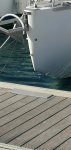
Perfect for G&Ts with friends and a nice sea view.
 
On buoyancy and bows:
A traditional, deep fore foot was expected to not only float that enormous bow sprit, but also a couple of outlandishly heavy anchors with a goodly amount of chain. The contemporary, shallow forefoot does not do well in this regard and some companies. like Boreal. that recognize that fact and have understood that some far flung cruising grounds, like the high Arctic, require 80 m or more of anchor chain, due to a dearth of full-service marinas, have moved the chain lockers to amidschip.

I think we should bury the concept of hull speed as an absolute barrier, but simply view it as the point were the curves of hull resistance, available driving force and stability intersect.

Flat hull sections are generally the result of light displacement and wide beam. Wide beam has, of all factors, the greatest influence on sail carrying power. In fact it enters into the equation to the third power. While wide beam promotes planing, it should be remembered, that all characteristics which contribute to planing greatly increase resistance at displacement speeds. This is why planing craft are not well suited for cruising.

I'm sorry, but regardless whether the Herd's lines accurately follow those of an authentic oyster catcher or not, the fact remains that it is an interpretation of the original, simply because it was built in GRP. This certainly changes such things as the amount of ballast she carries, compared to the original heavy, timber workboat construction. This alone has far-reaching effects on righting moment, stability and moments of inertia. Additionally the original workboats were not or only partially decked. It is still a fine craft.
 
Isn't the sea where you are also a swimming pool? .... if not then come to the Adriatic - it's gorgeous here ... no hurricane season either :cool: .... just lots of sunshine and anabatic winds to carry you to the next azure blue swimming pool.

Perfect for G&Ts with friends and a nice sea view.
What wind? Anabatic, because the gradient wind doesn’t exist enough to propel you and you have to be thankful for every feeble alternative.
 
I’m planning a week in the Stockholm archipelago in July. We’ve chartered a Dufour with a fairly plumb bow so as first timers in that area, it feels a bit different from the Med stern to mooring we’re more used to. I‘m assured there is a bow ladder and planning to moor against pontoons rather than rocks, at least for the first couple of days. Hopefully it will all make sense when we get there. In the meantime, if anyone has a spare copy of the Arholma-Landsort cruising guide in English, I have popped a wanted ad over on the wanted thread.
 
I’m planning a week in the Stockholm archipelago in July. We’ve chartered a Dufour with a fairly plumb bow so as first timers in that area, it feels a bit different from the Med stern to mooring we’re more used to. I‘m assured there is a bow ladder and planning to moor against pontoons rather than rocks, at least for the first couple of days. Hopefully it will all make sense when we get there. In the meantime, if anyone has a spare copy of the Arholma-Landsort cruising guide in English, I have popped a wanted ad over on the wanted thread.
Often we found all the locals anchored against the rocks, leaving a gap in the middle to anchor conventionally, which suited us better.
In terms of the guide, Arholma-Landsort guide in English is generally in very short supply. But unless updated very recently, is also very old now. We used an online subscription to The Harbour Guide, which is extremely detailed, great illustrations of layout, and fantastic value for money compared to the paper books - Harbour Guide Online | Harbour Guide
 
I’m planning a week in the Stockholm archipelago in July. We’ve chartered a Dufour with a fairly plumb bow so as first timers in that area, it feels a bit different from the Med stern to mooring we’re more used to. I‘m assured there is a bow ladder and planning to moor against pontoons rather than rocks, at least for the first couple of days. Hopefully it will all make sense when we get there. In the meantime, if anyone has a spare copy of the Arholma-Landsort cruising guide in English, I have popped a wanted ad over on the wanted thread.
I shouldn’t worry. Swedes are pretty irresponsible sailors and regard hitting rocks as an everyday occurrence. I’m sure your charterer will view your scars indulgently. Bows-to against rocks might be a bit challenging with a plumb bow, but might be OK if you don’t mind getting your feet wet. In any case, there might well be someone ashore to take your lines.
 
Top