Plotting charts for celestial navigation

ollyp

Member
Joined
5 Jul 2016
Messages
23
Visit site
I have just started some celestial navigation and was wondering where i could buy some plotting charts for celestial navigation

thanks so much
 
I have just started some celestial navigation and was wondering where i could buy some plotting charts for celestial navigation

Pretty sure I got mine from Kelvin Hughes (www.bookharbour.com): Just tried to check though and their web site is up the spout giving database errors but it might be somewhere under:
http://www.bookharbour.com/chartwork-instruments/

[EDIT: I presume you mean those enormous plotting sheets which of course you don't actually need but are nice to try out just to see what they're like...]

[Further Edit]. Web site back up now. This what you're looking for?
http://www.bookharbour.com/astro-navigation/plotting-sheets-and-sight-forms-for-yachtsmen-25-sheets-per-pad/
 
Last edited:
Just make sure you get the ones in Mercator Projection, and not Lambert's Conformal or Polar Stereographic.
And the best source of 2B plotting pencils - pre-sharpened - is IKEA....

:encouragement:
 
If you go here: http://www.backbearing.com/links.html
you will find the easiest way to learn to use the Sextant ever written. Just click on the Sextant Users Guide link.
Included in this guide, and elsewhere on that webpage, you will also find excellent plotting sheets and calculation sheets that you can print off
Have fun.
 
Last edited:
Just make sure you get the ones in Mercator Projection, and not Lambert's Conformal or Polar Stereographic.

While Mercator is undoubtedly best for latitudes less than around 65, in very high latitudes it's perhaps better to use a less distorting projection: I use Transverse Mercator in the charts at http://www.awelina.co.uk/sextant/plotting_sheets.

At altitudes below this I always make my own plotting sheet from graph paper. I describe how I make them in http://www.awelina.co.uk/sextant/reduction_tables/ReadMe.pdf (it's not a great read but the info is in there).

Also on that website is a sight reduction program which will run in a browser or can be downloaded. Takes a lot of hassle out of sights and encourages one to do more, and more complex ones (moon with a star or two for instance). http://www.awelina.co.uk/sextant/JavaScript_Sextant_calcs_2016_2.html

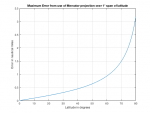
The max error from a Mercator plotting sheet is shown here:
plotting_error.png
 
Use the reverse side of a paper chart or if really flush with funds buy A3 paper.

Try the simple formula Long scale = cos Lat x 12 cm

12cm is nice and convenient for plotting Lat / degree / miles.

Example for 50 degree Lat,
Cos 50 x 12 = 7.7 cm = 1 deg Long.

Buy beer with the savings!
 
https://www.imray.com/charts/Admiralty/Plotting+diagrams+and+sheets/ACD6018/

Etc

I see lots of candidates who have been taught using graph paper. I grit my teeth as I was brought up on universal plotting sheets and find graph paper can be confusing. (Especially when they don't use standard or traditional plotting symbols...)

Whilst I would agree there is a lot to be said for plotting sheets and that was how I was taught first but in practice I also used ordinary charts for example in the Bay of Biscay or of Beira. On my RYA course we used both graph paper and plain paper both of which worked fine.
 
Whilst I would agree there is a lot to be said for plotting sheets and that was how I was taught first but in practice I also used ordinary charts for example in the Bay of Biscay or of Beira. On my RYA course we used both graph paper and plain paper both of which worked fine.

You are of course right. I was only stating a personal preference (and voicing my frustration at occasionally having to decipher the lines of others plotting...)

All the methods 'work fine' if you know what you are doing. :)
 

Other threads that may be of interest

Top
