Plastic Canoe Repair. Polyethylene - Plastic Weld or West system?

HandmadeMatt

Active Member
Joined
2 Jul 2013
Messages
48
Visit site
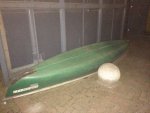
I have recently acquired a FREE Coleman Ram-X 15 Canadian Canoe which is pretty lucky.
It's old and appears to be in pretty rough shape though. I've not seen it in the flesh yet, only these pictures. I'm picking it up on Sunday.

It's had some fibreglass repairs which look a little bit dubious. I'm used to working with fibreglass and would be happy to re-do these repairs to a much higher standard and then paint them to improve the aesthetics of the boat. However, having done a brief Google search I'm not sure polyester fibreglass is right for plastic boats, it won't bond properly perhaps? People seem to be using heat, aluminium mesh with more heat and polyethylene to "plastic weld" repairs on these boats....

Alternativley West G-Flex Epoxy claims to bond to plastics and has been recommended to me. Does anyone know anything about that?

Any advice would be appreciated. It doesn't look too bad, with one repair midway. A big repair at the bow and perhaps something also at the stern although I can't quiet see from the pictures. The bulk run of the keel looks to be pretty solid. The aluminium gunnel's are lightly bent and wobbly but at least they look robust.

IMG-20160829-WA0003_zpse1ul0zk9.jpg


IMG-20160829-WA0002_zps3ipqjjjb.jpg


IMG-20160829-WA0001_zpsq2mmpaqn.jpg


IMG-20160829-WA0000_zpsxm5cbjvu.jpg


Thanks for looking.
 

Attachments

  • IMG-20160829-WA0003_zpse1ul0zk9.jpg
    IMG-20160829-WA0003_zpse1ul0zk9.jpg
    45.7 KB · Views: 0
A lot depends on the actual plastic used but plastic welding is well established and kits are available on ebay and elsewhere. Google should show up companies who do it in your area which may get you some expert advice.
 
It's Cross-linked polyethylene, commonly abbreviated PEX or XLPE.

https://en.wikipedia.org/wiki/Cross-linked_polyethylene

"PEX is used in many canoes and kayaks. The PEX is listed by the name Ram-X, and other brand specific names. Because of the properties of Cross-Linked Polyethylene, repair of any damage to the hull is rather difficult. Some adhesives, such as 3M's DP-8005, are able to bond to PEX, while larger repairs require melting and mixing more Polyethylene into the canoe/kayak to form a solid bond and fill the damaged area."

West G-Flex Epoxy claims to bond to plastics and I have been told it will work on PEX.
I'm used to working with resins and composite materials and have never done plastic welding.

So I'd prefer to use epoxy but...
I do have a good soldering iron with various flat tips, a heat gun, butane torch and a strong will!
 
I've had various plastic canoes over the years. The only thing that sticks to the material your canoe is made of is the 3M DP8005 you mentioned. Its not cheap and requires a special applicator 'gun' that also isn't cheap.

West G-Flex is the best epoxy for plastics but it will not last forever - repairs I made with it lasted a year or two before starting to peel at the edges where there was any movement in the plastic during use. With the exception of the 3M stuff not much really sticks to certain plastics - I read somewhere that HDPE plastics (what my canoes were made of) are in the same chemical 'family' as teflon.
 
About 25 years ago I had a Dancer kayak made from plastic. I also got with it a couple of sticks of plastic with wicks down the middle as a repair material. You lit the wicks which melted the plastic and this was drizzled onto the damaged area, like sealing wax. I think the m/f was a company called "Federation" but don't quote me on that. Coleman canoes were made of something resembling Lino then, with a fabric reinforcement. The dancer was swapped for a fibreglass canoe polo bat as it was easier to repair. Stopped canoeing shortly after as I got too fat.
 
Basically there are two types of plastic used for kayaks and canoes - cross linked and linear.

Linear can be repaired, e.g. with the plastic candles mentioned or a trim from the cockpit rim (kayaks).

Cross linked is nigh on impossible, as mentioned.

I did a lot of multi-day whitewater kayaking on remote rivers earlier in my life. I always used cross linked boats because they were stronger. My emergency repair kit was a rivets and rivet gun, ally sheet, and bathroom sealant. Some of those rather ugly repairs lasted well.
 
I stuck a mast step into my canoe using g-flex and it seems to have bonded very well. Those repairs are on the classic scuff points though - if it ain't broke don't fix it? Wait until they wear through then do something better.
 
Some great info here chaps.
Thanks very much.
Once I've picked it up I'm going to have a good look and I'll report back.
It might be that those patches are not as bad as they look and it'll hold up for a few more trips.

If not I think I'm going to go down the G-Flex route. There's a guy on another forum that had the G-Flex repairs last years on his Ram-X Coleman.
 
Just bought some G flex for another application and it seems excellent stuff. The instructions that came with it suggest heating the areas you are going to apply the stuff to first as it makes a better bond on plastic canoes. You can also use fibreglass and fillers in the same way as other west stuff.
 
HI Gryphon2, thanks for your input


What exactly do you mean?
Once the G-Flex is done then you can use normal epoxy products on top of it?

Fairly sure he/she means you can use fibreglass fabric reinforcement and fillers such as silica etc to modify the properties of the G-Flex resin.
 
Correct. I just used some with some wood fibres to act as a filler as well as a glue, but the instructions detailing using it with grp matt and wetting it out with the G flex just like polyester resin.

Male!
 
Top