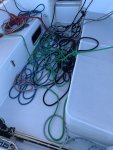
Placement of Rope clutches

I disagree. The rope does not meet the winch at its centre.

The natural line of the rope out of the clutch should make a tangent with the left-hand (in this view) edge of the winch drum.

Pete

You will never get all the lines from each clutch to have an ideal lead so a compromise is needed.
 
I disgree. Stuffing ropes anywhere is not the way to go. Coil the ropes & hang them neatly. When you need to let them off the coils are neat to hand & can be fed out at whatever speed required. Leaving them tangled is a recipe for getting a knot in the line & is just lazy sailing.
Dumping lines below leave them open to getting caught. One cannot immediately see where that may be without going below, thus wasting time
Do you also leave your heaving line coiled rather than stuffed into its bag? If so, try throwing it any distance.
A coiled halyard will inevitably tangle when you want to drop a sail quickly in an emergency, whereas ones that are dropped down companionways or stuffed into bags will run out more reliably.
 
Do you also leave your heaving line coiled rather than stuffed into its bag? If so, try throwing it any distance.
A coiled halyard will inevitably tangle when you want to drop a sail quickly in an emergency, whereas ones that are dropped down companionways or stuffed into bags will run out more reliably.
It depends how you coil the line. Allowing the line to make ‘figure of eights’ instead of heat coils takes all twists out and the line runs freely. Longer lines need to be ‘handed’ to avoid twists. Thrown down on the deck, either option rarely gets snarled up.
We still throw lines down the companionway sometimes though.
 
" . . . Stuffing ropes anywhere is not the way to go. . . "

Au contraire - cavers, mountain rescue teams, rope access workers, white water kayakers, etc, learnt years ago that when dealing with long lengths of line in adverse conditions, that stuffing ropes into bags is exactly the way to go. As long as you load the bag in the reverse order from which is retrieved, you will never have a tangle or knot. That's how a throw bag works.

When Robin Knox Johnson was dis-masted in Suhuli, it was because he couldn't execute his storm survival tactic of deploying trailing lines and drogue. He had his long warp coiled and tied with small stuff bindings as taught at Merchant Marine College. But as he snipped the bindings he was pooped and the whole lot was whipped into a cats cradle. If he had it flaked into a rope bag, he could have secured the top end and then simply chucked the whole bag off the transom and it would have deployed perfectly.

Bags are versatile and easy to stow, but admittedly they do take time to re-pack. If you have space, then drums mounted somewhere convenient are by far the quickest and safest way to both deploy and retrieve long lengths, especially in 14mm diameter and more. You'll see drums on most high latitude cruising boats for shore lines, etc.
 
Do you also leave your heaving line coiled rather than stuffed into its bag? If so, try throwing it any distance.
A coiled halyard will inevitably tangle when you want to drop a sail quickly in an emergency, whereas ones that are dropped down companionways or stuffed into bags will run out more reliably.
being a single handed sailor, I have learned to plan ahead & not sail randomly. I cannot recall when I ever had to drop a sail quickly in an emergency, in the last 20 + years. I do not get tangles in my halyards because I coil them correctly & if necessary snake them when dropping. Even my jib sheets get a couple of coils after sheeting in & laid on the cockpit seats ready.
As for heaving a line, I always set up some coils in each hand prior to launching.
Coming into the marina my lines are fastened to the cleats at one end & the other coiled on deck or coiled & hung on the cockpit winch. Simple quick to do & avoids the silly snarl ups that one sees all the time. It is just common sense really.
 
Stuffing or coiling lines makes it more of an effort to adjust, so risk of leaving lines at the wrong tension. Dumping lines below is my regular metod. This alternative works when single-handed. :)


D4CA6345-CB80-40F2-AF5D-F6CA7A253E00.jpeg
 
being a single handed sailor, I have learned to plan ahead & not sail randomly. I cannot recall when I ever had to drop a sail quickly in an emergency, in the last 20 + years. I do not get tangles in my halyards because I coil them correctly & if necessary snake them when dropping. Even my jib sheets get a couple of coils after sheeting in & laid on the cockpit seats ready.
As for heaving a line, I always set up some coils in each hand prior to launching.
Coming into the marina my lines are fastened to the cleats at one end & the other coiled on deck or coiled & hung on the cockpit winch. Simple quick to do & avoids the silly snarl ups that one sees all the time. It is just common sense really.
I wasn't referring to heaving shore lines, but to the MOB heaving line which resides in a 'throw bag' alongside the horseshoe buoy etc. On any boat I have been on, I have found this particular piece of equipment to have been in its original, "as delivered" state, neatly coiled, which when deployed, travels about five metres from the boat before dropping into the water in a hopeless tangle. The only way it can be relied upon to be heaved any distance is to stuff it into the bag from beginning to end, with no attempt to coil any part of it, a practice which in my humble opinion applies to main halyards, i.e., either in a bag or down the hatch.
While I admire your sense of planning and preparedness, I still believe that you can never completely anticipate every close encounter with a badly marked lobster pot, which, when it happens, instantly requires a freely running main halyard.
 
I wasn't referring to heaving shore lines, but to the MOB heaving line which resides in a 'throw bag' alongside the horseshoe buoy etc. On any boat I have been on, I have found this particular piece of equipment to have been in its original, "as delivered" state, neatly coiled, which when deployed, travels about five metres from the boat before dropping into the water in a hopeless tangle. The only way it can be relied upon to be heaved any distance is to stuff it into the bag from beginning to end, with no attempt to coil any part of it, a practice which in my humble opinion applies to main halyards, i.e., either in a bag or down the hatch.
While I admire your sense of planning and preparedness, I still believe that you can never completely anticipate every close encounter with a badly marked lobster pot, which, when it happens, instantly requires a freely running main halyard.
You are not going to convince me that a tidy ship is not better.
I have hit many lobster pots & been held by the stern in 20kts of wind on a really dark night whilst sea sick. . My torch failed & in the dark. Fortunately, it was much easier to reach for the coiled halyard & let the rope run free than try to un knot it half way along due to it being caught around another in the cockpit . I could not see properly due to being ill & the dark. Just being able to grope for the coil & let go was so much easier than risking a tangle round my feet.
In my racing days, we often chucked ropes down the hatch (to get caught round the sink fawcett :() & more than once over the stern to get the tangles out so we could coil them properly.
As for those silly little heaving lines. Have you ever tried pulling a fully kitted up person, with LJ inflated, through the water to the boat whilst they try to hold such a thin line that they supply, with cold hands. It is nigh on impossible. No substitute for getting the boat alongside- I know, I have tried
 
Last edited:
Top