
Pippin 20 Thread - For New and Experienced Owners :)

Hello all
I bought my Pippin in August and sailed her on the Norfolk Broads for a month or so. I was anxious about learning how to take down the mast, get her on a slipway and trailer her to a farmer's barn for winter but I have succeeded and learned a lot.
I made a gin pole which worked a treat. I watched this video and made the pole.
Happy to share what I made it with if you want.
I was stunned to see the keel when the boat was out of the water. I had imagined it to be a dagger board not a large piece of shaped metal.
The rubbing strip needs attention and replacement but maybe that is a 2027 project if I can use some epoxy wood filler in the meantime when the boat dries out.
I have a question. My outboard is a Mariner 6 and it was in poor condition. The company that serviced it said it is a short shaft outboard.
They said they might have expected a log shaft engine.
Does anyone know if there is a definitive spec for a Pippin? Should the engine be a long or short shaft to give best power?
Thanks and if anyone has a Pippin on the Norfolk Broads I would be pleased to get in touch.
 
I think you will be ok with the short shaft engine. You will hopefully have used the engine already and found any problems with it being short shaft. Essentially the cavitation plate should be at or below water level. With a short shaft this usually means the motor itself will be lower down on it's transom bracket. (assuming this is what you have) The disadvantage being that it is further to reach down to the motor for starting.
One of the problems of an o/b on a small sail boat is that the fore and aft trim can change dramatically. For instance if someone goes to the bow to pick up a mooring the stern will rise and motor may lift high enough to cavitate and make a lot of noise and lose thrust. An adjustable height bracket can help here. ie push motor down lower. If however the motor is lower if you encounter waves it may go down until body of motor is under water. (although surprisingly on my old motor (Johnson) with forward speed motor did not stop despite water around the head. (hopefully you will not have rough water on the broads.
I did help a friend replace rubbing strips on a similar sort of boat. (22ft) He got the wood planed it to shape and scarf jointed to make it long enough. On the day with friends to help hold in place. He had 5mm screws and a tap for that thread. A drill to cut a hole through strip and through GRP. Another drill with bit to cut the hole in the wood to clearance, another drill with countersink bit another drill with the tap in it to cut the thread and another drill to drive in the screw. Bang a screw in about every 30 cms. Helpers (on ladders to bend the wood in to place and hold. Both sides were done in a couple of hours. A bit tricky at bow and transom.
Best wishes with the new boat and enjoy refurbishing over winter. ol'will
 
I think you will be ok with the short shaft engine. You will hopefully have used the engine already and found any problems with it being short shaft. Essentially the cavitation plate should be at or below water level. With a short shaft this usually means the motor itself will be lower down on it's transom bracket. (assuming this is what you have) The disadvantage being that it is further to reach down to the motor for starting.
One of the problems of an o/b on a small sail boat is that the fore and aft trim can change dramatically. For instance if someone goes to the bow to pick up a mooring the stern will rise and motor may lift high enough to cavitate and make a lot of noise and lose thrust. An adjustable height bracket can help here. ie push motor down lower. If however the motor is lower if you encounter waves it may go down until body of motor is under water. (although surprisingly on my old motor (Johnson) with forward speed motor did not stop despite water around the head. (hopefully you will not have rough water on the broads.
I did help a friend replace rubbing strips on a similar sort of boat. (22ft) He got the wood planed it to shape and scarf jointed to make it long enough. On the day with friends to help hold in place. He had 5mm screws and a tap for that thread. A drill to cut a hole through strip and through GRP. Another drill with bit to cut the hole in the wood to clearance, another drill with countersink bit another drill with the tap in it to cut the thread and another drill to drive in the screw. Bang a screw in about every 30 cms. Helpers (on ladders to bend the wood in to place and hold. Both sides were done in a couple of hours. A bit tricky at bow and transom.
Best wishes with the new boat and enjoy refurbishing over winter. ol'will
Thank you William. A very helpful reply, David Michael
 
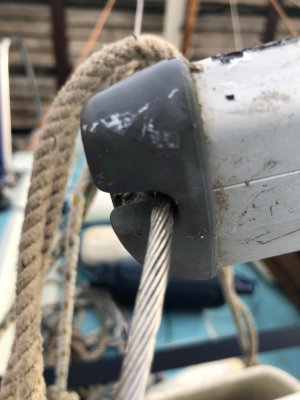
Spreader Tip End Fitting
Does anyone know where to buy this fitting for a Pippin mast spreader bar?
This one had electrical tape at the end and I suppose I can do the same again but ir would be nice to have a proper fitting.
Thanks
1763111008927.jpeg
 
The end fitting for the spreader should be robust enough to take inward pressure of the wire in to the mast. Usually on a small boat the wire will be able to slide up and down. (not always so on bigger rigs). What is critical is that the wire will probably become loose when it is a lee shroud and the rig is under pressure. This is almost inevitable. A more highly tensioned rig will have less tendency to go slack. (another argument)
The stay wire must be captured in the slot of end fitting. Use lock wire and drill tiny holes to take the wire. Or possibly a screw through the plastic closing off the slot. I have seen string used and let go. Tape may be good to cover the whole end to minimise chafe on the jib but is inadequate to restrain the wire. (plastic may be smooth enough on the ends)
The end fitting looks ok to me however if you feel the wire is cutting in to the plastic too much you might try gluing some more plastic in the bottom of the slot or even aluminium tube cut open. If all else fails make a new end fitting of hard wood. ol'will
 
The end fitting for the spreader should be robust enough to take inward pressure of the wire in to the mast. Usually on a small boat the wire will be able to slide up and down. (not always so on bigger rigs). What is critical is that the wire will probably become loose when it is a lee shroud and the rig is under pressure. This is almost inevitable. A more highly tensioned rig will have less tendency to go slack. (another argument)
The stay wire must be captured in the slot of end fitting. Use lock wire and drill tiny holes to take the wire. Or possibly a screw through the plastic closing off the slot. I have seen string used and let go. Tape may be good to cover the whole end to minimise chafe on the jib but is inadequate to restrain the wire. (plastic may be smooth enough on the ends)
The end fitting looks ok to me however if you feel the wire is cutting in to the plastic too much you might try gluing some more plastic in the bottom of the slot or even aluminium tube cut open. If all else fails make a new end fitting of hard wood. ol'will
Thank you so much for the explanation William. It's a big help. David
 
Top