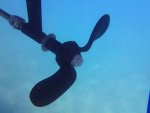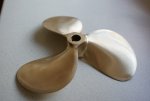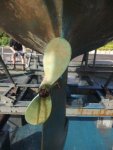
Photo of copper plated propeller

Taunto

New Member
Joined
15 Jun 2012
Messages
18
Location
Australia
Visit site
jacko;s prop 9th oct 2014.jpg

As promised , photo of the prop 5 minute's out of the water . This has been a good little project that so far looks like a success, this prop was taken off and a new three blade that has been copper plated has replaced it , it will go back into the water on Friday . The cost to plate the prop was $70 Aust, the cost for having this size prop painted in Propspeed, here is $300 , Vellox is about the same , International about $150 , but there effectiveness is patchy at best . In twelve months time i will post a photo of the new prop and i think that will be the completion of this experiment . Thank to every one who has followed this post and for all your comments , and suggestions on this project , there are other yachtie's in our area that have been enthused enough to give it a try .
Cheers Taunto.
 
Looks good. As we are not meant to use copper based barnacle food on saildrives is this a no no for us?
 
Looks good. As we are not meant to use copper based barnacle food on saildrives is this a no no for us?

If you refer to the galvanic series of metals in seawater at http://www.corrosionist.com/Galvanic_Series_of_Metal_in_Seawater.htm you can see that copper is more anodic than any likely propeller materials, e.g. Brass, manganese bronze, nickel aluminium bronze, etc. so any galvanic reaction that occurs will result in loss of the copper, fair enough. However, if you were to plate an aluminium saildrive leg the situation is reversed and the aluminium would be lost. Not what was wanted!
 
If you refer to the galvanic series of metals in seawater at http://www.corrosionist.com/Galvanic_Series_of_Metal_in_Seawater.htm you can see that copper is more anodic than any likely propeller materials, e.g. Brass, manganese bronze, nickel aluminium bronze, etc. so any galvanic reaction that occurs will result in loss of the copper, fair enough. However, if you were to plate an aluminium saildrive leg the situation is reversed and the aluminium would be lost. Not what was wanted!
So taking off the prop and copper plating is a viable option. Sounds like a business opportunity for someone if this is the case. I suspect the snag might be in preparation, getting an old prop clean and smooth enough for this to work could be an issue.
 
Props and sail drives are an enormous issue regarding antifouling, or keeping them clean - and Propspeed and Velox are neither cheap nor foolproof.

Copper plating is hardly new technology, raw copper has been used (think of copper clad square riggers or Coppercoat) - why has it never been done before on props?

And why are sail drive legs aluminium?

Why is the whole lot not some fibre reinforced polymer.

Jonathan
 
My reservation about using copper, expressed on a previous thread, is that pure metals are very soft. Erosion or cavitation, both inversely proportional to hardness, are likely to remove the copper under some circumstances, which would open the combination to galvanic corrosion, accelerating the total loss of the copper. Fortunately, in the OP's case this has not happened.
 
I'm surprised to see it's still copper coloured rather than verdigris green. I know that Coppercoat is supposed to go green and this is taken as a sign of its activity.
 
Are the drive and prop shafts isolated from the casing?

Featherstream stipulate "no copper based antifoul" on their props.

I have no idea, I was speaking generically. If the prop is a copper alloy then presumably it is isolated from the saildrive leg. Bruntons also recommend no copper on their props but there is no justification that I am aware of.
 
not sure what this is all about - can someone emlighten me? is it about plating the prop so that any galvanic action simply removed the plate and not the prop, or is it about antifouling the prop? If the latter, why is it that the copper which is already there ( in the alloy that is bronze) doesnt work? and why not paint spray the prop with coppercoat?
 
not sure what this is all about - can someone emlighten me? is it about plating the prop so that any galvanic action simply removed the plate and not the prop, or is it about antifouling the prop? If the latter, why is it that the copper which is already there ( in the alloy that is bronze) doesnt work? and why not paint spray the prop with coppercoat?

Pure copper, and copper-nickel that I know of, have antifouling properties. Other alloys, including brass, bronze, manganese bronze, aluminium bronze, nickel aluminium bronze, aluminium brass, etc., do not. Coppercoat alone does not adhere to propellers, it needs a primer first. Several coats of epoxy based coating will affect the hydrodynamics of the propeller, a problem well known in the pump refurbishment industry. Copper plating seems to be cost effective and functional.
 
I too had thought of copper coat, but considered there would be an adhesion issue. Surely 'our' props will not have large issues of hydrodynamics, of if they do surely a whacking layer of silicone al la Propspeed/gold (and its underlying primer) will have the same effect. I also note that Velox suggest that if their primer coat stays sound then all you need do is re-coat with new topcoat (active) layers - eventually leading to quite a thickness of old Velox under the new surface.

There seems to be lots of answers to treating props and the major one is getting anything to adhere long term.

We are trialing Velox, with mixed results. Adhesion is still the issue (using the Velox primer).

Jonathan
 
I too had thought of copper coat, but considered there would be an adhesion issue. Surely 'our' props will not have large issues of hydrodynamics, of if they do surely a whacking layer of silicone al la Propspeed/gold (and its underlying primer) will have the same effect. I also note that Velox suggest that if their primer coat stays sound then all you need do is re-coat with new topcoat (active) layers - eventually leading to quite a thickness of old Velox under the new surface.

There seems to be lots of answers to treating props and the major one is getting anything to adhere long term.

We are trialing Velox, with mixed results. Adhesion is still the issue (using the Velox primer).

Jonathan

I have posted my Velox photos previously, cannot get Photobucket to work in Greece so unable to repost at present. I used Hammerite Special Metals primer simply because I had a full tin of it and it has turned out to be brilliant stuff. First season I only did the prop, which after six months was as good as the day I first did it, no fouling whatsoever. Previously I was scrubbing tube worm off the hub and blades several times per season. Only problem was that I had applied four coats of Velox, as instructed, but this seemed too thick and had chipped off in a typical cavitation pattern.

Last year I sanded back the Velox to the primer, then applied two fresh coats. Superb result, no chipping and no fouling. I also did the P-bracket with Hammerite and two coats of Velox. Equally good result.

This year I did much the same and also did a small area at the top surface of the rudder, beloved by barnacles. Every one perfectly clean after nearly six months.

image.jpg
 
Vyv,

I'd read you experiences with Velox and the use of Hammerite. I used Velox' own primer and I'm not too impressed. We painted the Saildrive and Prop and have lost a lot of the active surface Velox and primer off the prop, the saildrive looks OK. I have a friend who applied the same way, to a prop, on a runabout - so faster prop - and he too has lost almost everything off the blades. When we slip next we will be trying Hammerite. The reason we did not follow your advise was - we are testing Velox and if it failed, they would then blame the Hammerite. We are trialing another product PropGold (similar in technology to Propspeed, but cheaper here) which looks as good as Propspeed, we need wait and see. We have Velox on both saildrives and Velox on one prop and PropGold on the other. But Velox, if we can repeat your success is the way to go as if you can get the primer to adhere you only need to abrade and reapply more Velox topcoat, whereas the silicone finishes demand grinding down to bare metal each time.

We are into 6-7 months now with the Velox and PropGold - and hoping for 12 months.

But maybe electro plating with copper will turn up trumps.

Jonathan
 
I agree about the copper plating, and now that I have had a look at the galvanic series there seems to be little wrong with using it. I still wonder about its life in water with a lot of silt and mud but that seems a relatively minor concern.
 
New Prop
DSC00582.jpg


Plated
DSC00604.jpg


After 6 months in Calais
PICT0927_zps8a41085c.jpg

PICT0929_zpsc19d07f4.jpg


Didn't work for me.
 

Attachments

  • DSC00582.jpg
    DSC00582.jpg
    55.1 KB · Views: 1
Top