Perkins Prima M50 alternator output voltage

MikeBz

Well-Known Member
Joined
22 Aug 2005
Messages
1,804
Location
East Anglia
Visit site
We were launched today. Started the engine and noticed the charging light on the panel flickered occasionally - put a few revs on and out it went. So far so good.

Then went and checked the battery voltage(s) - with some revs they are steady at 14.8V. This seems high - I don’t remember it being that high last year. If I’m concerned about 14.8 for a long period cooking the batteries now then I would also have been last year - I tend to be a bit OCD about monitoring battery voltages. At idle the voltage cycles a bit and occasionally drops to 13 and peaks at over 15. I’ve measured the voltage at the ‘Alt in’ terminal on the Pro Split-R and got the same results.

Is this likely to be a failed/failed alternator regulator?

I believe it’s the standard Prestolite alternator, isolated earth version. Does anyone with this alternator know what to expect from the regulator?

Engine start and bow thruster batteries are sealed LA, house batteries are wet LA. Until I have a diagnosis I might temporarily disconnect the Pro Split-R from the sealed batteries.
 
Thanks Paul, I will follow your advice. Removing the alternator looks like a Houdini act. I need to get the boat home before I can do that (Titchmarsh to Brightlingsea) but I’ll make sure we so a minimum of motoring doing that or disconnect the sealed batteries from the Split-R temporarily.
 
Well… another owner with the same boat/engine/alternator advised that some were fitted with an external Adverc Battery Management system, rather well hidden away. I looked and… there’s a Sterling Pro Reg Alternator regulator. But, on all 4 available settings the voltage is cycling between 14.9 and 15.2V (today - yesterday it was steady at 14.8…). I email Sterling and they (Ben) were helpful. Was asked to measure the alternator output with and without the white (alternator control) wire connected. It made no difference. With this not connected the Sterling is not controlling the alternator so it seems that something is up with the alternator regulator itself. So alternator out for testing it will be.
 
Well… another owner with the same boat/engine/alternator advised that some were fitted with an external Adverc Battery Management system, rather well hidden away. I looked and… there’s a Sterling Pro Reg Alternator regulator. But, on all 4 available settings the voltage is cycling between 14.9 and 15.2V (today - yesterday it was steady at 14.8…). I email Sterling and they (Ben) were helpful. Was asked to measure the alternator output with and without the white (alternator control) wire connected. It made no difference. With this not connected the Sterling is not controlling the alternator so it seems that something is up with the alternator regulator itself. So alternator out for testing it will be.
Check the battery in your DMM and then its accuracy before condemning the alternator. Check the ground connection on the alternator too, its a separate terminal on the Prestolites.
 
Thanks Paul, I will follow your advice. Removing the alternator looks like a Houdini act. I need to get the boat home before I can do that (Titchmarsh to Brightlingsea) but I’ll make sure we so a minimum of motoring doing that or disconnect the sealed batteries from the Split-R temporarily.
Following Paul's advice is obviously the first and most sensible step. However, I would check and clean all connections, depending on the sensing arrangement you could have a dodgy connection causing the alternator to ramp up. Just a thought.
 
Following Paul's advice is obviously the first and most sensible step. However, I would check and clean all connections, depending on the sensing arrangement you could have a dodgy connection causing the alternator to ramp up. Just a thought.
Check the sensing wire from the Sterling controller to the battery positive. If this is poorly connected it will let the controller go overvoltage even with the white wire from the alternator disconnected.
 
Check the sensing wire from the Sterling controller to the battery positive. If this is poorly connected it will let the controller go overvoltage even with the white wire from the alternator disconnected.
Just trying to understand - this is because the alternator’s built in regulator also uses this sensing wire? If the white wire to the Sterling (field control on the alternator) is disconnected then the Sterling can’t affect the alternator output.

[Edit] the alternator doesn't have a battery voltage sense input It's the alternator output which feeds the batteries not the Sterling. The Sterling alters the field current in the alternator to control the output from the alternator itself so I don't see how it can go over voltage if nothing is messing with the field current.

I will check/clean all connections before removing the alternator. I'm monitoring voltage on a multimeter, a NASA BM-2 and the boat's built-in voltmeter - they are all within 0.1V of each other.
 
Last edited:
Just trying to understand - this is because the alternator’s built in regulator also uses this sensing wire? If the white wire to the Sterling (field control on the alternator) is disconnected then the Sterling can’t affect the alternator output.

[Edit] the alternator doesn't have a battery voltage sense input It's the alternator output which feeds the batteries not the Sterling. The Sterling alters the field current in the alternator to control the output from the alternator itself so I don't see how it can go over voltage if nothing is messing with the field current.

I will check/clean all connections before removing the alternator. I'm monitoring voltage on a multimeter, a NASA BM-2 and the boat's built-in voltmeter - they are all within 0.1V of each other.
Very basically, if the sensing system sees a battery low voltage (or none). either true or false (due to bad connections) it will try and drive the alternator voltage to max. If the connection(s) is just a bit iffy it can raise the output voltage which may then show a correct or near correct voltage on the sense wire which will cause the alternator output voltage to drop, and so on and so on :eek:
 
Yes but… if the Sterling is disconnected the only sensing is the alternator regulator looking at the output from the alternator. Some alternators have battery sensing but this one doesn't.

I've been back to the boat (the advantage of living 5 minutes walk away - especially when you get home and find you've left the house keys on board...) this evening.

My understanding is thus - I may or may not be entirely correct:
  • The alternator is negative field control.
  • This means that one side of the field winding is at 14Vish, and the other is varied by the regulator to control the output voltage.
  • Increasing the field current increases the alternator output voltage.
  • The field control wire to the Sterling regulator is attached to the 'control' side of the field winding (not the permanent 14V side), so the Sterling can override the efforts of the alternator regulator and pull the voltage up (reduce field current) to reduce voltage output and down (increase field current) to increase voltage output.
I ran the engine with the field control wire disconnected from the Sterling regulator/controller:
  • At the alternator the voltage, where the Sterling would connect, was 0.8V which is virtually max achievable field current. This tells me that the alternator regulator is trying to get the output voltage up even though with batteries connected it's over 15V (batteries not connected it's ~28V which may or may not mean anything, and no I didn't connect/disconnect the batteries while the engine was running).
  • At the Sterling end the voltage was 14V, which tells me that the Sterling is trying its hardest to bring the output down (unsurprisingly).
Having got home and written this up I realise that would I should also have done was measured the field control voltage with the Sterling connected to see who 'wins', However it seems to me that when the alternator regulator alone is in control and the alternator output is > 15V then it shouldn't be putting max current through the field winding, so that might suggest that the regulator is faulty?

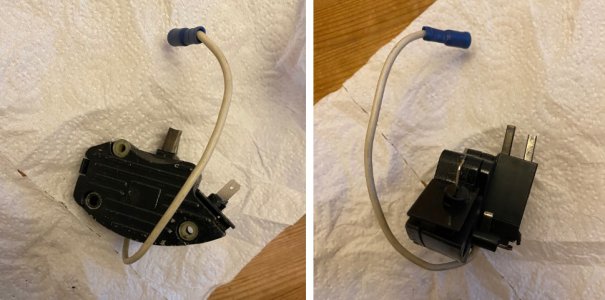
This is the regulator:

alternator regulator.jpg

The white wire is the 'add on' field control to connect the Sterling controller, connected to the brush on the variable side of the field winding. The brushes are different lengths and at slightly juanty angles, but if either of them were not making contact then there would be no field current and hence little or no output I would have thought.

I imagine that with a variable DC power supply I could test the regulator's behaviour. Google here we come...
 
Yes but… if the Sterling is disconnected the only sensing is the alternator regulator looking at the output from the alternator. Some alternators have battery sensing but this one doesn't.

I've been back to the boat (the advantage of living 5 minutes walk away - especially when you get home and find you've left the house keys on board...) this evening.

My understanding is thus - I may or may not be entirely correct:
  • The alternator is negative field control.
  • This means that one side of the field winding is at 14Vish, and the other is varied by the regulator to control the output voltage.
  • Increasing the field current increases the alternator output voltage.
  • The field control wire to the Sterling regulator is attached to the 'control' side of the field winding (not the permanent 14V side), so the Sterling can override the efforts of the alternator regulator and pull the voltage up (reduce field current) to reduce voltage output and down (increase field current) to increase voltage output.
I ran the engine with the field control wire disconnected from the Sterling regulator/controller:
  • At the alternator the voltage, where the Sterling would connect, was 0.8V which is virtually max achievable field current. This tells me that the alternator regulator is trying to get the output voltage up even though with batteries connected it's over 15V (batteries not connected it's ~28V which may or may not mean anything, and no I didn't connect/disconnect the batteries while the engine was running).
  • At the Sterling end the voltage was 14V, which tells me that the Sterling is trying its hardest to bring the output down (unsurprisingly).
Having got home and written this up I realise that would I should also have done was measured the field control voltage with the Sterling connected to see who 'wins', However it seems to me that when the alternator regulator alone is in control and the alternator output is > 15V then it shouldn't be putting max current through the field winding, so that might suggest that the regulator is faulty?

This is the regulator:

View attachment 192049

The white wire is the 'add on' field control to connect the Sterling controller, connected to the brush on the variable side of the field winding. The brushes are different lengths and at slightly juanty angles, but if either of them were not making contact then there would be no field current and hence little or no output I would have thought.

I imagine that with a variable DC power supply I could test the regulator's behaviour. Google here we come...
I see what you are saying, OK. My original thoughts were a suggestion so I would say that the original advice from Paul is what to follow.
 
Yes I expect that's where I will end up. I thought it was worth investigating further and educating myself a bit before trying to remove the alternator. If it's the regulator that is faulty then that's easy to change with the alternator in situ.
 
Yes I expect that's where I will end up. I thought it was worth investigating further and educating myself a bit before trying to remove the alternator. If it's the regulator that is faulty then that's easy to change with the alternator in situ.
Quite agree, if nothing else you at least now know a bit more than when you started:unsure: Every days a school day:ROFLMAO:
 
Yes I expect that's where I will end up. I thought it was worth investigating further and educating myself a bit before trying to remove the alternator. If it's the regulator that is faulty then that's easy to change with the alternator in situ.
Might be worth trying a new regulator ?
 
Might be worth trying a new regulator ?
Yes I think I will try that before removing the alternator. Identifying the exact correct part might be tricky - there are lots of numbers on it but the only one which yields anything in a web search is VR-LC116 which points me at regulators with part number LC111... Lots of similar looking ones on EBay (12V Alternator Regulator Lucas Type A127 Fits Ford Massey Perkins MOB VR-LC111 | eBay) but no specs plus I I don’t have specs for the current one. [Edit: the LC111 isn’t necessarily an insulated earth type, I do need insulated earth. From the pics I can see that the EBay ones are not.]

Anyway I will try and bench test it tomorrow when I’ll have access to a DC power supply.

Then maybe I’ll take the regulator to Nacton and see what they say.
 
Last edited:
So… the regulator is dead. I took it to Nacton Auto Electric, the helpful chap there said it’s not an off-the-shelf part, the alternator manufacturer modifies a non-isolated return version to isolate it.

I found the part number on Prestolite’s website (P00370j and spoke with them, they don’t have any and there aren’t any on the next shipment from China. Hmmm. I’m going to start a new thread on this specific subject.
 
Top