Perkins 4236 - Coolant Expansion Bottle - Should I Fit One?

  • Thread starter Thread starter Deleted member 36384
  • Start date Start date
D

Deleted member 36384

Guest
Hello,

My 4236 does not have an expansion bottle. About every 10 to 20 hours of engine running the coolant level has dropped in the heat exchanger and I have to top it up. Is this normal?

The heat exchanger is fitted with a radiator cap and there is a small spigot on the up-stand that the radiator cap screws onto; never had a hose on it as long as I have owned the yacht. I am assuming that if an expansion bottle is fitted then expanded fluid would flow into the bottle and then be sucked back into the header tank as it cools down.

Current practise is to fill up the header tank until it is more or less just below this spigot, which is about an inch above a pipe running through the heat exchanger.

Clearly the yacht has never been fitted with an expansion bottle, so could there be something else wrong? I don't remember having this issue before the refit (nothing done to the engine) but then again, maybe I did and I just can't remember (I am shit at keeping detailed records). If I fit one, it will be mounted on a bulkhead, should it's inlet be level with the spigot, below, or above, or does it not matter?

The engine temperature gauge is rock steady at 85 Celsius when steaming.

Thanks,

BlowingOldBoots
 
If you inspect the radiator cap you can check whether it has an upper and lower rubber seal with the spigot outlet branching off between the two seals, If it only has a lower rubber seal which holds back the radiator pressure, then fitting an expansion bottle to the spigot will not achieve anything as it will not suck back once the single seal has closed as there is no upper seal to form a closed environment for an NRV in the cap.

Richard
 
Last edited:
Just a single seal. When the pressure pushes up the plunger, it rises until the spigot is connected to the heat exchanger and excess pressure simply vents into the engine room. Could a weak spring be causing the plunger to rise at less pressure than design and thus increase the rate of water loss? I assume so. I think I will fit a bottle and hose just to catch what is coming out and order a new radiator cap.

Unless the upper seal is supposed to be directly below the radiator cap, there is no seal there, just the metal underside of the cap. The seal is on the bottom of the radiator cap plunger and it presses against a lip on the housing that the cap screws onto.
 
Last edited by a moderator:
Just a single seal. When the pressure pushes up the plunger, it rises until the spigot is connected to the heat exchanger and excess pressure simply vents into the engine room. Could a weak spring be causing the plunger to rise at less pressure than design and thus increase the rate of water loss? I assume so. I think I will fit a bottle and hose just to catch what is coming out and order a new radiator cap.

Unless the upper seal is supposed to be directly below the radiator cap, there is no seal there, just the metal underside of the cap. The seal is on the bottom of the radiator cap plunger and it presses against a lip on the housing that the cap screws onto.

The point Richard makes it that in order to suck the coolant back from an overflow bottle the pressure cap must also seal onto the top of the HE filler neck. That is in addition to the pressure controlling valve that seats on the lip at the bottom of the filler neck.

I once made the cap on a troublesome cooling system seal on the top of the neck by adding a circle of thin gasket jointing material. A bit of a bodge but effective, allowing me to and add an overflow bottle to a system that did not have one

HOWEVER the sensible way forward is to first ensure that the cap is functioning correctly and allowing the system to operate at the correct pressure. They are usually complex things incorporating a valve to control the pressure and another to allow air to enter when the system cools. Both must seal in order for it to work properly. If it does not allow the system to pressurise properly replace the cap!

OTOH
You may be simply trying to keep the HE too full. Instead of topping it up fully watch it over a longer period to see if it finds a stable level somewhat below the bottom of the filler neck, but still just covering the HE tubes. If it does then all is well . Dont keep on topping right up .... there must be a bit of expansion space left in the top of the HE!

2qunrjs.jpg
 
Last edited:
As they say RTFM! A previous owner attended a Perkins Engine owners course and the manual is still on the boat. In the cooling section it confirms what you advise VicS about overfilling. A hand written note states 'Fill to 1" below header (finger), over filling leads to more overfilling, 7 psi blow off, 5 psi, steam off".

Thanks for posting the picture of the cap, it definitely does not have the bigger seal.
 
I added an overflow tank to my boat diesel engine.

A cap like this on to the heat exchanger cap.

thumbnail_13750_Greddy_12400906_FS02-02@2x.jpg


I then ran a pipe from the spigot/overflow pipe to the expansion tank and fitted the cap that was on the heat exchanger to the expansion tank. like the one Vic poster
 
I added an overflow tank to my boat diesel engine.

A cap like this on to the heat exchanger cap.

thumbnail_13750_Greddy_12400906_FS02-02@2x.jpg


I then ran a pipe from the spigot/overflow pipe to the expansion tank and fitted the cap that was on the heat exchanger to the expansion tank. like the one Vic poster

That is a rather unusual solution though Roger. Not so unusual as it turns out.

Richard
 
Last edited:
That is a rather unusual solution though Roger. All the expansion tanks I have ever seen have been plastic and would not support a pressurised connection to the heat exchanger. In fact, the usual plastic pipe from the spigot would probably not be up to the job either. A pressurised remote expansion tank would be a fairly specialised contraption .... and begs the question as to whether the pressurised expansion tank would then need its own vented expansion tank.

Richard

Not unusual to have pressurised plastic expansion tanks surely ? I think nearly all the cars I have owned in the past 30 years have had one.

Heres one in an old Volvo. Not dissimilar to those supplied as an "extra" for various VP engines. The black cap is the pressure cap !

iylmp0.jpg
 
Last edited:
Not unusual to have pressurised plastic expansion tanks surely ? I think nearly all the cars I have owned in the past 30 years have had one.

Heres one in an old Volvo. Not dissimilar to those supplied as an "extra" for various VP engines. The black cap is the pressure cap !

iylmp0.jpg

But that cap is nothing like the one you posted in #4. I've never seen an expansion tank which takes the #4 kind of pressure cap.

Richard
 
But that cap is nothing like the one you posted in #4. I've never seen an expansion tank which takes the #4 kind of pressure cap.

Richard

No its not the same design of cap, but a pressure cap nevertheless.

In #4 I posted a diagram of a cap similar to the one I guessed the OP had on his Perkins HE ( except for the upper seal)

The one on the Volvo is the type which Volvos used on the expansion tanks in their cars and VP used on the expansion tanks on various engines.

The one on my Renault it different yet again but as far as I can remember the Ford and the Peugeot had caps similar to that in #4
 
But that cap is nothing like the one you posted in #4. I've never seen an expansion tank which takes the #4 kind of pressure cap.

Richard

I had one on one boat, it was on an expansion tank supplied wth an Eberbasto water heating system IIRC/AFAIK.
When you add volume to the cooling circuit by adding in calorifiers, heaters, etc., it's someitmes necessary to add more expansion space.

There are two sorts of 'vessel' which get vaguely called 'expansion bottle'.
One is pressurised and has a max line above which it should have an air space.
The other is a 'catch bottle' which is attached to the spigot output of the pressure catch fitting. The bottle is unpressurised, it catches the excess from the engine as it heats up and allows it to be drawn back in as the engine cools. Not very common these days?
 
The other is a 'catch bottle' which is attached to the spigot output of the pressure catch fitting. The bottle is unpressurised, it catches the excess from the engine as it heats up and allows it to be drawn back in as the engine cools. Not very common these days?

But isn't that the type which is normally found on current boats? Genuine question as that's just my impression but I haven't seen that many boat engines.

Richard
 
But isn't that the type which is normally found on current boats? Genuine question as that's just my impression but I haven't seen that many boat engines.

Richard

Most common on boats seems to be a big air space in the top of the heat exchanger?
No catch bottle or separate expansion vessel?
But most of the engines I see are older and/or low tech on sailing boats.
 
Most common on boats seems to be a big air space in the top of the heat exchanger?
No catch bottle or separate expansion vessel?
But most of the engines I see are older and/or low tech on sailing boats.

The "big air space" is definitely rather old school. Even the 1982 Landy I was working on this afternoon has a vented expansion bottle.

Richard
 
The boat was built in '73 and it is the original engine, so air gap at the top of the heat exchanger is in keeping with the age as well as the instructions. There is also a very large calorifier, so lots of extra volume. I'll run the engine with the level about 1" below the top (where it is now) and continue to monitor. Thanks everyone for the input.
 
The boat was built in '73 and it is the original engine, so air gap at the top of the heat exchanger is in keeping with the age as well as the instructions. There is also a very large calorifier, so lots of extra volume. I'll run the engine with the level about 1" below the top (where it is now) and continue to monitor. Thanks everyone for the input.

The calorifier might be the cause of the problem if any air is trapped in the coolant circuit to/ from it. As the engine warms up the air will expand and force coolant out of the HE.
If that is the cause then venting all air from the system is the remedy. It might help to fit air vents in any high points like those often fitted in car cooling systems these days.
 
Last edited:
No its not the same design of cap, but a pressure cap nevertheless.

In #4 I posted a diagram of a cap similar to the one I guessed the OP had on his Perkins HE ( except for the upper seal)

The one on the Volvo is the type which Volvos used on the expansion tanks in their cars and VP used on the expansion tanks on various engines.

The one on my Renault it different yet again but as far as I can remember the Ford and the Peugeot had caps similar to that in #4

This is the kind of expansion tank I used from a Mk1 mini but used and several early BMC cars

arh250_1.jpg
 
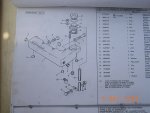
I have a 1982 Perkins 4236M Low Line and there is an overflow pipe attached to the radiator cap which vents into the bilges if you overfill it. (See Diagram attached), no expansion tank. I have found if you overfill the reservoir up to the bottom of the cap, it just blows it out.

If you look in the reservoir with the cap removed you will see a lip about 1 ½ to 2 inches down in the tank. This is the level you should fill it to as it will then stay steady and stops blowing out water. I have put a plastic soda bottle on the end of my pipe to stop the water going into the bilges

Hope this helps
 

Attachments

  • Page 30.JPG
    Page 30.JPG
    145.4 KB · Views: 9
Top