Perkins 4108 expert needed.

ianj99

Well-Known Member
Joined
11 Nov 2009
Messages
2,097
Location
UK
Visit site
According to the workshop manual the (interference fit dry) liners must protrude above the block by about .5mm when new ones are fitted.
However I'm sure when I had the head off a couple of years ago, they were flush.
Have Perkins changed the liners, have they been fitted incorrectly, or has the process of torqueing down the head bolts pushed the original liners down?

I wondered if indeed, when the head is torqued down fully, this presses the liners down by design to ensures a more gas tight seal rather than relying on the head gasket alone. However this is clearly a one time feature until the liners are replaced.

Ian
 
I think they are fully bedded down when the head is first fitted.

It makes sense but retorqueing the head bolts after the first run must be crucial. I suppose its done at the factory the first time but I am surprised the workshop manual makes no mention of this in the section on liner renewal.
 
According to the workshop manual the (interference fit dry) liners must protrude above the block by about .5mm when new ones are fitted.
However I'm sure when I had the head off a couple of years ago, they were flush.
Have Perkins changed the liners, have they been fitted incorrectly, or has the process of torqueing down the head bolts pushed the original liners down?

I wondered if indeed, when the head is torqued down fully, this presses the liners down by design to ensures a more gas tight seal rather than relying on the head gasket alone. However this is clearly a one time feature until the liners are replaced.

Ian


IIRC it depends on the liner - chrome liners and spun iron liners were different. One had a flange and one did not. The pre finished one with the flange would be the one that could be expected to protrude slightly, the other liner was glued in with copious amounts of loctite, pressed in, decked and then honed to size. I would not expect this to move at all.

0.5 mm sounds an awful lot though. You sure it is not 0.05mm?


Still it is 30 years since I even set eyes on one of those lumps, so could well be mixing it up with something else.
 
Last edited:
IIRC it depends on the liner - chrome liners and spun iron liners were different. One had a flange and one did not. The pre finished one with the flange would be the one that could be expected to protrude slightly, the other liner was glued in with copious amounts of loctite, pressed in, decked and then honed to size. I would not expect this to move at all.

0.5 mm sounds an awful lot though. You sure it is not 0.05mm?


Still it is 30 years since I even set eyes on one of those lumps, so could well be mixing it up with something else.

The 4017 has wet liners which have a flange and are just dropped in.
The 4108's are 'centrifugally cast iron' and an interference fit so no sealant needed. The manual states 0.584 to 0.686mm protrusion.
 
That's very cryptic and not really very helpful!:confused:

Sorry. 4108s had many liners inc chrome flanged and others. Many have come to grief trying to rebuild them using specs from the wrong manual for their particular engine variant.

Perkins is NOT a one size fits all engine manufacturer.

Not that I am saying you have the wrong manual....just ....Beware.


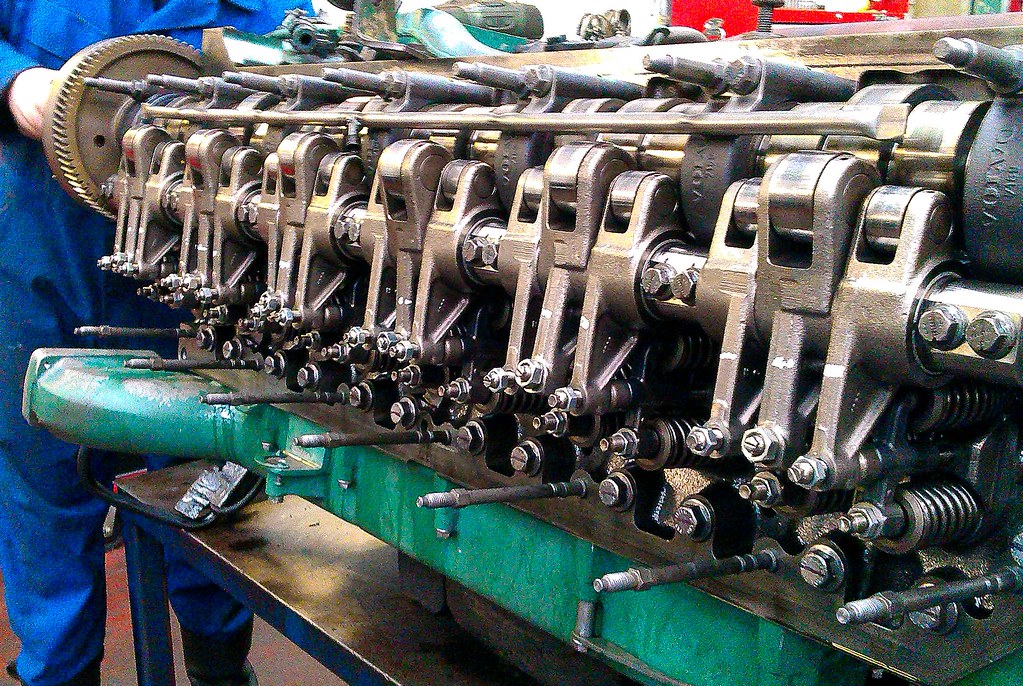
I recondition diesels for a living and have done so for many years. Stuff like this un being more common candidates for rebuild than old Perks these days.

8303214635_0f3a72293a_b.jpg
 
Last edited:
If you contact Diperk with the engine no they will be able to get the build details for your engine. The build number is what is used to identify parts and spec you have.
I have 107's and they gave me all the info on the engine.
 
Sorry. 4108s had many liners inc chrome flanged and others. Many have come to grief trying to rebuild them using specs from the wrong manual for their particular engine variant.

Perkins is NOT a one size fits all engine manufacturer.

Not that I am saying you have the wrong manual....just ....Beware.

Ah, thanks for that.

Once the engine has been lifted and dismantled in the wheelhouse, I will have to decide whether to take the block to a reconditioner for liner replacement. I'm hoping this won't be necessary as there is no way to crane the engine out of the boat, only disassemble it inside and drag the block up the wheelhouse steps, over the cockpit combing and into a wheelbarrow. Then its a 100mile drive to the nearest reconditioners.

I was intending to replace bearings and piston rings, but if there is any wear ridge at the top of the bores, I believe its not a good idea to fit unstepped top rings so new liners may be essential.

(The engine is over 30years old, but although it starts easily and doesn't use much oil, the exhaust smells a bit oily and it does seem to be down on power a bit. Oil pressure is about 20 hot idling, 50-60 when hot above 1000rpm)
 
If you contact Diperk with the engine no they will be able to get the build details for your engine. The build number is what is used to identify parts and spec you have.
I have 107's and they gave me all the info on the engine.

Thanks,will contact them next week.
Ian
 
Top