perkins 4.270 fuel usage?

... If I could find a Perkins site or even a MF (one of the main/many agricultural users) with fuel consumption figures, I'd be happy. ...

This is for the engine you have, it is based on a tractor installation and has a lot of information for different loads and PTO speeds. Perhaps you could work out what your engine would consume in a boat.

https://tractortestlab.unl.edu/Massey Ferguson 4270.pdf but this is for 6 cylinder model.
Perkins 4.270D various 4270 designations.
 
Let me recap, perhaps starting again. Steel, 8mWL, about 6tonnes. Engine IS Perkins 4.270, 4.4L. Has its 60th birthday next month, but has not run for about 12years (on the hard). Had been happily well used, running at about hull speed, probably between 1800 and 2000rpm. Previous owner now unavailable. If I could find a Perkins site or even a MF (one of the main/many agricultural users) with fuel consumption figures, I'd be happy. I do have the manuals, but not with such data. I DO appreciate all helpful comments. Many thanks.
The fuel consumption graphs are not a lot of help. The specific fuel consumption varies very little from engine to engine. What is important is the power your prop is demanding to achieve your desired speed. some quick calculations suggest that your hull speed is just under 7 knots (6.8) and requires 30hp. If you are right, and I think you are it will run to 2000rpm with an output of 62hp. With a 2:1 reduction and a 22*16 prop you will achieve 8,4 knots.

As I suggested earlier, if you have the correct prop you will be able to run at 1500rpm and 6.5knots. Your fuel consumption will be between 3-4 litres an hour, probably the lower end of that range. If you have a smaller prop the engine will run faster, but use the same power and fuel. Power outputs shown on the graphs are the potential at given revs. The amount actually produced is a function of the demands placed by the propeller to move the boat. Fuel consumption is a function of power demanded.

It is not unusual to overpower boats like this because of the potential of wide changes in displacement if, for example i is a 12 person passenger boat where a full load adds well over 1 tonne.
 
No, its a rule of thumb to provide a guide and usually overestimates actual. My last 3 30hp nominal engines cruised at about 20hp and consistently burned just under 2l/h. The point that I was making was that the previous estimates of 2-3 gallons an hour were way out. Very few people actually run their engines in auxiliary yachts at constant speeds for any length of time so the constant consumption shown on the graph is not really particularly useful. An average for mixed use is more useful.
Most people cruise at their chosen revs, most of the time. I found the graph very useful and surprisingly accurate for my boat. Its no accident that 1200rpm on my engine is maximum torque as well. We choose 1200rpm as it gives a good speed/fuel consumption balance. If we have to motor several hundred miles we will often drop to less revs to conserve fuel.
 
What you must understand is on a diesel engine the sped of the engine is controlled by the governor that opens and closed the fuel supply to provide more power to maintain the selected speed.
 
What you must understand is on a diesel engine the sped of the engine is controlled by the governor that opens and closed the fuel supply to provide more power to maintain the selected speed.
Of course, but how does that change anything? You can only quote a fuel consumption for comparison purposes in flat water, no wind at a certain revs
 
Of course, but how does that change anything? You can only quote a fuel consumption for comparison purposes in flat water, no wind at a certain revs

Its all about thee power consumed by the propeller and produced by th engine which doess not depend on the speed of the engine as the govener controls the fuel feed to produce the power required.

The power curve defines the maximum power that the engine can produce at a particle engine speed.

If the load on an engine cannot be produced at the required speed the governor will supply more fuel than the engine can burn thus produce black smoke as unburned fuel thus increasing the fuel consumption without any requird ctr speed.
 
Back to rules of thumb as used by many engine manufacturers of yacht auxiliaries such as Yanmar. Prop so that the engine can achieve a minimum around 90% of its rated maximum and continuous running at between 60-70% of maximum. For example on a 3600rpm engine should achieve 3200rpm+ and cruise in the range of 2200-2600rpm. If you look at the graphs of such engines as the Volvo 2030 and Beta 30 the torque curve is at its maximum (and almost flat) as is the specific fuel consumption in this range. If the prop size is correct then on a typical 9-11m yacht that is likely to have this size engine this equates to a cruising speed of =/- 5,5 knots and a maximum of 7+ knots.

This is of course in flat water and if adverse conditional are encountered speed will fall unless the control lever is moved to demand more power at higher rpm.
 
Give or take, 1 gallon per 20hp per hour, at displacement speeds. So look at the power curve and see what HP you might use for a given speed to calculate distance. Your displacement hull speed can be calculated as 1.6 x square root of WL length. So 25ft boat, 8kts.
Give or take.
You can open the throttle and overpower it and use twice the fuel for very little extra speed.
A guess, at 4.42 litres your Perkins is likely to be about 80hp. Could drive a 30ft boat at 8kts.
Give or take.
Much depends on transmission and prop.
A prop with, say 16in pitch will advance 16 ins for every revolution, through butter, so in water minus 20% for slip, so 12.8ins.


Give or take.
 
The link below to the Kiwiprops site gives a calculator for power used at different speeds for a given displacement and waterline length.

What it shows is the dramatic increase in power to get to or just past hull speed, and how much less power is needed at hull speed minus a knot.

So, yes, you need to understand the fuel consumption characteristics of your engine (and prop) but also how your boat fits with the hull speed calculation. And how you plan to use it. Long trips with maximum economy or short fast trips as fast as practical.

I think (but based on reasoning, not science) that an engine speed set where maximum torque is developed combined with a speed about a knot below hull speed when little wash or waves are created will give the most economical cruising. But not everyone wants or needs economy.

https://www.kiwiprops.co.nz/cms/index.php/resources-general/vesselspeedcalc
 
Last edited:
As others have said, albeit in a different way, the consumption and power graphs in the manufacturer's specs are not at all directly related to the actual consumption you will experience.

Your diesel consumption will be close to that experienced by any other boat of the same sort at the same speed, and which engine it has will make remarkably little difference.

The manufacturer's power curve shows the MAXIMUM power the engine can deliver at any particular revs, but most of the time in practice in a boat you will be using less (often much less) than that. The consumption graph is showing how much fuel the engine would need to achieve that MAXIMUM potential power at those revs, but you will rarely be using that.

The actual consumption you experience is dependent on the power needed to drive your actual boat at the speed you achieve at those revs (and in those conditions), which in turn depends mainly on the hull shape and condition, displacement, gearbox and propellor type/sizing, and not much at all on the particular diesel engine.

The engine control lever in the boat sets the engine speed, not the fuelling of the engine. (It doesn't work at all like a throttle/car accelerator pedal). The automatic governor will then deliver only just enough fuel to maintain the engine speed you have set. Most of the time in a boat it will not be consuming the figure shown on the manufacturer's graph, because it rarely needs the maximum power available from the engine to maintain the revs set.

The engine control lever in boat works much more like a car cruise control than an aceelerator, except it is controlling engine/propellor speed, not speed over the ground. A car's cruise control will deliver much more fuel to the engine going up hill than down. Similarly, the automatic governor will deliver more fuel to the boat's engine bashing into headwind and waves than when in smooth water or downwind in a strong wind and surfing down waves. Increase your engine revs and more power, and therefore fuel, will be needed to propel the boat at that faster speed, but you will still probably be using less than the engine can deliver at the new speed.

Only when the engine is struggling to maintain the engine speed you have set - in which case you will hear the engine revs repeatedly dropping and rising, will you be using the maximum power, and therefore maximum consumption, shown in the graphs. The power (and fuel) needed to drive a boat typically reduces much faster as you reduce speed from flat out, than the potential max power available/consumption from the engine (as shown in the graphs) falls off as revs are reduced to give the lower speeds.

e.g. My boat has an engine almost twice the size/power (36hp) of the standard one (20hp) fitted to most of them, with the same maximum revs. It does not consume twice the amount of fuel, despite the maximum power available at all revs and the max consumption at all revs, as shown in the manufacturer's graphs, being much higher. Both 20hp and 36hp versions of that model of boat will take exactly the same amount of power to drag them through the water at, say, 5.5 knots.

My 36hp engine will consume very slightly more than the 20hp at that speed, because it is bigger and has an additional cylinder, and so additional internal friction plus an additional pair of valve springs, etc. to overcome. But the power needed to overcome those additional internal loads (a fraction of a hp, I guess) is dwarfed by the power needed to move the boat at that speed.

A different brand/design of 20hp engine might be slightly more or less fuel efficient, but again the difference will be dwarfed by the power & fuel actually needed to move the same hull at any particular speed.

Hence it will be much more useful to ask other owners of the same or similar type of boat what their diesel consumption is, than it will be to seek that information from owners of different boats with the same engine.
 
Last edited:
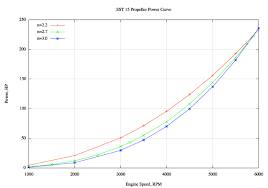
This shows the typical propeller power consumption at warious revs

1687961240110.png

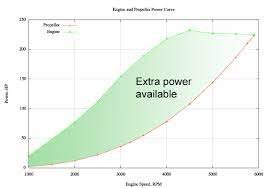
This shows the typical diesel engine maximum power developed at various revs superimposed on the propeller curve showing the extraa power available at various revs up to the maximun power the engine will produce at the maximum power the propeller will absorb

1687961435941.jpeg
 
.................
.................
As others have said, albeit in a different way, the consumption and power graphs in the manufacturer's specs are not at all directly related to the actual consumption you will experience.

Your diesel consumption will be close to that experienced by any other boat of the same sort at the same speed, and which engine it has will make remarkably little difference.
Not in my experience.
Friend have the same boat. We cruised in company with them for a while. We worked out that his 6 cylinder engine consistently used and extra litre per hour than our 4 cylinder engine when we were cruising at the same boat speed. Ours is direct injection. Their engine isn't.
Technology moves on and engines become more efficient. My engine was developed for commercial use and fuel efficiency. They actually increased the cubic capacity from 4.0L to 4.4L as part of its development and achieved better fuel efficiency
 
As others have said, albeit in a different way, the consumption and power graphs in the manufacturer's specs are not at all directly related to the actual consumption you will experience.

Your diesel consumption will be close to that experienced by any other boat of the same sort at the same speed, and which engine it has will make remarkably little difference.

.................
.................
Not in my experience.
Friend have the same boat. We cruised in company with them for a while. We worked out that his 6 cylinder engine consistently used and extra litre per hour than our 4 cylinder engine when we were cruising at the same boat speed. Ours is direct injection. Their engine isn't.
Technology moves on and engines become more efficient. My engine was developed for commercial use and fuel efficiency. They actually increased the cubic capacity from 4.0L to 4.4L as part of its development and achieved better fuel efficiency

Nothing that you have reported there contradicts what I said.

What you report does not demonstrate any direct relationship between the fuel consumption reported in manufacturers' graphs (which relates to the maximum power potentially deliverable by the engine at different revs) and the actual consumption in practice (which relates instead to the almost always less power actually required to maintain that engine speed (= prop speed = similar to boatspeed).

I specifically said that a larger engine, and one with more cylinders, will consume more fuel, and that engines vary in efficiency. The additional 1 litre per hour consumption you mention is meaningless for the current purposes unless it is also shown as a proportion of the actual consumption.

The fact remains that if you replace an engine with one twice the size in the same boat, its consumption will not be very much more than the previous one, whereas if you put the original engine in a boat twice the size, the fuel consumption to achieve the same speeds will be much higher.

The OP wanted to understand what his fuel consumption might be. For that purpose the boat size, displacement and hull form are much more important factors than this or that diesel engine.
 
Nothing that you have reported there contradicts what I said.

What you report does not demonstrate any direct relationship between the fuel consumption reported in manufacturers' graphs (which relates to the maximum power potentially deliverable by the engine at different revs) and the actual consumption in practice (which relates instead to the almost always less power actually required to maintain that engine speed (= prop speed = similar to boatspeed).

I specifically said that a larger engine, and one with more cylinders, will consume more fuel, and that engines vary in efficiency. The additional 1 litre per hour consumption you mention is meaningless for the current purposes unless it is also shown as a proportion of the actual consumption.

The fact remains that if you replace an engine with one twice the size in the same boat, its consumption will not be very much more than the previous one, whereas if you put the original engine in a boat twice the size, the fuel consumption to achieve the same speeds will be much higher.

The OP wanted to understand what his fuel consumption might be. For that purpose the boat size, displacement and hull form are much more important factors than this or that diesel engine.
My fuel consumption is identical to the Perkins published graph for my engine
 
Congratulations. You've beaten the laws of physics!
No.
Congratulations. You've beaten the laws of physics!
I really don't think so. We have filled the tank to the brim. Engined 350nm then filled the tank to the brim. 1200rpm. 3.3l/hr. Did the same at 1000rpm. 2.5l/hr. This is exactly what the graph says. How does that defy physics? We work on this consumption and know how much fuel will be in the tank. I dip it, and guess what? Its right. The graph gives these predictions and its correct
 
We may be talking at cress purposes.

I would like to see the consumption graph you are comparing youe measured consumption with

At the lower revs the engine will be feeding less fuel in to the engine to allow the engine the power that would be absorben by the propeller and not the maximum that the engine is capable of developing at the selected revs

Have a look at the lower graph on post 33

the lower like is the power the propeller will absorb and the upper is the maximum the engine an produce at the specified revs at maximum wide open fuel flow
 
We may be talking at cress purposes.

I would like to see the consumption graph you are comparing youe measured consumption with

At the lower revs the engine will be feeding less fuel in to the engine to allow the engine the power that would be absorben by the propeller and not the maximum that the engine is capable of developing at the selected revs

Have a look at the lower graph on post 33

the lower like is the power the propeller will absorb and the upper is the maximum the engine an produce at the specified revs at maximum wide open fuel flow
Who uses maximum wide open throttle on a yacht? The OP wanted to know realistic fuel consumption for his boat and engine. I gave mine being a similar size and hp. My boat is a lot heavier but it would give a worse case for the OP. I gave my cruising speeds for different revs.
My fuel consumption at cruising speed is identical to the curve. I can't tell you if the actual fuel consumption at WOT is the same as I don't do that
Edit
Just type in perkins m92b to Google. The curve is online in numerous location
 
Top