Pentland Firth Scrabster to Kirkwall - CCC tide guidance

dunedin

Well-Known Member
Joined
3 Feb 2004
Messages
15,905
Location
Boat (over winters in) the Clyde
Visit site
So just looking through the superb CCC pilot book for Orkney, Shetland and the N Coast, as one does.

However, I am struggling to reconcile their tide guidance for heading through the Pentland Firth Eastbound then heading North.

Dunnet Head to Old Head looks to be around 15 miles. But it seems to suggest
- leave Scrabster to be mid channel “not earlier than -0450 Dover”, but
- “it is ESSENTIAL to reach Old Head “not later than 4 hours before HW Dover” - ie -0400 Dover

I know the tides are fast there, but it looks like there is only a very precise 50 minutes to transit this 15 miles. And as tides are not that precise, high risk of actually being too late at Old Head.

So how do folks reconcile this?
 
Never done Eastbound then North, but I do recall the very last thing you want is the risk of getting sucked back through to the West. We used to use Scapa Flow rather than Scrabster in later years to await weather and tide. Going East, provided the wind is not a fresh SE is much easier than going West into the swell. So in settled weather I would carry some ebb through, get a decent offing to the East so that the tide change carried me N past Copinsay and beyond. Not sure what that means in exact times but I definitely wouldn't time the change to the second. If caught by the tide, go North into Scapa Flow and it all goes quiet.
 
Never done Eastbound then North, but I do recall the very last thing you want is the risk of getting sucked back through to the West. We used to use Scapa Flow rather than Scrabster in later years to await weather and tide. Going East, provided the wind is not a fresh SE is much easier than going West into the swell. So in settled weather I would carry some ebb through, get a decent offing to the East so that the tide change carried me N past Copinsay and beyond. Not sure what that means in exact times but I definitely wouldn't time the change to the second. If caught by the tide, go North into Scapa Flow and it all goes quiet.
Yes it is easy enough going into Scapa Flow - but then the wrong side of the Churchill Barriers if wanting to head N up the East side of Mainland towards Kirkwall.
Just the CCC timings look to be impossible Eastbound through the Firth and turning North. I must be missing something.
S
 
I just remember that Orkney is best going clockwise, as heading north on the east of Orkney, you will always have a tide against you which seams to head south permanently unless you go way far east. We’ve always gone up the west coast and through Eynhallow Sound.
 
Eynhallow Sound is exciting especially going E to W and I recall quite shallow. I'm assuming Dunedin rejected that option.

We only used Scapa Flow to split the journey, returning back into the Firth on the next tide/weather window. Exiting W at Stromness was much rougher than the N side of the Firth

I don't have access to the full tide tables but it looks like you would leave Scrabster at HW Dover -6, stay close to Dunnet Head, then aim to pass between Stroma and Swona to avoid being swept S. As soon as the tide picks up (HW -5) you will be ejected from the Firth. Dont be afraid to steer 90 degrees to the tide flow when necessary. We used to do this pre GPS using transits and bearings. The current was frightening but there is plenty of space. With a W wind the sea should be settled.
 
I just remember that Orkney is best going clockwise, as heading north on the east of Orkney, you will always have a tide against you which seams to head south permanently unless you go way far east. We’ve always gone up the west coast and through Eynhallow Sound.
Been in and out via Hoy and Eynhallow Sounds a few times - last year stopped to go ashore on Eynhallow Island, which was nice.
Perhaps tides do suit clockwise better - but the East side can be rather exposed to a big swell from the west.
 
Eynhallow Sound is exciting especially going E to W and I recall quite shallow. I'm assuming Dunedin rejected that option.

We only used Scapa Flow to split the journey, returning back into the Firth on the next tide/weather window. Exiting W at Stromness was much rougher than the N side of the Firth

I don't have access to the full tide tables but it looks like you would leave Scrabster at HW Dover -6, stay close to Dunnet Head, then aim to pass between Stroma and Swona to avoid being swept S. As soon as the tide picks up (HW -5) you will be ejected from the Firth. Dont be afraid to steer 90 degrees to the tide flow when necessary. We used to do this pre GPS using transits and bearings. The current was frightening but there is plenty of space. With a W wind the sea should be settled.
If it is “essential” to be at Old Head before Dover HW -4 that still leaves an extremely tight window as need to guarantee getting all the way in 2 hours - with no margin for tide turning slightly early.
 
Dunnet Head to Old Head looks to be around 15 miles. But it seems to suggest
- leave Scrabster to be mid channel “not earlier than -0450 Dover”, but
- “it is ESSENTIAL to reach Old Head “not later than 4 hours before HW Dover” - ie -0400 Dover

Assuming it's not a misprint are they saying a lengthy stop in between is essential? Or by 'mid channel' do they mean half way along the 15 miles, leaving you 7 miles to knock off in 50 minutes, which still seems a big ask.

Neither of those seem very plausible, I'm bewildered and I was hoping someone might have posted the answer by now.
 
There's quite a bit of detail on Caithness CWS - Pentland Firth - Tides

Essentially N of Dunnet Head things run in your favour from -0450 Dover, but off Old Head a S current forms from about -0350 (and will be against you as you push N, hence presumably needing to meet the first of it).

The "good" news is everything between those points is running at a hellish pace in your favour, so take a fast boat and pack your finest pair of brown trousers. It's an utterly eyepopping read and a fine advert for taking the Caledonian Canal!
 
Last edited:
There's quite a bit of detail on Caithness CWS - Pentland Firth - Tides

Essentially N of Dunnet Head things run in your favour from -0450 Dover, but off Old Head a S current forms from about -0350 (and will be against you as you push N, hence presumably needing to meet the first of it).

The "good" news is everything between those points is running at a hellish pace in your favour, so take a fast boat and pack your finest pair of brown trousers. It's an utterly eyepopping read and a fine advert for taking the Caledonian Canal!
It's like canoeing and it all hinges on getting into the right place at the right time. Getting pushed out E is OK, you don't want caught in the S going stream. Having done both, mastering the Firth is obviously weather dependant but very rewarding. The canal and it's locks is stressful in a different way.
 
Well, after studying the Admiralty Tidal Stream Atlas I came to the conclusion that CCC was right and there was basically no way to time the tides right from Scrabster to get round Old Head and turn north in one tide. So need to head into Scapa Flow instead.

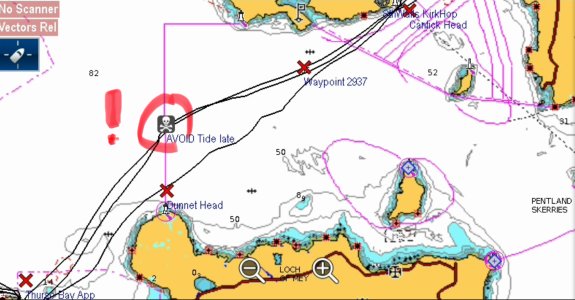
However, I am not sure where CCC considers “mid-Chanel” from Scrabster, but I seem to have found a rather dangerous spot where the tide still runs West at 2 knots - an hour after it should according to the tide tables have turned East. This is 3 miles due north of Dunnet Head light, close to the K tidal diamond on an Imray chart. West going tide and Atlantic swell from the west are clearly not a happy combination, hence why one tries to time this trip very carefully.

The first time I did Scrabster to Scapa I stuck fairly low in Thurso Bay to benefit from the early tide East, but found waves got up within 3/4 of a mile of Dunnet Head light- nothing serious but rolly.
So last two times I tried to leave a bit more distance from Dunnet Head to keep away from a lee shore in NW waves - and not wanting to be swept past Cantick Head entrance. So had a waypoint 3 miles off Dunnet Head.

I had forgotten that last year I suddenly found a bit of adverse tide West going tide there when should have been going East for an hour - was relatively benign weather so sudden wave build up was not a major concern in a seaworthy boat.
This time in stronger winds had been doing 8 knots SOG downwind and down tide (6 knots + 2 tide) with bigger but benign waves, when suddenly things started to get more menacing. Big beasts all round. Looked at chart plotter and noticed was suddenly 4 knots SOG though speed through water still 6 knots - roughly same place as last time (which I had assumed was just an anomaly).
Biggest and most mixed waves I can recall (and I have crossed the Atlantic), but had already prepared with hatch boards in and harnesses on just in case. Unfurled full genoa to increase speed and with careful hand steering (and no waves actually breaking) we surfed further East as fast as possible.
10 minutes later we’re back in East going tide, and water was so flat (barely half a metre of ripples) that the coffee cups were not being spilt. Like a different planet a mile further East. But I will keep within a mile or so of Dunnet Head next time (or take the ferry!)

PS. another going to make same mistake next time so amended previous waypoint to remind me ….
IMG_1593.jpeg
 
Last edited:
On page 23 there's a warning (column 1 para 2) to "expect the unexpected". I've been through there several times and only once did the tides obey the forecasts, and do the expected.
I'm researching this summer for the next edition of this book (be a 3rd edition), and would be pleased to consider improved wording of this section on the Pentland Firth.
The complicating factors in this area are the huge eddies that have flows adverse to what you'd expect given the average that "the flood runs east".
For the OPs route, the latter part runs into difficulty in that there's never a useful North running stream close in to S Ronaldsay. There's slack a few hours, but a S running stream for most of the rest of the time.
Passing Dunnet Head at about HWD-5 gets a good east going stream until about HWD-1. But that stream increasingly sweeps into the Moray Firth round Duncansby Hd. Heading at 90 degrees across the tide towards the NE and then passing 3-4M east of Old head looks a possibility. But it's still tight, that stream starts at HWD-5 until HWD-2.

I hope to be in the area about mid June, then heading for Shetland.
Clockwise round Orkney is far easier!
 
On page 23 there's a warning (column 1 para 2) to "expect the unexpected". I've been through there several times and only once did the tides obey the forecasts, and do the expected.
I'm researching this summer for the next edition of this book (be a 3rd edition), and would be pleased to consider improved wording of this section on the Pentland Firth.
The complicating factors in this area are the huge eddies that have flows adverse to what you'd expect given the average that "the flood runs east".
For the OPs route, the latter part runs into difficulty in that there's never a useful North running stream close in to S Ronaldsay. There's slack a few hours, but a S running stream for most of the rest of the time.
Passing Dunnet Head at about HWD-5 gets a good east going stream until about HWD-1. But that stream increasingly sweeps into the Moray Firth round Duncansby Hd. Heading at 90 degrees across the tide towards the NE and then passing 3-4M east of Old head looks a possibility. But it's still tight, that stream starts at HWD-5 until HWD-2.

I hope to be in the area about mid June, then heading for Shetland.
Clockwise round Orkney is far easier!
Thanks for your comments - and for clarity, no criticism implied or intended for CCC Directions. They are brilliant and the indispensable "bible" for sailing in Scotland.

Having grown up racing slow dinghies in very fast tides, i am very familiar with the vagaries of Scottish tides - which often seen to rudely fail to read the tide tables.
Also very familiar with typical sources if tidal eddies, and have used to sail through places like Dorus Mor (regularly), Corryvreckan, Kyle Rhea etc against the nain tide using eddies - and caught a great one through Yell Sound earlier this week (thanks again CCC Directions!).
However the spot marked with skull and crossbones on my original track seems a very odd place to get a total tide reversal - in mid channel miles from any headlands or bays. Very odd - and borderline dangerous if caught out.

Going clockwise didn't appeal on the day as after brisk SW winds the swell was low near the North coast of Scotland - but predicted to be 4m off Hoy Sound. If was at all late there, or a tidal eddy or even reflected waves, a lee shore with tide starting to flow out of Hoy Sound would definitely spoil one's day. Indeed, even Hamnavoe seemed to agree and inbound aldo went via Scapa Flow

Enjoy your trip to Orkney and Shetland and already looking forward to next edition (though current 2nd Edition is still great, massive advance over 1st Edition).

Thanks
 
Also very familiar with typical sources if tidal eddies, and have used to sail through places like Dorus Mor (regularly), Corryvreckan, Kyle Rhea etc against the nain tide using eddies -

I did that in Kyle Rhea once. Arrived at completely the wrong time, decided I'd have a go with zero hope of success. In the event I found I could hop from eddy/whirlpool to eddy/whirlpool. I couldn't quite beleive it when I found myself all the way through. Quicker than waiting for the fair tide.
 
I find it a great challenge to defy some of the tidal flows (with appropriate caution). I once spent a day or 2 finding a way to sail through Corryvreckan against the tide (halfway between springs and neaps). Of course flows vary with atmospheric pressure too, and wind direction makes some things possible only some times.
Yes, there are weird things at sea. Amphidromic points, and things like that!
 
Top