PC Nautic Teller Pilot Review

Slight thread drift but I wonder if any of the autopilot experts could confirm. I use a Raymarine EV-100 set up with their above deck ram. It all works fine for me, however I see references in the documentation to a rudder angle sensor. In a case like mine, with an above deck ram connected directly to the tiller, and no play in the steering, am I right in thinking that a rudder angle sensor could not possibly provide any additional info?
I took my rudder angle off the system which was on when I bought the boat - it ran a Wheelpilot device and then put the EV-100 on without any angle input, Didn't seem to make any difference.
 
'Twould seem, from what I've found so far, is that the RM systems have it as optional/helpful/recommended, but seems to do OK without & I saw this on Pirate's Cave "Virtual Rudder Feedback (VRM):
Raymarine's Virtual Rudder Feedback technology eliminates the need for installing a physical rudder feedback sensor, which simplifies installation and reduces maintenance. VRM calculates the boat's rudder position based on the autopilot's steering commands and the vessel's response, resulting in precise steering control."
That's a relief as it doesn't massively lift it above the Pypilot, but a slight disappointment that these systems don't really use that data if it's available - I'd imagined a whole nother level of magic going on inside the black box 😄.

On the plus side, I've found that the Pypilot uses it inter alia to determine arm travel limits efficiently: it would seem that without either a rudder sensor or limit switches, the system detects a power spike when the motor runs up against the limit if rudder travel. With the rudder sensor, this is avoided and that energy is not expended, which helps make the Pypilot so energy efficient.

I've just looked into it a bit and it would seem that our older ST4000 detects the power surge as above (might help explain why it's lasted so long), the Simrad units use a hall effect sensor to shut off power at the end of travel, whereas the ST1000 & 2000 have no system at all and just grind away when the limits of travel are reached (eg when the boat slews round on a quartering sea passage) .
Just thought this might be of interest to some.
 
Slight thread drift but I wonder if any of the autopilot experts could confirm. I use a Raymarine EV-100 set up with their above deck ram. It all works fine for me, however I see references in the documentation to a rudder angle sensor. In a case like mine, with an above deck ram connected directly to the tiller, and no play in the steering, am I right in thinking that a rudder angle sensor could not possibly provide any additional info?
I can't see why your assumption would be right. Why would an above deck ram be any different to a below decks one? The autopilot simply applies +12v to steer port and -12v to steer starboard (or voce versa).

Interesting. I thought (assumed) the PCNautic unit used that info as part of its calculations but it quite possibly doesn't - I haven't looked into it properly yet, maybe one needs an NKE level system to do that? Going to investigate...
I'm pretty sure PC Nautic unit use the version of the HB-DJ809 which has a built in potentiometer go give a position reading. I've posted a video demonstrating this model in the past.

From this Raymarine support article one can deduce that the M81105 is wired like this. I guess it may just be a 5kΩ pot, limited to the middle third of its travel. So I believe it should be quite straightforward for a DJ809 to give rudder feedback to a Raymarine EV-100; I've been advised to add a couple of inline resistors, to ensure the resistance can't ever go to 0Ω, which might risk damaging the autopilot.
I took my rudder angle off the system which was on when I bought the boat - it ran a Wheelpilot device and then put the EV-100 on without any angle input, Didn't seem to make any difference.
I thought I'd read that the rudder position sensor can make a big difference, although possibly EV-1 sensor (9-axis heading sensor) is more important.
 
I can't see why your assumption would be right. Why would an above deck ram be any different to a below decks one? The autopilot simply applies +12v to steer port and -12v to steer starboard (or voce versa).


I'm pretty sure PC Nautic unit use the version of the HB-DJ809 which has a built in potentiometer go give a position reading. I've posted a video demonstrating this model in the past.

From this Raymarine support article one can deduce that the M81105 is wired like this. I guess it may just be a 5kΩ pot, limited to the middle third of its travel. So I believe it should be quite straightforward for a DJ809 to give rudder feedback to a Raymarine EV-100; I've been advised to add a couple of inline resistors, to ensure the resistance can't ever go to 0Ω, which might risk damaging the autopilot.

I thought I'd read that the rudder position sensor can make a big difference, although possibly EV-1 sensor (9-axis heading sensor) is more important.
From my reading earlier, I gather the sensor is most useful in below deck systems where there's a Heath Robinson string of levers, cables, quadrants and whatever, where slop can be introduced at every point and I concur with mrming about the tightness of a direct tiller system.
That's not to say the sensor is entirely pointless and to me, the reduction in power consumption would be worth it alone I think.
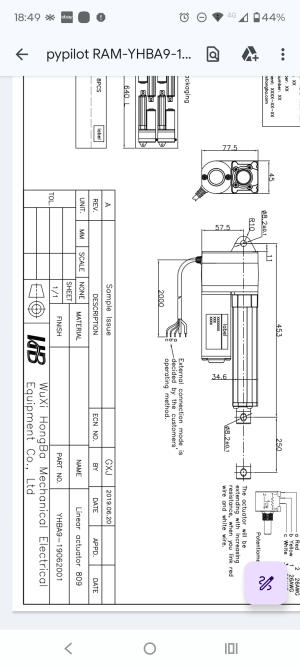
This is from the PDF if the drawing of the ram I read was used in the Pypilot - I'd saved it for future reference, it may be the same unit, IDK.
 

Attachments

  • Screenshot_20260105-184944.Drive.png
    Screenshot_20260105-184944.Drive.png
    408.6 KB · Views: 5
This is from the PDF if the drawing of the ram I read was used in the Pypilot - I'd saved it for future reference, it may be the same unit, IDK.
You can see from the bottom of the diagram (on the left, in the rotation I'm seeing) that it's a Wuxi Hongba, Model 809 is also mentioned there.

Wuxi issue a spec sheet like this with every order placed, based on the options chosen by the customer. I posted the full version of mine in post 27, yours is just a crop from one.
 
You can see from the bottom of the diagram (on the left, in the rotation I'm seeing) that it's a Wuxi Hongba, Model 809 is also mentioned there.

Wuxi issue a spec sheet like this with every order placed, based on the options chosen by the customer. I posted the full version of mine in post 27, yours is just a crop from one.
Haha, I was looking at the long product number, which didn't have 809 in it - completely missed that immediately above it 😄. OTOH , it's good to get it corroborated.
 
My (vague) understanding of the rudder ref sensor is that it tells the ev100 the exact rudder angle, regardless of where ram attaches to tiller. This info is used while ev100 is ‘learning’ characteristics of your boat.
 
Last edited:
My (vague) understanding of the rudder ref sensor tells the ev100 the exact rudder angle, regardless of where ram attaches to tiller. This is used while ev100 is ‘learning’ characteristics of your boat.
I have a solid bar link between wheel and rudder. When I set up the Raymarine it asked to press the button at each limit of travel. That would be unlikely to change.
 
I have a solid bar link between wheel and rudder. When I set up the Raymarine it asked to press the button at each limit of travel. That would be unlikely to change.
EV100? But surely at that point the TP only knows that you are at max lock of steering. It doesn’t know what angle the rudder is at. Or do you tell it the rudder angle at that point also?

During the ‘dockside wizard’ setup process mine never asked for a limit of travel input - mines a tiller steered boat, obvs.
 
Ok I have scanned through the responses.

After afew seasons use, I still swear buy it, including 1000 miles single handed in 2024.

Including a few interesting moments, F6 wind against tide Portland Bill & Start Point one up wind one down wind.

I use it navigating in the river putting fenders out etc even with light traffic.

It has never struggled with power even though Morgan Giles 30 are known for weather helm.

150 mile's in 28 hours single handed auto pilot all the way.

Power usage is very low my chart plotter pulls more power.

It is tweaky regarding gains, I have a beating reaching running and motor settings. Although that might be me expecting it to be perfect.

Sometimes it carries a 2 or 3 degree course error but it does it constantly. possibly settings but I live with it or due to weather helm.

I have set it up with the Anticence NMEA 2k thing that allows the same WiFi to send wind, depth and AIS info to phone.

I have kept a 2 up Contessa 32 behind my little 30 Morgan Giles across Lyme Bay single handed much to there annoyance. I had it set to wind beating across the bay.

It's worth getting the USB GPS or connecting to your nav system. One function that is very user friendly is steer to COG

EG leaving Lymington River set to COG as the current changes in long reach on the way in and out she keeps her cog in the channel.

Only problem I had was my first tiller arm developed a fault where it would stick. It was replaced within warranty.

I had a connector full of water, at the time that may of caused the fault. PC Nautic where aware and still replaced.

Yes the unit has rudder feed back, I have an app that monitors it.

I get frequent updates.

Yes if you can program a Raspberry Pie and ardweno hat you can make your own. You can buy the tiller arms direct from China at 1/2 the price. However you pay for the package as plug and play.

Any more questions do ask..
 
Onesea, thanks for that. It's presumably easy enough to switch between gain profiles (beating etc)? I'm pretty sold on it anyway and plug and play is not without its appeal :-)
 
I may be a less demanding user than onesea; I don't generally change gain profiles (but it is easy). My boat is pretty easy to turn though so maybe the pilot has an easier time.

Good to read about your longer term experience onesea, thank you! Quite reassuring. You say you use the actisense NMEA2k/USB widget, is that with a laptop?
 
Last edited:
Good to read about your longer term experience onesea, thank you! Quite reassuring. You say you use the actisense NMEA2k/USB widget, is that with a laptop?
The widget is a €215 device:
NMEA2000/SeaTalkNG to USB converter

However for me it linked allot together.
I have a 12” Onwa chart plotter/ AIS/ Sounder that merges my NMEA 183 wind input so it becomes n2k that outputs to the above “widget” that then gives all the data to the tiller Pilot.

That then can wifi data to phones and tablets.
I generally navigate on button on control head or

Android Tablet set up in companion way giving more control, AIS data & charts (memory map/ Navionics plus others) and data on free apps. It also has my automatic log app.

I have larger 10” tablet for passage planning and general use below.

Oh and phone is an option too.

Only thing I would like to add is a GSM connection to monitor boat and all data at anchor etc, However it’s easy to leave back up phone or tablet with anchor app that reports to my phone, it also pulls less battery power. One day I might work it out.

However it will be a whilst before I can get 3 months to go sailing again so this is more than enough.

As for course keeping I probably expect allot out of it, all sea conditions and winds it has never let me down. By not letting me down I mean steer an accurate course, alter course. From drifting to F6 and probably a tad more, including under spinnaker although is oversized that comes down in a F3-4.

Admittedly it doesn’t maintain COG very well when sailing slowly pushing a current that your barely making headway against, or drifting back wards but even I can understand that.
 
Last edited:
Top