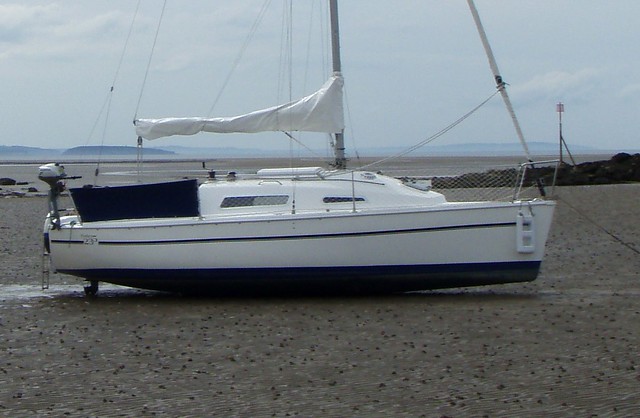
Parker 235 Lifting Keel

salinia

Well-Known Member
Joined
24 Oct 2010
Messages
987
Location
Staffordshire Moo lands
Visit site
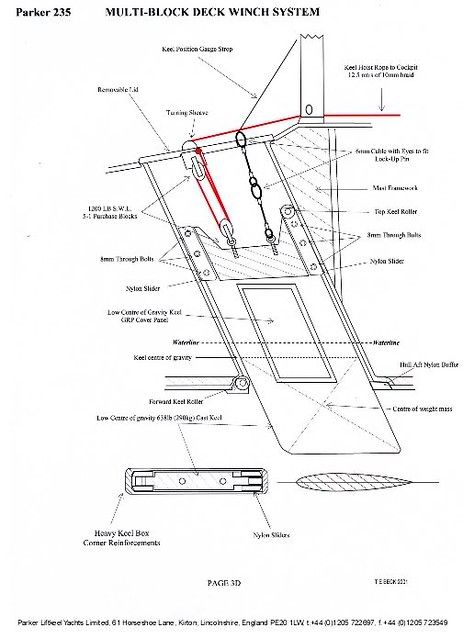
I read about an unfortunate situation where a trailer sailer (Parker 235) had suffered a gear failure while unattended on its mooring. As a result the keel became fully extended and it lay on its side when left by the tide. I pondered whether or not this would be safe to do intentionally so as to make it easier for applying antifouling other than scrawling under it on the trailer. After giving it some thought I decided against the idea.I would think the weight of the boat applying force to the top part of the keel would be very likely to cause damage, would the forum agree that it would be to risky?
6445878275_0967bcb410_z.jpg


5104681490_ffd81bc6fa_z.jpg
 
Last edited:
Is all the ballast in the drop keel? I'm not saying that would make it safe to dry out your Parker 235 with the keel down, but most fixed fin keel boats would lie over on their side quite safely. Can you work out the position of the c of g for your hull without the ballast keel? And the angle it would lie at when dried out? If so you could calculate the moment required to roll it over to that angle.

A practical thought, though. When ever I have tried this with my Seal 28, the keel has no means of being locked down and so it gently houses itself back in its case as the water disappears.

Neil
 
I think the ballast is all in the keel but the weak spot would be at the top of the keel. Regarding the guy whose P235 ended up on its side with the keel extended it is thought that the failed gear jammed the keel in its extended position although I would have thought it would have self stowed on a swinging mooring must have been trapped somehow. I suppose the only way to dry out with the keel extended would be to have a lot of weight on one side so as to trap the keel in position.
 
Judging by the ease with which I tipped my Copland Harrier with the keel up I would say you could try beaching her with the keel up and careening her by pulling her over with a halyard. You will need to be near a stout post or anchor point.

I did it afloat between two finger pontoons, Searush was spectating but I didn't know at the time. It was so tippy with the keel up I bottled it and put the keel half way down. It was still easy enough to careen her but reassuringly difficult indicating she wasn't going to turn turtle. I was scraping off fouling, not antifouling.

I have a "thingy" that fits in the keel box to keep the keel down. It will hold it in place if the boat turns turtle (I'm told, and I have no intention of testing it) but I wouldn't trust it to dry the boat out upright.
 
I know where you are coming from with regards crawling under the trailer as I had to do the same with our Trapper TS240.

One way around this to make it slightly easier is to jack the trailer up and put it on wheel ramps. I have also driven one side up a kerb to give a liitle bit more clearance under the trailer.

I wondered about laying ours over on her side in order to do some proper keel maintenance rather than slapping another coat of af over the rusty bits.

Trouble is with a draft of 1.7M you need to be laid over a long way. I did consider beam on to the steepest slope of the beach at Llanbedrog with the top of the mast tied to a tree!
 
The P235 is a little heavier but I will have a play about next summer and see what gives (not literally) thanks for all the comments.

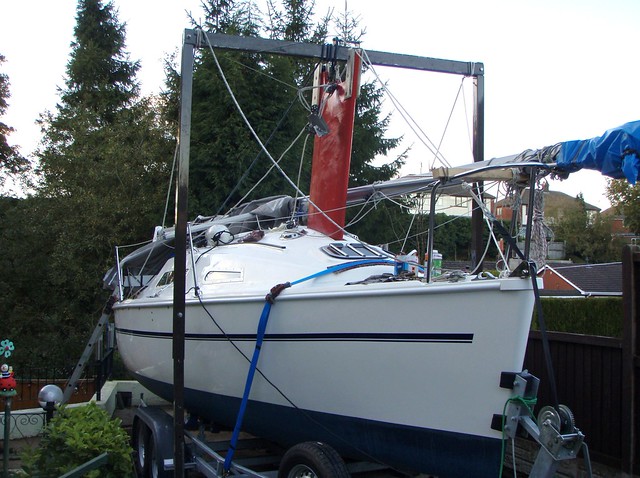
Just taken a close look at your trailer bow blocks and winch. Our trailer only has shaped bunks, no rollers and no winch.

Do you have an eye in the vertical part of the bow just above the water line to which you attach the winch?

I am reviewing our front chock arrangement as it works well at positioning when crane loading but not so well when float retrieving.
 
Yes we have a fixing point for the winch you can just about make it out on this photo. I have a really good pair of car ramps that I used to use for our previous boat a Swift 18, I want to use these with some extensions so as to get a little more height...the trailer is now twin axle so its more of a problem to solve.
6500287751_fdbf7057b4_z.jpg
 
Top