Parallel for engine start.

jac

Well-Known Member
Joined
10 Sep 2001
Messages
9,241
Location
Home Berkshire, Boat Hamble
Visit site
I'm undertaking some electrical upgrading over the winter.

At present, whilst in theory we have dedicated engine start and domestic banks, we don't in practice. Instead each bank goes to bat on off switch. The engine is then on one battery, domestic is on the other. The two switches are then paralleled so that when either battery is on, power is available on either engine start or domestic. Charging also feeds in so the battery switches also control which battery gets charged.

I need to separate the batteries - at present if I leave both switched on I can flatten both. But I want to be easily able to start the engine from domestic bank. I could put in a separate battery type switch that parallels but it could get get left on.

I have seen emergency paralleling switches that operate for 10 mins then isolate again which sounds like a good idea. Has anyone used one of these or got any other suggestions?
 
I'm undertaking some electrical upgrading over the winter.

At present, whilst in theory we have dedicated engine start and domestic banks, we don't in practice. Instead each bank goes to bat on off switch. The engine is then on one battery, domestic is on the other. The two switches are then paralleled so that when either battery is on, power is available on either engine start or domestic. Charging also feeds in so the battery switches also control which battery gets charged.

I need to separate the batteries - at present if I leave both switched on I can flatten both. But I want to be easily able to start the engine from domestic bank. I could put in a separate battery type switch that parallels but it could get get left on.

I have seen emergency paralleling switches that operate for 10 mins then isolate again which sounds like a good idea. Has anyone used one of these or got any other suggestions?


Why not fit a VSR and use it for charging, plus link start if needed ?

Brian
 
I have now fitted a Smartguage + Smartbank system that does all you ask and more. But it may be an overkill for your boat? I have taken out a 1-2-both-off switch that will simplify your switching but works essentially in the same way. PM me if you're interested in the switch - it's in v good condition.
 
Have already bought the sterling Alternator to Battery Charger which does some monitoring via the remote and takes care of which is charging so not changing that side.

It's more the best way of paralleling I'm interested. Do I go for simple on off type switch or is there something better
 
Have already bought the sterling Alternator to Battery Charger which does some monitoring via the remote and takes care of which is charging so not changing that side.

It's more the best way of paralleling I'm interested. Do I go for simple on off type switch or is there something better

A standard car start solenoid connecting the two separate +VE, with the solenoid feed from the standby side ++VE via a simple momentary on button. That's how its done on my Fairline, and works very well if the domestic set gets a bit flat.
 
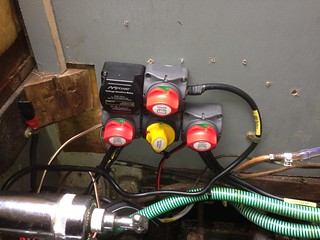
A BEP Marine battery cluster will do the job. Separate isolators and a parallel switch. You need to wire your banks so that the engine start only does that and everything else off the house bank.
 
+1 This my twin engine setup. One house isolator (top), one for each engine and the yellow one parallels them all together. VSR top left to look after it all in day to day use.

9688736214_fb9fc44908_n.jpg
 
I have separate engine and domestic batteries switches with an additional emergency paralleling switch to link the domestics to the engine circuit after the engine battery, so that a dead engine battery can't drain the domestics. The emergency switch key is left in the drawer and if needed the engine battery key is used hence the engine battery must be isolated before switching. The two keys are on retaining strings but only the engine battery key will reach the emergency switch.
 
Your present arrangement doesn't seem that silly to me. It's equivalent to the common 1,2,both switches with the slight downside that it is easier to accidentally leave it on both. This will evoke responses that 1,2,both switches are the work of the devil, but it does me just fine. I have symmetrical battery banks and alternate which I use, keeping one fully charged for emergency starting. My chargers - alternator and shore - charge both no matter which is in use, each separately regulated. My tiny engine can easily be started form a general purpose battery.
 
I recently did mine with a row of battery isolator switches.Placed next to each other mine are linked with copper strip such that I can have one or both aux.batteries to aux.From the aux.side a link to my link isolator which links one or both to starter side of dedicated starter battery isolator,
So in an emergency I can start with any or all batteries whilst isolating any dead batteries.
I used this to great effect last year when unknowingly the glow plugs lead was loose.
I managed to fire up the engine despite this using the 330 odd combined ah.
 
Why not fit a VSR and use it for charging, plus link start if needed ?

Brian
+1
Separate battery banks, alternator charges engine battery with a VSR that connects the domestics once voltage high. Have an emergency parallel switch with a key hidden away at the back of the chart table, or in a break glass to open type box. You should virtually never actually have to use the link switch.
 
I need to separate the batteries - at present if I leave both switched on I can flatten both. But I want to be easily able to start the engine from domestic bank. I could put in a separate battery type switch that parallels but it could get get left on.

I've just got three simple cheap battery switches.

Switch one connects the domestic batteries to the domestic circuit.

Switch two connects the starter battery to the starter circuit.

Switch three connnects the domestic batteries to the starter circuit and doesn't normally have the red key in it (hidden elsewhere).

If the starter battery was flat, I'd take the key out of switch two and use it in switch three. A big advantage is that this would isolate the flat engine battery rather than connecting it in parallel. I don't see why you would need an automatic switch with an arrangement like that as you'd be aware you'd moved the key to the other switch, and anyway as the batteries aren't parallel there'd not be a problem with forgetting about it for a few hours.

It is possible to parallel the batteries by turning on both switches 2 & 3, but that would be an absolute last resort when engine and domestics are both already pretty flat.

Charging doesn't go through the switches, so no vulnerability to one of the crew accidentally switching one off. I've a Sterling A2B Charger, but as others have said a VSR is an alternative.
 
I've just got three simple cheap battery switches.

Switch one connects the domestic batteries to the domestic circuit.

Switch two connects the starter battery to the starter circuit.

Switch three connnects the domestic batteries to the starter circuit and doesn't normally have the red key in it (hidden elsewhere).

If the starter battery was flat, I'd take the key out of switch two and use it in switch three. A big advantage is that this would isolate the flat engine battery rather than connecting it in parallel. I don't see why you would need an automatic switch with an arrangement like that as you'd be aware you'd moved the key to the other switch, and anyway as the batteries aren't parallel there'd not be a problem with forgetting about it for a few hours.

It is possible to parallel the batteries by turning on both switches 2 & 3, but that would be an absolute last resort when engine and domestics are both already pretty flat.

Charging doesn't go through the switches, so no vulnerability to one of the crew accidentally switching one off. I've a Sterling A2B Charger, but as others have said a VSR is an alternative.

Thanks - that is close to what I had in mind.

To those suggesting a VSR to control the charging - I am putting in an A2B charger so don't see that they could co-exist.

This is for the 1% chance that the engine start battery is flat and I need to start. I could just carry jump leads but I want something quick to operate as if the engine start battery is knackered I can guarantee that I'm about to need the engine urgently as well.
 
Cheap and simple way I used was to have a key switch for parallel on a length of string/elastic route the string or elastic so you cant miss it, but in practice to need to parallel the batteries is usually a one off emergency so you can also have a key switch attached to you on a piece of elastic like a kill cord, once the engine starts switch off and remove the key. Having a removable key was also good if we had guests on board as there was no chance of anyone switching it by accident without first finding the key. I have been on boats where guests had switched on everything including the parallel/both batteries and then flattened everything.
 
Just to sum up what I think has been said. It is not normal to parallel domestic and engine battery for normal start. Indeed you should start on engine battery to ensure it will do the job. It will die one day. If you always use domestic in parallel you may not know if engine battery alone is good or not. While lots of battery power will give a spirited start it is conceivable that the starter motor could be overheated with prolonged cranking. it is designed to operate on about 9v the voltage of a correct sized battery under large load.

If the engine battery does fail. I think usually a help from another battery in aparallel will be the way to go. This assumes that the dead engine battery can supply some current to assit the added battery. However occasionally depending on the fault a dead battery can be a detriment when parlleled to a good battery. The concept of a solenoid on a momentary switch to jump start from a domestic battery has merit in this case. The other option being to disconnect the engine battery is also good. A switch to parallel the batteries can leave both batteries paralleled for a short time before start when the engine battery could discharge the good one. I think I would use the latter option anyway and risk it.
As said you can use a paralleling switch to get charge into domestic battery provided it is only connected after engine start (or at least is occasionally left till after engine start to check engine battery) and then opened when domestic battery is used (discharged overnight). But a VSR will make it foolproof. good luck olewill
Just thinking about this some more. of course a lot of people always start on all batteries paralleled apparently without detriment to starter. But checking occasionally if a start is Ok on just one battery is very desirable.
 
Last edited:
Top