Panope Vid No 138

Jonathan and I differ on the topic of burying. I have taken hundreds of underwater photos of my Rocna in Greek seabeds and have never seen it completely buried. I have rarely seen any make of anchor totally buried, so maybe this is a function of the seabed.

The anchor is correctly sized for my boat and I do not subscribe to the oversized school of thought. You can read more about my reasoning on my website at Oversize anchors – necessary?
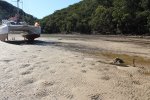


Definitely a function of seabed soft ness, the size of the anchor, type of anchor and the amount of power developed. But here is a buried anchor.

We have 2 x 20hp engines combined tension at maximum revs 400kg.

We were going to sit here for a couple of days and our normal procedure is to set 2 stern anchors off the transom and one off the bow. The 2 off the transoms we use the sheet winches short pieces of chain and dyneema as the rode, retired halyards. Off the bow we simply use the windlass, the chain rode. We drop the anchor reverse up (in this case its a 10:1 scope and then near maximum revs (in reverse) for a few seconds.

IMG_0071.jpeg

I was quite aggressive for this set and left the 400kg of tension for more than a few seconds. I had to dig to find the anchor (pic below), you can see the shank and the 'disappearing ' chain. That 'smooth' patch of sand on the left is caused by the anchor burying. I have lots of pictures of anchors - almost buried - I don't like to bury them completely as if I show a picture - there is no anchor to see! I like disappearing chain - as it means the anchor, any anchor, is well set, and sometimes I set a buoy and line at 1m from the shackle so that I know where the anchor is located

This is a 10kg Viking, its about the same size and develops a similar hold to a 15kg steel Excel or Spade or a 8kg aluminium Excel or Spade. The Viking sets well because its made from thin steel plate. I don't think anyone would suggest a 10kg Viking is oversized - but its about design not weight. The fluke is half the thickness of a similar 'conventional' anchor, the shank is thinner - that's what is possible with 1250 MPa steel.

IMG_0068.jpeg

Normally I would not have such an aggressive set - as wind will do the work for us and an anchor that has disappeared is not very photogenic :(. I was measuring the angle the shackle makes with the seabed - as I have (would you guess) controversial ideas about shackle angles.

The reason for the 10:1 scope - we like to pull ourselves 'off' as the tide rises so I winch us off with a mast based winch (we have 2) using a 10m dyneema strop and a hook on the chain. If we motor off we get stirred up sand through the heat exchanger. The further away the anchor the more chance we will pull ourselves off and float freely. Why were we beaching for so long? - we wipe down the hull and I can set the transom anchors, take pics, change the anchor or set the anchor more deeply and take further pictures - its more controllable than trying to do it underwater. If you have ever tried to dig an anchor out underwater - its a thank less task :(

Jonathan
 
As a bit of an aside I went into a few chandler's over the weekend and looking at the new Epsilon anchor which i was going to get a 6kg version I was immediately put off by the poor quality and patchy galvanising. Compared to a Lewmar Delta next to it the Epsilon looked like a it had the galvanising finish of a cheap copy.
 
Talking of asides......

My controversial idea was that the tension angle on the anchor is dictated by the angle of the shackle not the scope. As the anchor buries the shackle angle increases and bears little or no relation to scope. The larger the chain and larger the shackle the higher the angle. So at a 10:1 scope the rode is almost horizontal, and might be horizontal if you have heavy chain. As the anchor buries, and the shackle end of the shank buries almost as quickly as the toe then as the shackle resists burial it will tend to lie at a higher angle than the scope. The rode angle is dictated by the catenary but the shackle angle by the size of the shackle and chain (as both shackle and chain resist burial) and the seabed resisting their burial..

My though is that our fascination with scope is misplaced in the absence of any attention to the burial impediments of the rode, shackle, swivel and chain.

My ideas need supporting evidence.

Jonathan
 
The Manson was 25kg I think, possibly 33kg, carried by a 55 ft USA sailing yacht. Mine is a 15kg Rocna on a Sadler 34.

Jonathan and I differ on the topic of burying. I have taken hundreds of underwater photos of my Rocna in Greek seabeds and have never seen it completely buried. I have rarely seen any make of anchor totally buried, so maybe this is a function of the seabed.

The anchor is correctly sized for my boat and I do not subscribe to the oversized school of thought. You can read more about my reasoning on my website at Oversize anchors – necessary?
Thank you for more details and the article (for approximation I also use knox formula, for closer results alain.fraysse' meaning knox result x0.65 for straight line windage, and straight line x 2 for 30degrees towards wind, still approximation, no real peak loads involved, long snubber will help ahem ahem)
Also anchor chain calculator (webpage/app) from another thread here, gives quite useful force results to calculate with.

Taking your numbers for the Bft7 33kts TW I get 156kp straight, 312 kp 30 deg off: Efficiencies rocna 15: straight 10,4; 30deg off: 20,8 seabed looks like quite sandy assuming good holding, which doesn't seem a lot of burden for the size of anchor, of course the conditions above water feel rough.

Excuse my gossipping (probably more forum species-specific): So it's a little bit like posting about the satisfaction of your car, which is being taken around a certain corner at 20km/h safely, (while police regularly go around at almost 80km/h same car)? I assume several hearsay stories here express like that (at least lacking basic data for calculation) and finally concluding this anchor is so realiable, but rarely challenged in fact.

Actually I begrudge everyone here their contentment with their anchor and peace of mind, only: it doesn't help comparing data with test results' data and to learn and to extend knowledge. Obviously it serves enough for doubting third person's methodology and testing protocols, and furthermore wondering of secret hidden agenda and smelling conspiracy- very dubious. I strongly have a problem with bashing, regardless an odd ion hook's good or bad performance called Rocna.

Haven't had the time to review Westmarine links in detail just quickly looking I found quite different graphs presented by two magazines drawn from same raw data, and thirdly Mr Rocna. Also detected quite some averaging over various locations's pulls and thus excluding of certain models- makes it not easier to interpret certain anchor performance in specific seabed and comparison to other tests or panope. Will look into later, curious to know which seabed material made rocna suffer and CQR work in these tests.
Also had a look back into my old posts: Panope video 122 anchor survey shows apprx 50% sailboats carry bruce and copies, and CQR and copies, 10%each Danforth and Rocna, Location Port Townsend USA, their "typical seabed" being Sandy Mud :sleep:
But as thinwater said drawing conclusions on quality or performance or accuracy of product from popularity is at best dubious. end indirect quote.

To be more on-topic: I made the attempt of comparing voile tests to Panope Surf sand in October on this forum and found the numbers/efficiencies were in the same ballpark.
Analysis of Surf Sand video 126.
Rocna's bad press by video - anchor thread don't read if you don't like anchor threads!

Taking these results into account, Voile's dragging test at 5:1 (Voile Magazine, may 2012, page 74) for a

Kobra 2 (16kg) at 0,1kts/sec: 781 kgf x0.5=390,5 kgf static, efficiency: 24,4
Rocna (15kg) 0,1kts/sec: 680kgf x 0.5= 340kgf static, efficiency : 22,7
delete /sec
comparing results to panope drag surf sand Rocna efficiency 40 :2= 20 static (problem panope 22lbs anchor vs voile 35lbs range)
seabeds might slightly vary.

For curiosity I'd like to do the same comparison (even if just a rough approximation) for Westmarine vs Panope. Maybe this would be on-topic video 138 then.

best regards!
Y
 
Last edited:
Talking of asides......

My controversial idea was that the tension angle on the anchor is dictated by the angle of the shackle not the scope. As the anchor buries the shackle angle increases and bears little or no relation to scope. The larger the chain and larger the shackle the higher the angle. So at a 10:1 scope the rode is almost horizontal, and might be horizontal if you have heavy chain. As the anchor buries, and the shackle end of the shank buries almost as quickly as the toe then as the shackle resists burial it will tend to lie at a higher angle than the scope. The rode angle is dictated by the catenary but the shackle angle by the size of the shackle and chain (as both shackle and chain resist burial) and the seabed resisting their burial..

My though is that our fascination with scope is misplaced in the absence of any attention to the burial impediments of the rode, shackle, swivel and chain.

My ideas need supporting evidence.

Jonathan
This sounds interesting, just for suspicion of an advantage I attached a 1.2m wire penant (used translator not sure whether correctly) in front of my rode and use small high tensile shackles, unfortunately Croatia's seabeds don't allow enough burial to recognize the difference or any effect, at least at my destinations on my last vacation.
Any source for reading on this would be welcome, probably also interesting enough for a separate thread?

BR,
Y
 
Last edited:
@vyv_cox Found a couple of minutes to check out your webpage and edit my above post #89, my attempt of being funny failed I guess (n)
Re:website, it looks awesome! Thanks for sharing a platform like this. I added it to my favourites and will dig in a bit more on the weekend!

And besides, do you also share some impressions of live-aboard in the cyclades somewhere?

Have a nice evening!
Y
 
This sounds interesting, just for suspicion of an advantage I attached a 1.2m wire penant (used translator not sure whether correctly) in front of my rode and use small high tensile shackles, unfortunately Croatia's seabeds don't allow enough burial to recognize the difference or any effect, at least at my destinations on my last vacation.
Any source for reading on this would be welcome, probably also interesting enough for a separate thread?

BR,
Y

Using a short wire strop is not uncommon. I believe Danforth were supplied with same. The problem is that the swage is prone to failure and most boat owners simply cannot carry (nor want to buy) the kit necessary to re-swage. There is plenty of background to the idea of a thinner rode, or part rode (the bit at the anchor) and the desire for the thin shank is part of philosophy. The oil rig industry have this down to a fine art and actually measure shackle angle and can calculate shackle angle based on seabed consistency, depth of anchor in the seabed (out of sight) size of chain etc. Interestingly oil rig chain has moved to high tensile chain for the same reasons we do and more - increased setting depth being part of the equation. An inordinate amount of work has been invested in University research on the impact of chain on setting depth - a google search will turn up a lot - University Departments and individuals have made their names on the work.

Persauding a leisure sailor of the ideas - anchors are still sold by weight! (not design) Chain is still sold by link size - people completely ignore the idea that there is better chain with 4 times the strength available off the shelf.

We have a long way to go. - I exaggerate - but you get the idea.

Jonathan
 
Yooha83

If you want background on anchor design, not the rode, I can commend this Thesis.

https://core.ac.uk/download/pdf/147126425.pdf

The author looks are various design aspects and conducts actual tests on the variables. As fas as I am aware he defines nothing new but he draws together many designs and design constraints and offers them in one document.

Aubeny who is one of the mentors or adjudicators (I think that is his role) is one of the giants in anchor design and usage. You will note that the work was conducted in Houston - it is one of the centres of excellence for anchor design and anchor practices. Using Aubeny as one of your key words will turn up a list of titles.

The work focusses on unballasted fluke anchors, Fortress, Danforth, Bugel
The thesis contains an excellent reference list - if you feel the need to delve more deeply.

On the impact of the rode on anchor performance I can commend a search of work from the University of Western Australia where the 2 giants in this field are Neubecker and Randolph.

Jonathan
 
Well I was all set to buy the new Epsilon anchor from research a couple of years ago when it was still to be sold in the UK BUT having watched the Panope review this morning, there is no way i am going to buy one... it came out so badly the design seems to be fundamentally flawed. Hopeless thing just drags through. i think I am going to go with a Spade and never watch an anchor review again ?
 
Top
