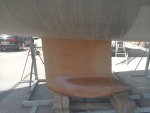
Painting GRP below waterline?

Sailfish156

New Member
Joined
21 May 2015
Messages
7
Visit site
Hi, Have just finished painting the deck and deckhead moulding with Toplac and am pleased with the overall result. I now need to paint the GRP hull itself, including the centreboard. I am looking for something gloss and durable but so far most paints I would have expected to be OK carry a warning 'do not use below waterline'.

Emailed International for their suggestions and so far no reply !

My Boat will spend more time out of the water than in but may be immersed for a few weeks at a time. My plan was to paint and jet wash on returning to its trailer rather than anti foul as most of these don't like being out of the water for long times.

So most topside paints do not like immersion and anti foul doesn't like being out of the water........ Surely someone has a durable gloss paint for use below the waterline? Any suggestions would be welcome.

Thanks

Phil - Sailfish 156
 
It sounds like you are after a purely cosmetic finish. Even so I would use a hard antifouling. It gives a reasonable cosmetic look, doesn't mind being lightly scrubbed and, so far as I am aware, doesn't suffer from being out of the water.
 
For the keel - it's steel isn't it ? - there's nothing to touch Dulux Metalshield.

I have tried every treatment going on my galvanised steel lift keel, and Metalshield gives results way, way better than anything else; the boat is afloat 7 months then ashore on high trestles for access to the keel.

Metalshield is one part, but requires the Metalshield Primer, also one part; I get mine from Brewers Paints - gloss white or silver.

By the way, has your Sailfish been modified in the keel area to prevent the keel dropping out ? I once met someone this had happened to and he was continuing on his family cruise !

I understand there is a modification, if there's a class association they'll have details.
 
I'm surprised International haven't responded. When I've asked questions in the past I've got a pretty rapid response from the Technical Manager in Felling. Maybe he's on holiday.

Beware that a lot of paints will blister if immersed long-term. I've even heard that said about AwlGrip by knowledgeable sources, so I'd really recommend getting confirmation from the manufacturer before commiting to any plan.
 
I asked the same question a while back about the bottom of my Hunter 490. As I recall, the only gloss paint I could find which was suitable for underwater use was something by Jotun, and only available by the barrel. In the end I used Trilux, as I had 2/3 of a 2.5 litre can left and, to my surprise, it was still perfectly usable after five years sitting in my workshop.
 
I have tried every treatment going on my galvanised steel lift keel, and Metalshield gives results way, way better than anything else; the boat is afloat 7 months then ashore on high trestles for access to the keel.

I've had good results with ordinary auto etch primer. I originally just used it for the lead part of the keel, but when the expensive Nautix stuff came off the iron part of the keel in patches when the yard was pressure washing the boat and I didn't have much spare time to treat it, I used etch primer for the repairs and it's still going strong after three years.
 
Yes they call it something else now don't they ?

I've tried all the steel treatments - with suitable preparation - but the only one as good at lift out as when launched is Metalshield; my keel gives stuff a particularly hard time as it scrapes in quite a close fitting slot going up & down.
 
Wading into this one again…did anyone make any progress? Looking at painting a
-steel keel
-fibreglass bottom

Seajet’s persistence with Metalshield can’t be understated, so that’s the keel sorted.

How silly is it to think that there must be some paint out there that is suitable for the bottom of a fibreglass boat which isn’t designed to leach a significant amount of chemicals into the water?

Much appreciate anyone’s thoughts!
 
Wading into this one again…did anyone make any progress? Looking at painting a
-steel keel
-fibreglass bottom

Seajet’s persistence with Metalshield can’t be understated, so that’s the keel sorted.

How silly is it to think that there must be some paint out there that is suitable for the bottom of a fibreglass boat which isn’t designed to leach a significant amount of chemicals into the water?

Much appreciate anyone’s thoughts!

Welcome to the forums!

Rather than resurrect a 6 year old thread, it would have been better to start a new one with your question. However, what's wrong with using antifoul? Is there no fouling where you operate your boat?
 
How silly is it to think that there must be some paint out there that is suitable for the bottom of a fibreglass boat which isn’t designed to leach a significant amount of chemicals into the water?

Yes, Coppercoat is as close as you will get. Epoxy your steel keel properly (after blasting) as well and Coppercoat that. Then forget about the bottom of the boat except for washing it for a few years
 
Am I missing something here; surely the recommendation not to use below the waterline is for single pack paints. Why not use a two pack top coat or primer...................and then if you want use A/F.
 
Dry sailed my albin vega,about a moth in the water a year,had a very old hard racing antifoul,just jet washed it on the hard after time in water over,very little growth
 
Welcome to the forums!

Rather than resurrect a 6 year old thread, it would have been better to start a new one with your question. However, what's wrong with using antifoul? Is there no fouling where you operate your boat?
Very quick replies thanks everyone. Sorry I thought as I’d searched the subject it would make more sense to continue the thread, although I can imagine that it may make things more complicated. I’ll take note of the recommendation for future posts!
There’s nothing wrong with using the antifouling, it’s just I was wondering if there was anything else, or what people might have tried. For the steel keel, Seajet’s recommendation of dulux Metalshield sounds quite compelling, and from what I understand, that is not an antifouling type coating. If I had a steel boat I would consider using Metalshield on the whole hull.
I’m sure coppercoat will also have some fans…from what I hear the application can be quite tricky?
Anyway many thanks for your replies so far; much faster than I had anticipated!
 
Very quick replies thanks everyone. Sorry I thought as I’d searched the subject it would make more sense to continue the thread, although I can imagine that it may make things more complicated. I’ll take note of the recommendation for future posts!
There’s nothing wrong with using the antifouling, it’s just I was wondering if there was anything else, or what people might have tried. For the steel keel, Seajet’s recommendation of dulux Metalshield sounds quite compelling, and from what I understand, that is not an antifouling type coating. If I had a steel boat I would consider using Metalshield on the whole hull.
I’m sure coppercoat will also have some fans…from what I hear the application can be quite tricky?
Anyway many thanks for your replies so far; much faster than I had anticipated!

But you haven't said where the boat is used. Is it in fresh water? Or salt water? Or dry-stacked?
 
Very quick replies thanks everyone. Sorry I thought as I’d searched the subject it would make more sense to continue the thread, although I can imagine that it may make things more complicated. I’ll take note of the recommendation for future posts!
There’s nothing wrong with using the antifouling, it’s just I was wondering if there was anything else, or what people might have tried. For the steel keel, Seajet’s recommendation of dulux Metalshield sounds quite compelling, and from what I understand, that is not an antifouling type coating. If I had a steel boat I would consider using Metalshield on the whole hull.
I’m sure coppercoat will also have some fans…from what I hear the application can be quite tricky?
Anyway many thanks for your replies so far; much faster than I had anticipated!
While Andy often had many useful things to say, he was rather stuck in the 1970s (Anderson 22, Harrier jump jets, Carter 30, 35mm camera etc).

If you want to protect your steel keel then have it grit blasted and coated with something like Hempadur, and use Coppercoat on both the keel and the GRP hull. Coppercoat is not difficult to apply in the right conditions, with the right preparation and following the instructions. Most problems are related to cast iron keels which are difficult to prepare and epoxy, but steel is easier. Photo of the iron keel on my boat after blasting epoxy and Coppercoat. Did it myself apart from the blasting and first (of 5) coat of epoxy. Hull was done professionally 5 years earlier when boat was new.
 

Attachments

  • IMG_20200623_150038.jpg
    IMG_20200623_150038.jpg
    650.9 KB · Views: 9
Dry sailed my albin vega,about a moth in the water a year,had a very old hard racing antifoul,just jet washed it on the hard after time in water over,very little growth
While Andy often had many useful things to say, he was rather stuck in the 1970s (Anderson 22, Harrier jump jets, Carter 30, 35mm camera etc).

If you want to protect your steel keel then have it grit blasted and coated with something like Hempadur, and use Coppercoat on both the keel and the GRP hull. Coppercoat is not difficult to apply in the right conditions, with the right preparation and following the instructions. Most problems are related to cast iron keels which are difficult to prepare and epoxy, but steel is easier. Photo of the iron keel on my boat after blasting epoxy and Coppercoat. Did it myself apart from the blasting and first (of 5) coat of epoxy. Hull was done professionally 5 years earlier when boat was new.

All very helpful. It’s not that I didn’t want to antifoul per se, just that I was wondering if there were any new alternatives that I hadn’t heard of. Last time I looked into it I came across copper coat and found many stories of people struggling with the application…now it seams perhaps that as more people have more experience using it a lot of these troubles have been sorted out somewhat, as I’ve now found several guides online with very specific “how to” instructions.
Much appreciate all the replies
 
All very helpful. It’s not that I didn’t want to antifoul per se, just that I was wondering if there were any new alternatives that I hadn’t heard of. Last time I looked into it I came across copper coat and found many stories of people struggling with the application…now it seams perhaps that as more people have more experience using it a lot of these troubles have been sorted out somewhat, as I’ve now found several guides online with very specific “how to” instructions.
Much appreciate all the replies
There are several new alternatives, but none that are appropriate to a leisure craft that spends more time stationary than moving. Foul release coatings that basically don't allow organisms to adhere to a surface work for vessels that move almost constantly at speeds over 8 knots are a good thing for commercial vessels (though I have heard that the cost and difficulty of application make them marginal commercially). There are other concepts on the horizon, but the problem is that short of broad spectrum poisons - by which I mean the copper that is the active ingredient of the common antifoul - getting something that works on one kind of fouling doesn't work on another; fouling organisms are remarkably diverse, being from both the animal and plant kingdoms, and many different phyla within those kingdoms.
 
Top