Paint It Black

In case others are reading this thread and are wondering what the original question was, it was to do with painting a small Bawley Yacht black, from its current colour of Fawn. The yacht, Storm, owned twice by Maurice Griffiths, and well documented in his books, was recently sold from the family where it had been owned for over four decades.

My reply to the current custodian is above in this thread. It is unfortunate that it has been interpreted as 'abuse', when it is simply an educated and passionate reply based upon knowledge of that particular boat and nearly thirty years in the trade of wooden boat care and restoration.
Abuse it was not.

Nick Gates.
 
In case others are reading this thread and are wondering what the original question was, it was to do with painting a small Bawley Yacht black, from its current colour of Fawn. The yacht, Storm, owned twice by Maurice Griffiths, and well documented in his books, was recently sold from the family where it had been owned for over four decades.

My reply to the current custodian is above in this thread. It is unfortunate that it has been interpreted as 'abuse', when it is simply an educated and passionate reply based upon knowledge of that particular boat and nearly thirty years in the trade of wooden boat care and restoration.
Abuse it was not.

Nick Gates.

Humm, well I have followed this tread with great interest, right from the start, as its a little 'bug' in my brain that has showed great interest on the choice of hull colour in commercial, or to be more accurate ex commercial vessels made from timber, since the early 50s.

I would comment thus on the poss differences shown between, shall we say 'professional boaters' and 'social boaters', the former focus in on 'practicality' of colour, its a shield to protect the timber from the elements, and with the later is probably a colour to 'look right' for the period or a personal preference choice of colour.

Never quite sure that the two will agree on a choice of colour for the hull topsides, and the latters choice will possibly make a lot of business for the former, if so engaged in vessel maintenance, for quite some time.

Slight thread drift, (please if I may), what is the pro experience of timber vessels topsides painted a 'light blue' in regard to timber protection in particular sunlight, as it used to be quite a popular colour in West Country fishing vessels?

Oh, 'seconds out' :)
 
Going back a bit, Mick (ex of Wooden Ships) arrived in Vilamoura with his 1939 36' Cutter, a really nice boat. But she was black and pretty soon the topsides opened up and you could see through the gaps. Trying to get into the Guardiana on a falling tide without the engine, he ran aground and she laid over and filled. He had no insurance and had to sell her for peanuts to a local guy. Really sad.
DW
 
Down in Portsmouth there is a fleet of clinker dayboats, all painted black apart from the GRP ones which are black gelcoat.
Victory Class.
Many of them have survived being painted black for well over 70 years.

There is another offshoot fleet in Gibraltar, those boats are painted lighter colours.
 
Down in Portsmouth there is a fleet of clinker dayboats, all painted black apart from the GRP ones which are black gelcoat.
Victory Class.
Many of them have survived being painted black for well over 70 years.

There is another offshoot fleet in Gibraltar, those boats are painted lighter colours.

Humm well, yes you appear to be correct about the 'Victory' class racing yachts /boats being traditionally coloured Black, but investigation shows that they are indeed built by way of 'clinker' construction so with overlapping planks there is usually no 'caulking' to show when plank seams dry out, as the planking overlap always prevents water coming aboard. Perhaps why in lighter build craft 'clinker' type construction is oft preferred.
The craft referred to in earlier reports of 'drying out' due (in part) to being painted black in colour are, I understand, all are built in 'carvel' construction, which when (if) topsides dry out the seams open up and 'caulking' materials show through and filler might fall out (or get dislodged) so 'taking in' of water happens.
Research shows that some of the timber built 'Victory' class yachts /boats do have GRP or similar cladding in places :(
 
http://bursledonblog.blogspot.co.uk/2013/03/tar-baby.html

Is worth looking at (classic pre war carvel yacht painted black) or Google "Tar Baby yacht" for an interesting read/photo's.

Storm has been stripped to bare wood from gunwhales down, primed, and as we speak planks are being replaced and caulking done.

Sailmaker been to quote for overall cover with sacrificial natural canvas sides to hang down into the water.
 
The victories do tend to leak to varying degrees, even kept out of the sun in the off season, and moored out of the sun.
I think that would be the same with any boat of the age and way of life.
I don't think you'd get much support for the 'clinker is superior' line of thought TBH. Slightly different problems from carvel, but problems all the same.
Some of them are in very good nick, the black paint does not seem to do too much harm on a swinging mooring in the UK.
I've heard it's a different story if you are going to spend 3 days on one tack in the sunshine.
 
In case others are reading this thread and are wondering what the original question was, it was to do with painting a small Bawley Yacht black, from its current colour of Fawn. The yacht, Storm, owned twice by Maurice Griffiths, and well documented in his books, was recently sold from the family where it had been owned for over four decades.

My reply to the current custodian is above in this thread. It is unfortunate that it has been interpreted as 'abuse', when it is simply an educated and passionate reply based upon knowledge of that particular boat and nearly thirty years in the trade of wooden boat care and restoration.
Abuse it was not.

Nick Gates.

Personally, I did not 'view' your comments as abusive, a 'tad' firm and 'too the point', but I recognised the sincerity of experience in them, along with the 'blood sweat and tears' that the experience came from.
 
Great thread , as I toy with British racing green or black for my topsides . Any advice on potential trouble black may cause on a cold moulded hull, could it really heat the glues between the laminates so much so cause problem maybe ?
 
Great thread , as I toy with British racing green or black for my topsides . Any advice on potential trouble black may cause on a cold moulded hull, could it really heat the glues between the laminates so much so cause problem maybe ?
Ihad a cold mounded hull a Commando class designedbyA Primrose……..black did it no harm and it looked very smart!
 
I noticed a definite temperature difference to the touch on the inside of a GRP hull. The white gel coat area was cool but inside the dark copper boot top was definitely warm when in the sun - and that was at 59 N.
Dark grey deck paint on my steel boat was taken off after one summer in west Norway, it got too hot to walk on with bare feet in the sun.
 
Last edited:
Great thread , as I toy with British racing green or black for my topsides . Any advice on potential trouble black may cause on a cold moulded hull, could it really heat the glues between the laminates so much so cause problem maybe ?
Devlin, in the US, a designer of stitch and tape boats up to quite large sizes, like 40ft, remarked that dark colours, esp black tend to 'print' through the weave of the sheathing glass and pox.
On your topside I would really think about a pale colour, esp as you are concerned about gaps.
I sailed a cold moulded 36ft in dark blue, it def required more work than a lighter colour. Black is quite a lot worse on this than other dark colours.

NB, Shame that Nick Gates left here a while back.
 
Great thread , as I toy with British racing green or black for my topsides . Any advice on potential trouble black may cause on a cold moulded hull, could it really heat the glues between the laminates so much so cause problem maybe ?

Yes, i remember a brand new cold molded yacht at the wooden boat show years ago, very well built & a beautiful britannia blue paint job. After a day in the sun the filler used in all the staple holes had swollen or "popped" & she looked awful. Apologies to the builder for reminding him if he ever reads this!
As most cold moulded boats are laminated with epoxy its worth noting that epoxy softens & loses strength rapidly from 160 degrees c, Though it may not get hot enough to cause damage initially long term it wont do the laminate very good, Probably more of a problem on Foam sandwich hulls where outgassing of the core could cause delamination.
 
The most efficient colour for solar heating panels is mat black. Once your shinny black topside gets a bit dull you will also have mat black . . . .
Solar panels are effective for heating water in Shetland, between 60 N and 61 N and I am told can reach temps of over 100C if water not circulating.
Likewise BRG won't be all that far behind black for solar absorption, certainly my dark green vehicle gets uncomfortably hot when standing in the sun.
 
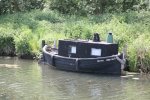
Storm about to launch.jpg

Storm just needs bowsprit putting on and ready to launch on Thursday. So far hasn't fallen apart by painting black. Was in a tent to have the whaleplanks (ie top/sheerplanks) replaced this winter.
 
Black is a no no is it?
Glad I never bought a Thames barge then.
Close shave that one. :rolleyes:
Well, this thread is about experience of black hulls, with different coatings.
People with experience would suggest a light colour, as it reduces the upkeep. If Storm remains on the East coast with the usual lack of sun and has the 'skirts' to protect the hull from the UV, fine and a personal choice.
Being old enough to remember the working Thames barges at Maldon, they were as rough as old boots, so completely different.
 
Well, this thread is about experience of black hulls, with different coatings.
People with experience would suggest a light colour, as it reduces the upkeep. If Storm remains on the East coast with the usual lack of sun and has the 'skirts' to protect the hull from the UV, fine and a personal choice.
Being old enough to remember the working Thames barges at Maldon, they were as rough as old boots, so completely different.
Well the subject was about black on wood & tar was mentioned. I do not know how a Thames barge is coated, but as the wife drove me along Downes road in Maldon ( albeit at great speed) this afternoon I thought that they ( I think about 4 or 5 of them not sure) looked very smart. Certainly not "rough as old boots" as one might suggest.
 
Top