
P Bracket, Welding Bronze Alloy

Besonders

Well-Known Member
Joined
1 Dec 2012
Messages
103
Location
Med for the summer, Caribbean for the winter
Visit site
Following lift out, I discovered a horizontal crack extending the full width of the P Bracket about halfway between the hull and the cutless bearing. A Picture is attached
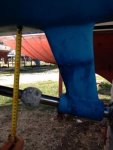
P Bracket showing crack.jpg
I applied moderate lateral force to the bracket and there was some water seepage. I do not know the exact composition of the bracket except it appears some form of bronze alloy.
I do not know the cause of the cracking but think some moderate vibration caused by worn engine mountings and a misaligned prop shaft have certainly contributed. ( All items to be fixed whilst out of the water at this time)
a friend of mine who was a metallurgist in a previous life has suggested this cracking could possibly be repaired by brazing or welding, certainly a far cheaper and less messy job than complete removal and replacement. My question is do any forumites have knowledge and experience of this they can share. The boat is currently on the hard at Preveza Greece and any information regarding a local specialist welder would be appreciated
Regards
 
If Admiralty bronze, a V-cutback and brazing should work. No one in the Materials Dept @ the school of Engg here would commit themselves without knowing the precise alloy.
Pat would probably do it, or find someone who can, can't remember his surname but he's a pretty competent all-rounder.
 
If Admiralty bronze, a V-cutback and brazing should work. No one in the Materials Dept @ the school of Engg here would commit themselves without knowing the precise alloy.
Pat would probably do it, or find someone who can, can't remember his surname but he's a pretty competent all-rounder.

Charles,
M Many thanks for the informative reply. pm sent
Craig
 
P-brackets are usually made from manganese bronze, basically a brass with small additions of manganese and maybe more. It is perfectly possible to braze repair it. Problems arise later because it will be impossible to match the composition perfectly and there will be some galvanic couple once immersed. I doubt that this will be very serious and a decent coat of primer plus paint should delay any corrosion. I find that Hammerite non-ferrous primer adheres well to my P-bracket and propeller.
 
If Admiralty bronze, a V-cutback and brazing should work. No one in the Materials Dept @ the school of Engg here would commit themselves without knowing the precise alloy.
Pat would probably do it, or find someone who can, can't remember his surname but he's a pretty competent all-rounder.

Surely you mean Bronze welding. Brazing is a capillary filling method-fixing lugs onto tubes.

I have experience of bronze welding using Oxy-Acetylene, but nothing that large.
I suspect the P bracket would require removing so the defect could be placed in a horizontal position. I looks to be very substantial and would also require pre-heating before the final welding.

It is, however, very possible that modern electric welding methods could handle it with the correct filler wire or rods.

Otherwise, as it drills and takes threads well, it could be drilled and tapped and a reinforcing plate made to bridge the gap.

Good luck.
 
Are you sure it is bronze all the way to the hull? it could be a P bracket on a GRP skeg, just that I've seen a few bent P brackets and cracks at the flange but never cracks across the middle and it looks almost too straight in a casting I'd expect to see a rougher crack. It could just be the photo. Just double check the alignment of the bearing carrier after it's fixed, it may not be straight.
 
Perhaps its just the way its made. Think I would agree with Neil_Y. If its cracked at that point why did it not just fall off. Is it the line they come down to with the fiberglass. Think you may need to do some research. Best bet would be the manufacturer. Send a picture and see what they suggest. Might be something really simple like the filler only goes this far. You could also ask them what its made of and how its made or get a sample and get it analyzed.

You will probably be better phoning them and explaining the problem. Be prepared for the never seen that before response ......
 
Are you sure it is bronze all the way to the hull? it could be a P bracket on a GRP skeg, just that I've seen a few bent P brackets and cracks at the flange but never cracks across the middle and it looks almost too straight in a casting I'd expect to see a rougher crack. It could just be the photo. Just double check the alignment of the bearing carrier after it's fixed, it may not be straight.
Guys,
Thanks for all your replies, with some novel ideas for solutions. Neil, you raise a valid observation in your reply, I guess I need to do some further investigations, then decide the best cure.
I will post further with developments in relation to this.
Craig
 
Neil, having thought about your comment that the bearing carrier may be misaligned, I think this is unlikely. Boat is now 20yrs old. I am second owner and have all previous work and repair receipts. Nothing regarding P Bracket and I assume this would have materialised before now, if it was misaligned
 
Methinks it might be time for a risk assessment.

What happens if that P bracket fails in service. Shaft is going to be whipping around like crazy and will most likely cause all sorts of damage resulting in fairly large leaks and water ingress.

If it is a one piece bronze P bracket I would want to be VERY confident in the welder who fixed it. Especially if he did it in situ. If he wants it removed then why not just fit a new P bracket and motor around with confidence.

If it were mine I would fit new and b*****r the cost.
 
Methinks it might be time for a risk assessment.

What happens if that P bracket fails in service. Shaft is going to be whipping around like crazy and will most likely cause all sorts of damage resulting in fairly large leaks and water ingress.

If it is a one piece bronze P bracket I would want to be VERY confident in the welder who fixed it. Especially if he did it in situ. If he wants it removed then why not just fit a new P bracket and motor around with confidence.

If it were mine I would fit new and b*****r the cost.

TQA,
All the above are fair comments, risk assessment well in hand, however, investigations first then potential solutions. I have already sourced a supplier of replacement P Brackets and spoken with them. If I have to remove the old one then if I send it to them they will attempt to make me a replacement for about £350. So far there are a lot of if's.
It may be as others have suggested that this could be welded and strengthened by supports without all the hassle of complete removal.
I keep all my options open at this time with the exception of doing nothing.
 
Many years ago I had a P bracket "welded" by a specialist co in the UK, they said no problem with doing the the job, it let go first time out, it was clear that the "weld" had no penetration, probably because they had not heated the item prior to welding.

I would second the recommendation to renew if possible.
 
See my previous post.............................

Pre-heating something of that mass would be essential.
Modern non Oxy-Acetylene welding may well cause distortion.

Replacement is obviously the best option, but not a job for the faint hearted.
 
I'm in the remove it and investigate group on that.
A weld/braze repair in situ will only tickle the surface and will certainly lead to another failure. Plus a repair without preheating may well cause cracking in itself as the localised heating cools.
If you have a price like that for a new item that has got to be better than a repair. Especially as both approaches will involve quite a bit of spanner work.
 
Neil, having thought about your comment that the bearing carrier may be misaligned, I think this is unlikely. Boat is now 20yrs old. I am second owner and have all previous work and repair receipts. Nothing regarding P Bracket and I assume this would have materialised before now, if it was misaligned

You'd be surprised, it does happen that builders get it wrong and it won't do anything that dramatic. Despite the checking of engine alignment to shaft the shaft bearings alignment are rarely checked. Good luck with the investigation, I'd be looking at a new P bracket, too many variables in expecting the end result to be straight, which would then mean re fitting it after welding.
 
I faced a similar situation earlier this year following a severely fouled prop. A heavy ground chain was pulled in to the spinning prop, damaging the bracket and my bank account!

Mine too was a bronze casting. It is known that the grade of bronze used on Trident 24's is unusual and can not be matched. No one was willing to attempt a repair, and I was not happy anyway with such an essential component.

Bronze being fairly malleable can easily distort as mine did, so that any attempt to realign it would have been extremely difficult anyway.

I concluded repair was not an option even though the alternative made a much bigger job than repairs would.

How is the bracket fastened to the hull? Generally they go through the hull and are glassed in to place. Mine was bolted on, which made removal much easier.

I then had the choice of replacing it with a stock item from Lancing Marine who can supply ready made brackets for around £275 for a 25mm shaft. T S Norris stock a similar line. these need to be glassed in, which makes alignment straightforward, but involves quite a lot of time and work. However I found a stainless steel welder who was willing to use the damaged bracket as a pattern, and who did a very nice job of making a new one to pattern. This cost much the same, but of course fitting was less than hours work, unlike glassing which would probably take a day or more.
 
Whether it is repaired or replaced it will need to come off the boat first. There is a page on replacing mine, not a bolted-on one, on my website under Stern gear, which should give you some idea of what is involved.
 
Top