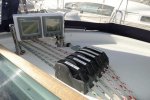
Overhatch / Deck Mount Instrument Pod

Nina Lucia

Well-Known Member
Joined
17 Jul 2005
Messages
880
Visit site
Does any one make or sell Overhatch/Deck Mount Instrument Pod that can suit our Vancouver 27?

I think it will be much better and more protected underthe sprayhood than in cockpit. Any way someone always lean on then and restets anchor dept, takes me ages to switch all accidentaly switchet on allarms

And I really think it will look good!
Might even sail faster?!
 
It will be under the sprayhood and we have a stuckpack for main, so it wouldnt be on the way...
Good point, though
Thanks
 
Does any one make or sell Overhatch/Deck Mount Instrument Pod that can suit our Vancouver 27?

I think it will be much better and more protected underthe sprayhood than in cockpit.

I've been looking at this to re-locate the instruments on my boat. Just about decided that I could knock up a stainlees steel frame using tube and fittings from these people https://www.seascrew.com/browse.cfm?BOAT-HANDRAIL-TUBING---TUBE-FITTINGS-IN-STAINLESS-STEEL-AISI-316&l=0000000031 - I made an antenna mast from their kit last year! And if you make the frame to the right dimensions you should be able to mount a standard pod on it such as supplied by these people http://www.interform-marine.co.uk/marinepod-collection/. The problem that I came up against is that if it is high enough and far enough forward to keep the companionway clear then it obstructs the lowering of the sprayhood. So I'm now looking for somewhere else to mount the instruments.
 
Yes, just normal instruments, like log, depth soundrer and wind...


There is a flat section of the sliding hatch cover that takes instruments. You have to route the transducer cables and power to them via the headlining. Better still have a master instrument at the chart table and then just run one data and power cable daisy chaining the instruments. That is how I did it on mine and all others I have seen have done it.
 
Chart ploter is fitted on the small tv bracket that we pull in and out of the cabin, that is next thing that needs improvement
 
Sorry no it's quite a time ago don't even think I had a digital camera then, but the arrangement is very standard and typical of many yachts. FWIW my instruments at the time were Raymarine ST50s, the trick is routing the cables and as I said having a master instrument at the chart table then makes it much easier. If I were to locate a plotter outside I would embed it into the cockpit side by the helm.
 
Don't know if these snaps help.

I considered using stainless, like DJEs idea but in the end decided it would be easier to work in wood:

View attachment 61823View attachment 61824

There is enough room for the detachable plotter which is kept below when not in use. The other thing is an echo sounder. It works very well, the small plotter is just where a long sighted old bloke can see it.
The tricky bit is getting hold of suitable c20mm teak.
 
This was our solution. We used a NASA instrument pod. you could mount two or more next to each other. If you have Raymarine instruments, you will need to file the opening a little to get them to fit, but it was not too difficult. We only needed to bring one SeaTalk cable up from below to both power and provide the data. The cable was routed above the headlining and came through a waterproof gland.

Click to enlarge...

Nasa Pods.jpg

NASA Pods here

http://www.nasamarine.com/product/clipper-pod/
 
Don't know if these snaps help.

I considered using stainless, like DJEs idea but in the end decided it would be easier to work in wood:

View attachment 61823View attachment 61824

There is enough room for the detachable plotter which is kept below when not in use. The other thing is an echo sounder. It works very well, the small plotter is just where a long sighted old bloke can see it.
The tricky bit is getting hold of suitable c20mm teak.

Very neatly done, looks great! Lovely
That's the thing I was thinking about, now I have to involvle my crew that is more cabinet maker minded, or find one in plastic or grp....
Thanks so much for great photographs
 
This was our solution. We used a NASA instrument pod. you could mount two or more next to each other. If you have Raymarine instruments, you will need to file the opening a little to get them to fit, but it was not too difficult. We only needed to bring one SeaTalk cable up from below to both power and provide the data. The cable was routed above the headlining and came through a waterproof gland.

Click to enlarge...

View attachment 61826

NASA Pods here

http://www.nasamarine.com/product/clipper-pod/

That's one of the options, Thanks for the great idea and photographs
 
Very neatly done, looks great! Lovely
That's the thing I was thinking about, now I have to involvle my crew that is more cabinet maker minded, or find one in plastic or grp....
Thanks so much for great photographs

What year is your V27 surely it already has a hatch garage with exactly what is in the picture in GRP!
 
now I have to involvle my crew that is more cabinet maker minded, or find one in plastic or grp....

If none of the off-the-shelf pods suit you, you could also make one in GRP.

I don't have a good photo of just the pods, but in this view of the overall cockpit the panel above the hatch is original and the ones each side with the plotter etc were home-made:

IMG_0264_zpsd6xctet7.jpg


I did take some pictures of the early stages of making them:

Clay plugs being shaped:

IMG_0431_zps2n3w9awd.jpg


High-build primer for a smooth impermeable surface sanded to remove small lumps and undulations:

IMG_0435_zpsxzp8hvc2.jpg


Blue PVA release agent:

IMG_0436_zpscxzuycit.jpg


Gelcoat for the inner surface of the mould:

IMG_0437_zpsps5qwnaz.jpg


Completed moulds (mat and resin over the green gelcoat, plus a couple of simple hardboard struts to hold the shape), being waxed:

IMG_0441_zpsw8shhhdp.jpg


At this point I forgot to take any more pics, but the remaining steps were to paint gelcoat inside the mould, apply glass tissue before it fully set, then mat and resin well rollered down. I then trimmed off the slightly ragged bottom edge of the pod to match the shape of the deck, stuck in a fillet of resin and chopped strands to make a sort of internal flange around the bottom, and once that had set glued it down with sikaflex.

The pods have worked well for the last few years. Some time in the not too distant future we're thinking of replacing the plotter/radar, at which point I'll lay up a replacement pod in the same mould, should only take a couple of hours.

Pete
 
Top