Outboard prop 'tubes' or 'tunnels' to reduce cavitation

whipper_snapper

Well-Known Member
Joined
9 Aug 2006
Messages
6,487
Location
Kenya
Visit site
Our 9.9 Yamaha high thrust drives the boat well in a flat calm, but in a chop it repeatedly surges and cavitates as it pulls air from the surface. It is as deep as we can reasonably get it but the pitching of the boat lifts it. The prop rarely actually breaks the surface but it gets close enough to loose all drive.

Someone suggested that planing fins would help by reducing the tendency to draw air down. I also saw this tunnel device that would surround the prop and may be more effective.

Does anyone have any comments or alternative suggestions? Do you think it will help ?


Thanks
 
Last edited:
Prop guards will not stop cavitation (or ventilation). In fact in some cases it will make things worse. We ended up taking them off our dive ribs as it was felt that they harmed performance.

Not sure about fins, they might improve the ride, thus improving prop performance.
 
Prop guards will not stop cavitation (or ventilation). In fact in some cases it will make things worse. We ended up taking them off our dive ribs as it was felt that they harmed performance.

Not sure about fins, they might improve the ride, thus improving prop performance.

I think jokerboat is probably right.

The best solution is probably a deeper propeller, but most manufacturers do not seem to advertise ultra long shaft outboards except Tohatsu.

My experience with small boats at sea is that long shaft outboards mounted on the transom are just not long enough in big waves!
 
Our 9.9 Yamaha high thrust drives the boat well in a flat calm, but in a chop it repeatedly surges and cavitates as it pulls air from the surface. It is as deep as we can reasonably get it but the pitching of the boat lifts it. The prop rarely actually breaks the surface but it gets close enough to loose all drive.

Someone suggested that planing fins would help by reducing the tendency to draw air down. I also saw this tunnel device that would surround the prop and may be more effective.

Does anyone have any comments or alternative suggestions? Do you think it will help ?


Thanks

I had this problem when I had a standard (15") shaft length outboard. Totally useless in a chop!

When I replaced it I did so with an Evinrude Yachtwin.

This has a long shaft (20") but has exhaust outlets higher than the ordinary long shaft engine. These enable the engine to be mounted with the prop lower without increasing the back pressure on the exhaust. The bracket remains at the same height as it was for the standard shaft engine. It also improves reverse thrust because the gases are not drawn in the prop when going astern.
In addition it has a low pitch prop with a large blade area to make it suitable for a displacement hull.

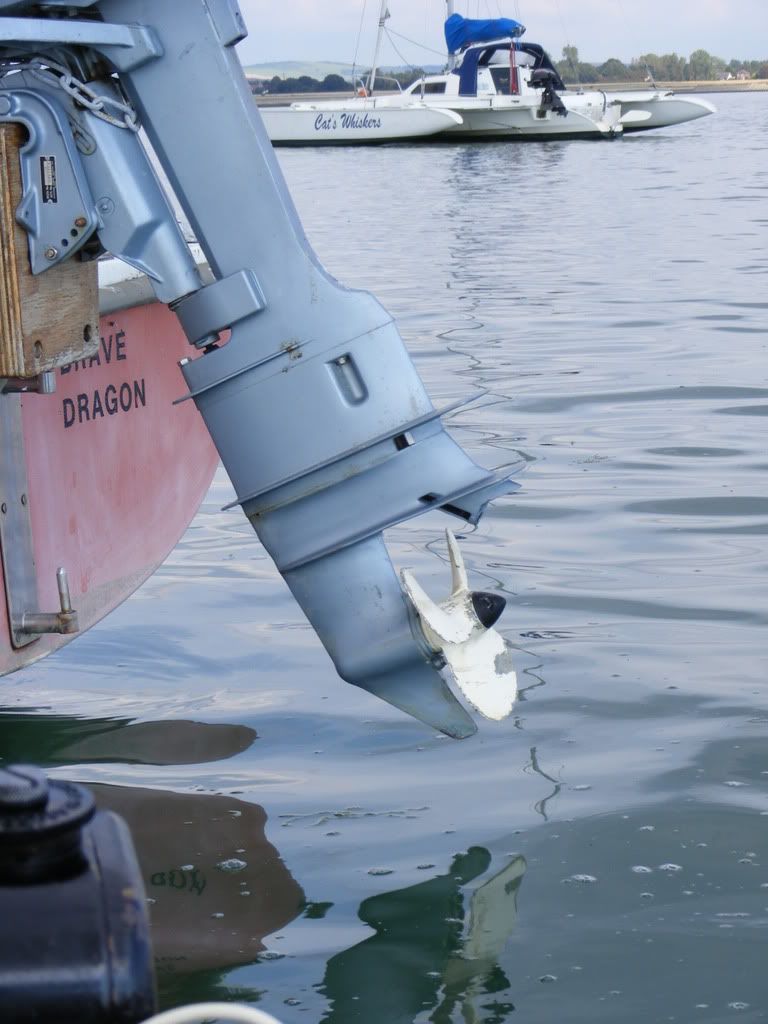
Picture below shows the exhaust outlets ... the square holes below the upper AV plate. The "standard" outlet behind the prop is in fact blanked off

Id suggest these are the features you should be looking in an outboard for a small sailing boat.

Mine is a 6hp engine. The equivalent 8 hp and 9.9 hp engines had extra long shafts (25") but one would have mounted them as though they were 20" shafts

 
I chatted with the vendors at SOuthampton IBS, particularly about the end-plate effect. Whilst they would not commit themselves, they agreed that in theory there should be more thrust as

a) induction is in line with the thrust axis, and water is not brought down from above

b) thrust is directed - for a couple of inches at least - to achieve more reaction, and water is not thrown vertically towards the surface in the line of least resistance


I suppose to be really effective you should have a ducted fan, as on jet engines.


The device seemed a very simple one, within the skill range of a competent blacksmith, sorry, local metal worker. ;)
 
Top