Osmosis Blisters and Epoxy Filling

Eero Gaffney

New Member
Joined
23 Jun 2021
Messages
6
Visit site
The past few days I have taken my polyester boat (from the 70s) out of the water and started prepping it for primer and antifouling. We first scraped away all of the lose layers of paint with triangle scrapers and then sanded down the rest with 80 and 60 grit. Initially I had noticed 2 of 3 osmosis Blisters around the size of a penny. Yesterday though after further sanding I found many more small ones (around 50) pushing up through the gel coat. I think foolishly I decided to start popping them thinking I'd fill them in with epoxy. I realize now that this does not address the root of the problem which is a general osmosis of the polyester. Since popping them I've dug around them expanding the area exposed to allow for better drying out. I did this mostly where the gel coat came off easily and showed wetness underneath. Others which seemed better adhered to the polyester I left relatively small. I did not on any places dig into the layers of polyester themselves as they all seemed dry within an hour or two. I then (again foolishly) started sanding the polyester and edges before cleaning them. I then bought some fiberglass prep cleaner and wiped the popped blisters down. After I re-sanded some more and then gave them another wipe. Some of the colour from previous sanding of the old antifouling and primer coats seems to have seeped in though (as seen in photos). I then gave everything a hose down. My plan is to let the blisters dry out for two days and then prep the surface with acetone and fill with epoxy resin thickened with colloidal silica. I am wondering whether anybody has any advice or suggestions for this process, if it seems like I have prepped properly (I fear not) and ultimately, whether the epoxy will adhere properly to the fiberglass and surrounding gel coat. If not, what can I do to make sure that it does. Thanks a lot for your help!

 

Attachments

  • IMG-20210623-WA0020.jpg
    IMG-20210623-WA0020.jpg
    287.5 KB · Views: 68
  • IMG-20210623-WA0019.jpg
    IMG-20210623-WA0019.jpg
    300.3 KB · Views: 68
  • IMG-20210623-WA0018.jpg
    IMG-20210623-WA0018.jpg
    298.7 KB · Views: 68
  • IMG-20210623-WA0017.jpg
    IMG-20210623-WA0017.jpg
    301.8 KB · Views: 66
  • IMG-20210623-WA0016.jpg
    IMG-20210623-WA0016.jpg
    251.6 KB · Views: 67
  • IMG-20210623-WA0015.jpg
    IMG-20210623-WA0015.jpg
    299.8 KB · Views: 67
I think once popped the area should be flushed with fresh water to encourage the salt to come out. Dry it of course before epoxy. ol'will
I agree with giving it a good fresh water wash down, not just once but quite a few times. But its not really the salt you want to wash out, its the vinegary smelling liquid. Boats kept in fresh water are more prone to osmosis.
 
I will also second the comments above about thoroughly washing the blisters.

My plan is to let the blisters dry out for two days and then prep the surface with acetone and fill with epoxy resin thickened with colloidal silica.

I think it would be worthwhile investing in a moisture meter - apparently even cheap ones for detecting moisture in walls will work (I have never used one of these).
You can calibrate it by measuring the moisture in a known dry area (hull topsides?) and comparing this reading against the readings below the waterline.
There are a large variety available on Amazon -
Amazon.co.uk : moisture meter for walls

And just leaving it for 2 days to 'dry out' is nowhere near long enough if you want to do a 'proper' job.
You need to let the blisters dry out properly, and that takes time.
 
Seems to me you have three choices.

1. If you're doing this as part of a major refit, leave it to dry for a few months, washing regularly with fresh water, then fill. Expect a few more blisters to appear.

2. Go to an "osmosis specialist" and they'll happily quote you several thousand for a gelcoat peel and recoating with epoxy. Expect a few more blisters to appear.

3. Dry out as best you can, with regular washing, fill and go sailing. Expect rather more blisters than with 1 & 2 to appear. Give them the same treatment when it's convenient.

Little blisters like that never sank a boat. If they're the size of a dinner plate, it's another matter, but you're still unlikely to sink. "Osmosis" - it often isn't but that doesn't matter - is a good thing when you're buying a boat, because it allows you to drive the price down, and a bad thing when selling, for the same reason. In between, it's rarely a big deal.
 
Pop blisters ... high pressure fresh water ... dry ... repeat a few times over a few days.

Epoxy fill making sure the epoxy gets into the strands that are likely now showing. Really work it in with stippling brush ... best to fill in stages if the area is deep or large.
Sand back to blend in. Prime and anti-foul.

As Stemar says ... #3.

Boat is 70's and most likely has had this 'pox' for many years and will survive many more ....

My boat is 70's and I have areas of 'micro blisters' .... couple of areas - I have had larger about size of 1p pieces .. popped - flushed - filled with epoxy.
Boat has been with me for more than 20yrs and the 'pox' has not increased much at all .. if any. My boat sits in river water that has a hint of Baltic Sea brackish ... so effectively fresh.
I don't antifoul .. as Baltics is not like UK waters .... so my underhull only has the remnants of the old hard antifoul previous owner used to apply.

The world of Osmosis ... there are those that will say - GET it stripped and sorted .... fine if THEY pay the bill. There are those like me - Stemar who consider how long the boat has probably been like it, age of the boat etc. and enjoy sailing it. There are those who don't give a monkeys and ignore it ...

Who's right ?
 
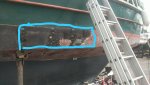
Hello all, I am so grateful for all of your replies. They are much appreciated! Since the post the situation has become slightly more complicated. I have found an area around 1.5 meters wide (the area displayed in the last two photos with the exposed black gel coat) where the hull is flexible. When pushed the hull of that section flexes inwards by a few millimetres. Someone else in the shipyard suggested that it is due to delamination. They suggested this could be caused by osmosis. I am not sure if this cause would make sense considering there does seem to be similar amounts of blisters everywhere around the ship. Why would delamination occur here in such a wide area and not at the other places (I have put pressure everywhere else and not found anything similar). Is it possible that the delamination would be caused by something else like a previous crash? What would you suggest the cause might be? Is there a large risk of the delamination spreading if that section of fiberglass is not removed and replaced?
 
Hello all, I am so grateful for all of your replies. They are much appreciated! Since the post the situation has become slightly more complicated. I have found an area around 1.5 meters wide (the area displayed in the last two photos with the exposed black gel coat) where the hull is flexible. When pushed the hull of that section flexes inwards by a few millimetres. Someone else in the shipyard suggested that it is due to delamination. They suggested this could be caused by osmosis. I am not sure if this cause would make sense considering there does seem to be similar amounts of blisters everywhere around the ship. Why would delamination occur here in such a wide area and not at the other places (I have put pressure everywhere else and not found anything similar). Is it possible that the delamination would be caused by something else like a previous crash? What would you suggest the cause might be? Is there a large risk of the delamination spreading if that section of fiberglass is not removed and replaced?
I expect that the laminate has broken down because of resin starvation when it was originally laid up. GRP lamination in the early days was a very hit and miss affair and it is not uncommon to find dry patches when the mat has not been fully wetted out. Usually the areas are small enough for it not to notice and hidden by the excessive amount of materials used in the layup. One boat from a major UK builder that I was involved with was so bad that when the bottom between the bilge keels was blasted prior to osmosis treatment it disintegrated like cardboard. A whole new centre section was laid up to replace the damage.

Difficult to know what to do with your flexible area. If it is not structural, for example around a bulkhead then it is tempting to just leave it. Opening it up to see what is happening inside the laminate could open up something you would rather not see. As Bajansailor suggested, get a moisture meter to get a better idea of how dry or wet the underwater part is compared with above water.
 
You haven't said what boat it is. They vary a great deal.
I believe it is a self-built boat but I may be wrong. There is the logo Tinker on it but from the googling I did, I couldn't find any history of them making boats so large. It also has somewhat peculiar dimensions (9.75x2.75x1.55) making it quite narrow for its length.
 
Hello all, I am so grateful for all of your replies. They are much appreciated! Since the post the situation has become slightly more complicated. I have found an area around 1.5 meters wide (the area displayed in the last two photos with the exposed black gel coat) where the hull is flexible. When pushed the hull of that section flexes inwards by a few millimetres. Someone else in the shipyard suggested that it is due to delamination. They suggested this could be caused by osmosis. I am not sure if this cause would make sense considering there does seem to be similar amounts of blisters everywhere around the ship. Why would delamination occur here in such a wide area and not at the other places (I have put pressure everywhere else and not found anything similar). Is it possible that the delamination would be caused by something else like a previous crash? What would you suggest the cause might be? Is there a large risk of the delamination spreading if that section of fiberglass is not removed and replaced?

Your photos do nothing to show us actually where on the boat ..

Remember - YOU have picture and info in your mind - all we have is your text and pictures.

We need to know more general detail ... maybe a photo taken from a bit further back so we can see the area in relation to the boat itself ..

OK - OSMOSIS only causes delamination IF the fluid in the blisters continues over a very long period of time is acting. But it will normally be only a very small area and I would not expect 1.5m sq ... that size to me indicates a different matter altogether.

So please : What boat is it ? What year built ? Where has it been mostly used ? Sat on moorings long periods or dry-sailed ? Pictures of boat ... and wider views ...

Info is paramount to be able to suggest ...
 
Your photos do nothing to show us actually where on the boat ..

Remember - YOU have picture and info in your mind - all we have is your text and pictures.

We need to know more general detail ... maybe a photo taken from a bit further back so we can see the area in relation to the boat itself ..

OK - OSMOSIS only causes delamination IF the fluid in the blisters continues over a very long period of time is acting. But it will normally be only a very small area and I would not expect 1.5m sq ... that size to me indicates a different matter altogether.

So please : What boat is it ? What year built ? Where has it been mostly used ? Sat on moorings long periods or dry-sailed ? Pictures of boat ... and wider views ...

Info is paramount to be able to suggest ...
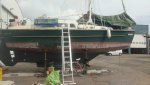
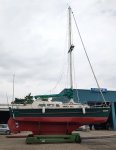
Apologies for not providing photos before. Quite silly of me. Thanks a lot for your response all the same. I hope these help. As for the build of the boat I don't have too much knowledge.
I believe it is a self-built boat but I may be wrong. There is the logo Tinker on it but from the googling I did, I couldn't find any history of them making boats so large. It also has somewhat peculiar dimensions (9.75x2.75x1.55) making it quite narrow for its length.
It was built somewhere in the early 70s in the UK but was sailed to the Netherlands by the late 90s. I expect it was used quite some before that in the North Sea and maybe some since. The past few years it has just sat in moorings though.
 

Attachments

  • IMG-20210626-WA0013.jpg
    IMG-20210626-WA0013.jpg
    140.4 KB · Views: 55
  • IMG-20210626-WA0012.jpg
    IMG-20210626-WA0012.jpg
    165.1 KB · Views: 58
  • IMG-20210623-WA0024.jpg
    IMG-20210623-WA0024.jpg
    170.2 KB · Views: 52
Top