Optimum boat size for the Baltic ?

dunedin

Well-Known Member
Joined
3 Feb 2004
Messages
15,868
Location
Boat (over winters in) the Clyde
Visit site
So what do folks think is the optimum boat size for a couple cruising the Baltic ?

Apologies for a slightly long post – but let me explain context and expand the question (to try to avoid another "how long piece of string" question).

We currently have a boat which seems to us about ideal size for a couple cruising the West Coast of Scotland – 11m (36 feet) long, 2m deep fin keel, 3.6m beam. This is big enough to give confidence in bad weather, fast enough to make quick day passages, yet small enough to fit into smaller harbours / anchorages / moorings. Also SWMBO prefers small and manageable.
However, it is now more than twice the age we bought it and will need some renewals – also lacks things like holding tank that are increasingly important abroad. Hence as we are hoping to do a longer cruise (2-3 months – or multiple seasons?) to the Baltic, we are starting to consider “next boat” options.

Looking at equivalent boats it seems we would need to pay an awful lot of money for an equivalent fast and nice real wood interior boat, as few are now made (think Maxi 1100, Arcona 370 etc) and hence very rare as recent second hand boats.
Similar money would get a 45+ foot Jeaneau etc at 1-2 years old – we don’t need the interior size, and hate the plasticy interiors, but increased LWL may give similar performance for less cash. However, bigger boats don’t tend to fit many visitor moorings, finger pontoons etc (though some big boat bully’s often try).

I had naively assumed (from one brief trip) that the Baltic was a bit like Scotland – either sharp rock or deep water, with not much in between :)
However, reading the excellent ICC/Imray Baltic Pilot, it would appear that
(a) A lot of both sailing areas and harbours are shallow – lots of Danish / German / Swedish waters. Often moorings in 2m, sometimes less
(b) Many places use “box moorings” between poles – with restrictions on beam
(c) Plenty of bridges – many lifting but quite a few with fixed headroom 18m- ish
Not keen on being forced to use the big boat berths, with advance booking etc.

So what do folks who have been there think is optimum size (particularly keel depth and beam) for relaxed cruising in the Baltic for 2 ?

PS Other Baltic boat factors indicated from reading so far
- Mandatory holding tank with pump out facility
- Avoid coloured gel coats – likely to het scuffed in getting in / out of narrow box moorings
- Good rubbing strip (cf Malo) or run a large rope round the outside
- Easy access off the bow – ideally with ladder
- Decent sized genoa (not one of these fashionable 100% ones) so can sail in the narrow channels, where permitted (much easier quickly unfurling / furling genoa, and can’t easily stop in narrow channels with mainsail – been there / done that in big gaffer on the broads!!)
 
I think you've got the gist of it but an enormous variety of boats actually sail there.

My HR34 is fairly average for the area but even we can sometimes find the boxes too narrow.
You are right about rubbing strakes/ropes
Shore facilities are usually plentiful but a holding tank can be useful - especially when it is raining
Bow access is almost essential, and some means of descending to a low pontoon from it often necessary as well
I don't have a large genny but can see that it might help occasionally

We mostly sail around the Soutern Baltic and Rugen area. Although there is much shallow water, the main channels will take a boat with up to 2m draft and there are many large yachts about. Up to 1.8m would be easier

I have sailed with a 45' Island Packet in company and was able to persuade them to accompany us into even the smallest harbours, at least before high season. Even the eastern harbours on beautiful Bornholm were no problem

I have not come across the need to book a mooring. An HR 62 we met was cruising without booking and we saw them at Ystad and Stralsund

I have sailed in the Baltic on a Sadler 29 with 5 on board (bit small) but would think that any boat from about 31' to 40' would be the most suitable, depending on the areas you want to visit.

A typical local boat would be something like a Comfortina or Luffe, with accent on sailing performance but possible a bit lively for comfortable Channel or offshore sailing, but anything from a seaworthy AWB or a scruffy big motor-sailor will be fine.
 
Our sailing has been mainly off the north East German coast and it can get shallow in places. However, I would not change a boat you know and can handle just because of the 2m draft and 3.6m beam. For sure there will be some small harbours which will not be suitable but that is also the case with our 1.5m draft. We are berthed in Ueckermünde and in our box berth 3.6m would be tight but there are many which would be ok. I would suggest doing some research based on the route you want take and the places you want to see. A holding tank is not a must in Germany, but of course does have benefits. If you've not already seen it You might find this link useful; http://kissen.co.uk/yacht.asp
I believe their boat had a 1.7m draft but a similar beam to yours.
 
Info based on E coast Swedish sailing. Draught is not too big an issue. You're either in deep enough water or you've hit a rock. Inshore charts show routes with acceptable draught. If yours is bigger take another route. Going 'off piste' is not a good idea as quite a few areas are unsurveyed. In fact, it is a pretty bad idea (see third sentence).

Beam can be an issue. Box moorings aren't that common further north but do exist. It is more normal to pick up a buoy or drop an anchor then squeeze in between two other boats (and I really mean squeeze). Narrower beam makes the latter more manageable.

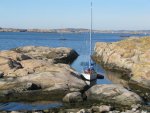
That said, within the Archipeligos on the Swedish coast there are literally thousands of natural harbours. You can often moor up bow first to a rock and jump ashore.

I found Finland more restrictive as, apparently, there's not as widespread a right to moor.
 
Further to the advice already given, if you are aiming to visit the archipelago areas of Norway, Sweden and Finland, you should consider access to shore in natural harbours – mostly bows to a piece of rock and stern anchor.
Here beam is not a problem, but draft sometimes is. Step through pulpit is essential and bow ladder also. A yacht with a modern vertical "icebreaker" bow might not be ideal.
Holding tank with pump out fitting on deck is already mandatory in Finland and will be in Sweden from 2015 (or rather discharge at sea will be illegal).
Furling headsail is not a bad idea, but many sailors in the Baltic proper seem to prefer smaller genoas or jibs to make tacking in narrow channels easier. Or selftackers.
As for optimum size: The smaller the better, but that must be balanced against the level of comfort that you want. We cruise two persons in a 9 m boat with 1,3 m draft and think that is the optimum size. But then we like places like this:
http://www.ybw.com/forums/images/attach/jpg.gif
 

Attachments

  • StHaskar2.jpg
    StHaskar2.jpg
    60.4 KB · Views: 2
I'm in my third season in the Baltic with Penguin - a Malö 37 - laying up there for the last two winters.

Vital statistics:
length 11.55m
beam 3.62m
draft 1.8m
air draft (from memory) 17.1m

When I say 'in the Baltic', I mean what Brits call the Baltic - Eastern Denmark, West Sweden north of Gothenburg, then round via the Sound and South Sweden to Stockholm Archipelago where we are now. Swedes don't really count it as 'The Baltic' until you get south of The Sound. These last two seasons we've been in Sweden only, and not yet got to Finland, Poland or the Baltic States.

We haven't found Penguin's size a limitation. Beam does exclude some box berths and 'booms' (aluminium box section bars floating at the outer end used to keep boats from touching), but most harbours have boxes or booms in more than one width. Sometimes we have squeezed in with very little (like a fraction of an inch!) clearance, but that's probably my laziness in failing to keep looking for a wider berth. Sometimes the maximum beam is conveniently marked on the berth.

In three seasons we haven't had to book a berth and have always been able to find one in the harbour we have 'aimed for'. However in July (peak season - August is quieter) it does pay to set off early and get into popular harbours by say 3pm. That isn't a problem because it's light early and there are no tidal streams to catch. Often arriving early isn't necessary but harbours do fill up for example if there's something going on in the town or bad weather is forecast so those that would normally anchor in remote spots all turn up for a shower and a supermarket shop.

Draft isn't a problem. There are plenty of places that are too shallow for us, but that would be true however shallow draft we were. Minimum draft along a route is marked on many of the charts so as you follow the line of a suggested route it says '3.5' or '1.8' or whatever, and that aids planning.

Air draft is a serious limitation on some routes with fixed bridges, but either you follow another route or don't go there. In reality we haven't been prevented from going anywhere we wanted by our air draft (except via the Södertälje Canal into Stockholm, but that was because they'd closed two bridges for maintenance without putting it out in the nav warnings - grr! wasted day spent getting to the bridges and back again). We had to take a longer route than some boats out of Karlskrona because of a low bridge, but that wasn't a problem as, like all of them, the clearance was marked on the chart.

So I think I'd choose a boat size to suit your taste and pocket rather than any limitation of the area. Possibly if you get beyond 40 to 45 feet then you get some berthing limitations but even then I don't think draft and air draft would be a problem. In Sweden there seem to be plenty of big (45 foot plus) boats, many from Germany.

I think a good rubbing strake is invaluable which is why many Swedish boats have them, but those that don't sometimes suspend a thick (say 2 inch diameter) rope round the widest part of the hull, hanging it from the rail with codline or similar). I reckon one or the other is near-essential unless you are going to be very picky about which harbours you go to (but less so on the Swedish East Coast where booms are more common than in the West).

I see what you mean about a big genoa. We don't have one, but we do have a cruising chute (with snuffer) which is useful in light airs, and also I don't hesitate to use the engine more often than in the UK because sometimes in the mornings the wind isn't light it's non-existent, and even when it's blowing some of the channels are too narrow for close tacking.

I echo the advice about some means of getting ashore over the bow and possibly carrying a portable step. Locals almost never go ashore any other way, even if they are in a pontoon berth with a walkway alongside! Most local boats have a bow ladder either permanently fitted or hung by hooks to the pulpit when in harbour. We use the mountain goat method of climbing up the anchor (which may be why I fell in Västervik harbour!).

BUT (big but) don't be put off. We've found that Denmark and Sweden are the most fantastic cruising areas. The different types of berth, rocks, swing bridges etc aren't a problem. They're just a bit different from what most UK sailors are used to and very soon you'll think they're normal. Against those peculiarities, you'll find a great boat-friendly culture, good public transport system for travelling back to the UK, everyone speaking English and nearly all sailors really helpful and courteous at sea and in harbour.

I reckon it's close to sailing paradise. If only the sailing season were longer and I could walk to the boat rather than having to fly, it would be perfect!

PS If you anchor or use what the locals call 'natural harbours' (rocky bays, some with mooring facilities) you needn't worry about beam and having a rubbing strake. Anchoring is a real pleasure. But you do need large scale charts and preferably local reference books.
 
Last edited:
I hope that doesn't mean you are in that rather dull-looking marina - the town quay is very comfortable, and cheap.
The town quay is comfortable but has limited space and not suitable for the whole season. There's mooring the other side of the bridge but it's limited and then you're tied to opening times. Monkebude was our first choice but unfortunately no space available. Lagunstadt is not that bad, although it can get busy with lots of non-boaty families staying in the apartments which are close to a very nice sandy beach.
 
I hadn't assumed that you were based there; a great area for exploring or relaxing. Uerkemunde claims to have the most beautiful entrance in the Baltic, maybe an overstatement but it is certainly lovely on a sunny evening.
 
Thanks all for the comments - very helpful.

As ever there is no absolutes, but the consensus does tend to suggest that a slightly smaller boat is better for the Baltic than a bigger version of the current Ben/Jen/Bavs etc - which are relatively cheap as chips (at least compared to HR/Malo etc). But a 40 footer is typically 4m wide, and some of the other brisk boats we have seen have 2.3m or more depth, with keels which are unlikely to be happy meeting the bottom (eg nice new Dehlers but narrow T-keel - whereas Swedish Arcona has a crumple zone at the front of the keel, expecting to meet something hard).

Just desktop research for now but does help planning
 
Top