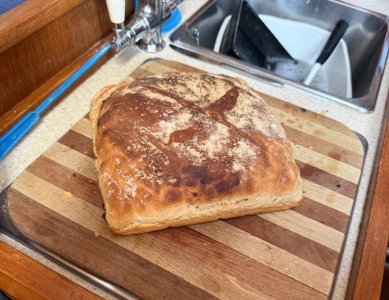
On board baking

I found myself in Tayvallich once, breadless, as was the only shop, but they had bread flour and yeast. I had only an Omnia oven at the time, but its recipe book had instructions on how to make a small ring shaped loaf, so I gave it a go. It was a partial success. The bread was great - so great that I scoffed it all the same evening, and the next day I was still breadless...
 
We decided that making loaves of bread used to use too much gas and that only one loaf in three was 'good', for the most part they were no more than edible. We ultimately decided that making tortillas was the way to go; they were consistently good and a batch could be made in less time than you could dinghy ashore for a loaf of bread; especially so when we were a week offshore.
 
We find soda bread is the way forwards, given a boat with an oven. However, with a DF920, the way to do it is to go shopping every 2 or 3 days. We need water anyway, and frequently another form of shore based service, our holding tank is quite small.
 
My wife scoffed when I came back with a cast iron roasting pot. Once I cooked the first proper loaf on a wet and cold day on our summer cruise - she was sold.

Big fan of baking bread aboard.
 
I found myself in Tayvallich once, breadless, as was the only shop, but they had bread flour and yeast. I had only an Omnia oven at the time, but its recipe book had instructions on how to make a small ring shaped loaf, so I gave it a go. It was a partial success. The bread was great - so great that I scoffed it all the same evening, and the next day I was still breadless...
Ah you just need to call Knapdale Artisan Bread now and they’ll deliver it to the pontoons for you! We have a coeliac on board so whilst we don’t do epic passages we always run the risk of ending up somewhere with no gluten free bread - so carry a GF bread mix.
 
. . .I had only an Omnia oven at the time, but its recipe book had instructions on how to make a small ring shaped loaf, so I gave it a go. . .
I use the part-baked baguettes, rolls and mini rolls you find in supermarkets. Their advantage is they keep for months before needed.

Our boat was too small for practical proper bread making, and had no oven, but we used an Omnia circular 'oven' on the hob for finishing off part-bake rolls, etc. (plus heating bought pasties etc., etc.).
 
Flatbread: 60gms (self raising) flour, 30gms water and a glug of oil. Roll it around and knead it until it's smooth. Roll or flatten it out, and then fry it at the hottest temperature in a dry pan, turn over after a minute or so, both sides will probably have 'bubbled' up a bit, remove and slather in whatever you want. 5 minutes start to finish.
As above but slather a bit of tomato sauce, (simply onboard as puree and a bit of olive oil), cheese on top, under the grill until the cheese melts and then eat your DIY cruising pizza, which is miserly with onboard gas..
Add herbs/spices/tabasco as required to recipe, and wallow in praise from crew.
 
Flatbread: 60gms (self raising) flour, 30gms water and a glug of oil. Roll it around and knead it until it's smooth. Roll or flatten it out, and then fry it at the hottest temperature in a dry pan, turn over after a minute or so, both sides will probably have 'bubbled' up a bit, remove and slather in whatever you want. 5 minutes start to finish.
As above but slather a bit of tomato sauce, (simply onboard as puree and a bit of olive oil), cheese on top, under the grill until the cheese melts and then eat your DIY cruising pizza, which is miserly with onboard gas..
Add herbs/spices/tabasco as required to recipe, and wallow in praise from crew.
One of our afternoon snacks is flatbread, (but with a little salt in mix) and home made hummus - can of chickpeas, some tahini, olive oil, lazy garlic paste and a good dash of lemon Juice. It goes particularly well with a g&t in the sun. All long life store cupboard items so easy to always have in the lockers.
 
We cheat,

We use a bread maker. You can bake bread so that its ready for breakfast, One of the pleasures is when at the end of a long overnight passage - you can smell the bread baking.

In south west Tasmania they don't have shops selling bread, their aren't any shops at all - if you want toast and marmalade you bake the bread yourself.

Jonathan
 
We cheat,

We use a bread maker. You can bake bread so that its ready for breakfast, One of the pleasures is when at the end of a long overnight passage - you can smell the bread baking.

In south west Tasmania they don't have shops selling bread, their aren't any shops at all - if you want toast and marmalade you bake the bread yourself.

Jonathan
Interesting. What sort of power does that pull through the inverter?
 
Interesting. What sort of power does that pull through the inverter?
Peak of, about, 1,500 watts when baking - The early part of the programme does not use much power, it warms and kneeds. The baking cycle pulses on and off. We use it off a 200 amp Lithium battery and a 1,500 watt inverter and it draws a bit over 100 amps, when it pulses on.

Jonathan
 
We ultimately decided that making tortillas was the way to go; they were consistently good and a batch could be made in less time than you could dinghy ashore for a loaf of bread; especially so when we were a week offshore.
Chapatis similar with wholemeal flour and also use little gas. Then of course you have to make a curry to go with them.
 
This chap has a simple method for bread making and it seems to work quite well:
Obviously pan size and stove top space limit how much can be made at one time but for crews of 1-4 it would be feasible.
 
The smell of baking bread in mid ocean is very good for crew morale. :)
Strongly agree. I baked bread on an Atlantic crossing, and although my efforts were average at best, it added a very welcome addition to our regular diet. Each loaf rarely lasted more than a few minutes after it was done.
 
Top