Old spinnaker broken rivets.. Alternative fixings?

Captain Crisp

Well-Known Member
Joined
1 Mar 2015
Messages
414
Visit site
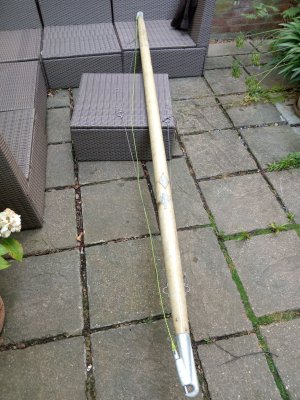
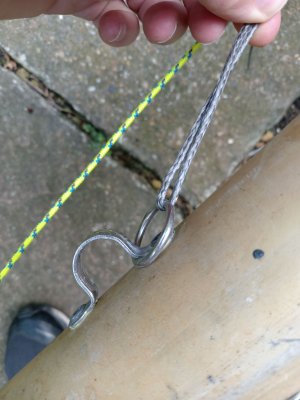
Hi, the downhaul has twice torn/snapped the rivets out of my original Sparlight aluminium spinnaker pole...
I'm wondering if it might be better to loop a nylon strap around the pole and attach the downhaul to that?
Or is it my rubbish riveting?
This image shows the current set up with the dyneema bridle pulling at the riveted fixing...
Any advice gratefully received!
Crisp
IMG_20240815_190946_L9sQJjuH1c.jpeg
 
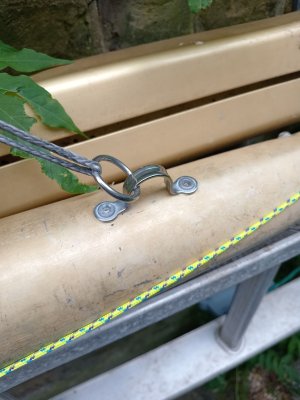
Your riveting looks fine, your rivets look malnourished, though that might have been dictated by the size of the holes in the saddle. If the rivets in the picture are indicative of the size of the 'overlap' at the other end of the rivet - I assume the rivets are simply pulling out. Your use of dyneema suggests high tensions but this is not reflected in the size of the saddle nor its rivets.

How big is the yacht.
 
I think that arrangement of rivets in tension is just asking for trouble. Ideally the bridle should go right out to the pole end where it attaches to the fittings.
However if you want to keep present arrangement you might try a lashing of dyneema cord around the pole and through the rings to take the pull with the saddles just there to locate the bridle along the pole. A down haul can take a fierce load at times when spin is shy.
I found on my little boat 21ft that a far better arrangement was with barber hauler lines from the gunwhale to the brace on each side. Giving better control of the down haul of the spin. PM me or search down haul for spinnaker. ol'will
 
I would suggest to take the downhaul to spinnaker pole outer end. If you gype the spinnaker and turn the pole around, most arrangements I have seen use a dyneema or wire birdle reaching both ends of the pole, while the downhaul connects to a ring/loop at the middle of this birdle. On our boat the boom is not swapped around and the downhaul stays at the outer end. Similar ring as yours (relatively) is used for boom lift / uphaul.
 
I think that arrangement of rivets in tension is just asking for trouble. Ideally the bridle should go right out to the pole end where it attaches to the fittings.
However if you want to keep present arrangement you might try a lashing of dyneema cord around the pole and through the rings to take the pull with the saddles just there to locate the bridle along the pole. A down haul can take a fierce load at times when spin is shy.
I found on my little boat 21ft that a far better arrangement was with barber hauler lines from the gunwhale to the brace on each side. Giving better control of the down haul of the spin. PM me or search down haul for spinnaker. ol'will
I agree that it is uncommon to find attachments in the middle of a pole on a yacht. The loads can be high and break a pole in the middle. I have seen attachments on dingy spinnaker poles like this but IMHO you would be much better with a bridal arrangement taking the loads to the end of the poles on any yacht.
 
A Spinnaker pole is under high compressive loads. Putting the bridle anywhere else other than the end fittings puts an extra bending moment on it, making the pole far more likely to buckle. If the end fittings permit it, I would definitely rig the bridle direct to the ends.

The neatest way is to use D12 dyneema for the bridle and splice some shock cord inside it, so that it takes up the slack when the bridle isn’t under tension.
 
He does say it’s a bridle, but the photo clearly shows that the bridle doesn’t go to the end of the pole….
How far away from the end is unclear - it looks like a tapered pole,
 
Thanks for the responses - the bridles do go nearly to both ends as you can see here:

IMG_20240816_101442_w83cCWYH7r.jpeg

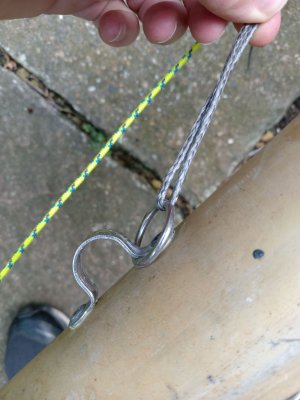
Another concern is the way the ring sits within the eye strap as it tends to get stuck on the 'bottom' and pull directly against one rivet as here:

IMG_20240816_101500_TWJ9DWLm1z.jpeg
 

Attachments

  • IMG_20240816_101500_TWJ9DWLm1z.jpeg
    IMG_20240816_101500_TWJ9DWLm1z.jpeg
    241.7 KB · Views: 7
Use fatter rings.

Aliexpress rappel rings - Google Suche

I'm not suggesting you buy from Aliexpress, try you local climbing retail outlet. I'd suggest using small Low Friction Rings, but they cost a fortune (our of proportion to the task). But there are a number of uses for small alloy rings - its a case of finding something - if their application is non boaty they will be cheaper.

Try your car part retailer

3 stücke Rot Eloxiertem Aluminium AC Climate Control Knob Ring Abdeckungen Für 2013-2015 Subaru WRX STI Impreza Forester xv cross - AliExpress 34

Jonathan

PS I was impressed with the gold anodising :) on what looked like the boom, or mast.
 
The problem is, the load on the bridle is very high, as it makes an acute angle with the spinny pole.
Combined with the thin ring, it's a powerful wedging action putting a lot of tension on the rivet.

You could change the saddle fitting, or modify the existing with a hammer and a vice.
You could lengthen the bridles for a better angle of pull, with less tension and more likely to avoid the wedging action.
Personally, I've ditched the bridle, I rig the up and downhauls to the end of the pole and use the pole in a single-ended mode.
It makes gybing 'different' but it's what I've used on other boats ranging from 505's to 50ft, with minor variations.

I also using chokes, AKA stranglers or twinning lines to pull the guy down, so the tension on the pole downhaul is kept reasonable.

Alternatively replace that shiny ring with stout soft shackle or even a lashing?

Or re-make the bridles so the spliced eyes go around the pole and have a bit of thick-wall plastic tube to stop them wedging under the saddle fitting? ( or 2 or 3 layers of heat shrink.

Those rings by the way, will jangle on a mooring at 3:30AM. I know this!

HTH?
 
Or re-make the bridles so the spliced eyes go around the pole and have a bit of thick-wall plastic tube to stop them wedging under the saddle fitting? ( or 2 or 3 layers of heat shrink.

This is what I would do - would remove most of the strain on the rivets.
 
Stop using Dyneema; that is the change and the cause. When the pole drops there is no stretch and the force is terrific. Go back to polyester.

It's not the static load that is doing this, it is the shocks. Dyneema has advantages, but you can't just change to it without making changes.
 
Stop using Dyneema; that is the change and the cause. When the pole drops there is no stretch and the force is terrific. Go back to polyester.

It's not the static load that is doing this, it is the shocks. Dyneema has advantages, but you can't just change to it without making changes.
Those bridles are traditionally wire, which would be similar stretch.
The forces have been made high by the angles of the bridles though.
 
As B27 says the horizontal component of the forces applied to the eye is increased by the shallow angle between the bridle and the pole. Lengthening the bridles will reduce it.

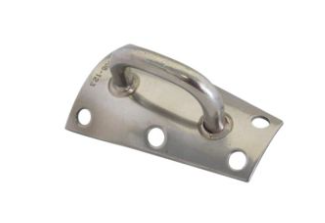
However the simple saddle fittings look hopelessly inadequate to me. Something more like these Selden fittings would be more satisfactory

1723816376490.png
 
Last edited:
Top