Old Aries or Hebridean windvane?

GTom

Well-Known Member
Joined
12 Jun 2017
Messages
954
Visit site
Thinking on a vane for our 33' boat and two options seem to match the <£1000 budget: second hand Aries from the '80s or a new Hebridean kit.

Former seems more robust, I might be able to use it as an emergency rudder too. Latter is lightweight, easy to store. Any thoughts?
 
I've not heard of an Aries being used as an emergency rudder before.
It's obviously a more established and very well renowned vane.
The Hebridean is interesting, though. I met the designer a couple of years ago and he was very helpful, quite happy to tell me that it was totally unsuitable for my own boat- so not a pushy salesman at all! One of its big selling points is that the whole thing can be lifted off the back of the boat and stowed away safely, which is handy if you are worried about it getting damaged in a marina etc.
 
I bought a second hand Monitor for my last boat, and kept it when the boat was up for sale. My current boat came with an old Aries that the original owner had bought second hand. So old that the paddle blade was fixed and could not be lifted out of the water. He had rebuilt it - the hammer marks clearly visible in the alloy casting where stainless steel components had to be removed. (Alloy corrodes around stainless steel effectively welding the two components). It took a lot of light machine oil and elbow gease to get it moving at all on the delivery trip from Plymouth to Orkney.
Once home I read the instructions: Aries - oil every day, Monitor - do not oil ever. I fitted the Monitor and sold the Aries.

Sorry, but no experience of the Hebridean kit to make a comparison. However, an Aries is a heavy lump to hang on the back of a boat. If you have a lightweight boat it may effect the trim.

Whichever you go for the secret of living with a windvane steering system is sail balance, set up the boat so it tends to stay on course with minimum use of the rudder. On my boat this means an early reef in the main, much earlier than when hand steering. With the servo pendulum system the steering lines need to be slightly slack (counter intuitive, I know, as you want maximum usage of the rudder). The slightly slack steering lines have far less friction over the blocks than tight lines and the vane gear works much better, especially in lighter conditions. I once met someone with a Monitor who complained his only worked in very strong winds. His steering lines were bar tight. The Monitor manual is available on line, - it has a useful set of instructions that are relevant to setting up and using any servo rudder gear.

I have used various wind vane gears since the 1970's and would not be without one on any sailing boat I own. No electrics to get wet and fail.
 
I bought a second hand Monitor for my last boat, and kept it when the boat was up for sale. My current boat came with an old Aries that the original owner had bought second hand. So old that the paddle blade was fixed and could not be lifted out of the water. He had rebuilt it - the hammer marks clearly visible in the alloy casting where stainless steel components had to be removed. (Alloy corrodes around stainless steel effectively welding the two components). It took a lot of light machine oil and elbow gease to get it moving at all on the delivery trip from Plymouth to Orkney.
Once home I read the instructions: Aries - oil every day, Monitor - do not oil ever. I fitted the Monitor and sold the Aries.

Sorry, but no experience of the Hebridean kit to make a comparison. However, an Aries is a heavy lump to hang on the back of a boat. If you have a lightweight boat it may effect the trim.

Whichever you go for the secret of living with a windvane steering system is sail balance, set up the boat so it tends to stay on course with minimum use of the rudder. On my boat this means an early reef in the main, much earlier than when hand steering. With the servo pendulum system the steering lines need to be slightly slack (counter intuitive, I know, as you want maximum usage of the rudder). The slightly slack steering lines have far less friction over the blocks than tight lines and the vane gear works much better, especially in lighter conditions. I once met someone with a Monitor who complained his only worked in very strong winds. His steering lines were bar tight. The Monitor manual is available on line, - it has a useful set of instructions that are relevant to setting up and using any servo rudder gear.

I have used various wind vane gears since the 1970's and would not be without one on any sailing boat I own. No electrics to get wet and fail.

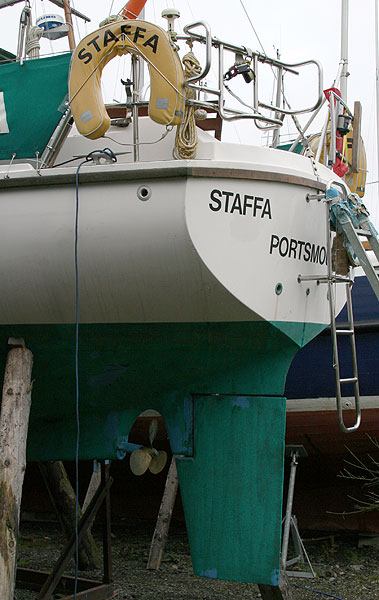
Thank you, I wonder if the Monitor could fit on the Westerly Discus, the ladder seems to be in the way:
1241.jpg
 
I have a lift up Aeries on a 31 ft hanse. i bought it because the whole unit can be removed in seconds for racing & the oar can be lifted clear of the water at the end of the day.
Not having used any other vane( other than home made ones on a different boat i owned) i cannot comment on how it compares.
However, i do feel that it is a little heavy for the boat. taken with liferaft & spare fuel & all the other gear that a modern AWB tends to store in the aft it all gets too much. I do not have the problem that others talk about with bearings .I find they all work perfectly well. perhaps that is a feature of the lift up.
If I was given the option to change I might go for a monitor or perhaps a Sailomat or something lighter. the Aeries performs badly down wind on my Hanse. But that might be just because my Hanse is so lively. I do use the Aeries a lot because the Raymarine AV100 autopilot is a pretty carp autopilot- but that is another story.
I will say that the Aeries is very powerful in strong winds & is great upwind. But i expect most are
 
Thank you, I wonder if the Monitor could fit on the Westerly Discus, the ladder seems to be in the way:
It probably will, but you will need to move the ladder. I now have mine alongside the cockpit. The Monitor frame can also double as a (rather inconvenient) boarding ladder on the stern. Fitting instructions included the requirement that it can support a heavy man.

Have a look at the Scanmar web site, lots of information including a gallery of different boats with Monitors fitted and detailed instructions for mounting and how high the gear must be above the static water line. I had to use an upward curve on the top tubes to get the right height above my transom. (a similar stern to yours on a Trident Voyager 35).

Sounds as if Daydream Believer (above) has the latest Aries model. Hopefully, it will be a number of years before it needs a rebuild and he discovers the stainless steel components have corroded the alloy casting.
 
Sounds as if Daydream Believer (above) has the latest Aries model. Hopefully, it will be a number of years before it needs a rebuild and he discovers the stainless steel components have corroded the alloy casting.
Mine is a older Franklin model & it has no stainless steel in it that i can see. I purchased it second hand 14 years ago & no problem with corrosion so far. I stripped it down last year to remove some old grease & it all came apart fairly easily.
 
I built a Hebridean in 2018 from a kit. I used it extensively in the 2019 season especially on longer overnight passages and it worked very well. I was particularly surprised at how well it worked downwind. In fact I tried it dead downwind for a couple of hours on a leg between Ireland and the Isle of Man, and it was very quick to react to any changes in wind direction, and even seemed to cope well with the rolling that particular boat was fond of doing while DDW. It's reasonably light in weight, so can be lifted off it's mount when not in use, and the pendulum (the rudder type part, though not actually a rudder) can be quickly removed from the whole assembly, so the whole thing splits down into more manageable chunks.

It will be going on the new boat once I have a bracket made up to go round the transom hung rudder, as I found it very useful as a singlehander.
 
I built a Hebridean in 2018 from a kit. I used it extensively in the 2019 season especially on longer overnight passages and it worked very well. I was particularly surprised at how well it worked downwind. In fact I tried it dead downwind for a couple of hours on a leg between Ireland and the Isle of Man, and it was very quick to react to any changes in wind direction, and even seemed to cope well with the rolling that particular boat was fond of doing while DDW. It's reasonably light in weight, so can be lifted off it's mount when not in use, and the pendulum (the rudder type part, though not actually a rudder) can be quickly removed from the whole assembly, so the whole thing splits down into more manageable chunks.

It will be going on the new boat once I have a bracket made up to go round the transom hung rudder, as I found it very useful as a singlehander.
Interesting. What boat did you use it on?
 
I built a Hebridean in 2018 from a kit. I used it extensively in the 2019 season especially on longer overnight passages and it worked very well. I was particularly surprised at how well it worked downwind. In fact I tried it dead downwind for a couple of hours on a leg between Ireland and the Isle of Man, and it was very quick to react to any changes in wind direction, and even seemed to cope well with the rolling that particular boat was fond of doing while DDW. It's reasonably light in weight, so can be lifted off it's mount when not in use, and the pendulum (the rudder type part, though not actually a rudder) can be quickly removed from the whole assembly, so the whole thing splits down into more manageable chunks.

It will be going on the new boat once I have a bracket made up to go round the transom hung rudder, as I found it very useful as a singlehander.
I am absolutely sold on the Hebridean in terms of windvane use, problem is that I want a solid emergency rudder option too. Maybe making the base of the Hebridean stronger to accept a larger rudder would solve the issue. AFAIK monitors work that way, you need to replace the vane rudder with a bigger one (the mounting base is strong already).
 
Thanks, PM sent. Not 100% decided on the model yet as I want a feasible emergency rudder function too.
 
I fitted a Windee (from Latvia because I liked the design. So far works well running and beam reach to close hauled but I am struggling to get it to broad reach in gusty “NW” wind conditions. Could, I think, be converted to be an emergency rudderwith a bigger blade and control lines to the vane base. The trouble on a broad reach is because the boat goes from nicely balanced sail plan to sudden weather helm which requires a sharp alteration of the wheel at the end of the servo travel. Thinking of lengthening the operating arm to give more throw. An owner of a sister ship has the same problem with a Hydrovane
 
I am struggling to get it to broad reach in gusty “NW” wind conditions.
Broad reaching has been less precise on the four boats that I have had wind vane steering on. Sail balance changes with both boat speed and wind speed. Reefing or even dropping the main may help the balance. I aim to set the gear and neutral rudder angle so the vane gear can cope, accepting that the heading will be swinging through +/- 20 degrees or so.
 
That was on an LM27...
So basically you have been using it on a boat that I expect is directionally stable to start with. That helps enormously.
I have a boat with a short fin & if I were to let the tiller go for a just a second the boat will go sharply off course.
It is extremely responsive to the helm
So the Aeries- any windvane in fact- is at a disadvantage,. Fortunately the Aeries is a fairly powerful gear once the wind gets up. So the boat veers about but can be steered
The point I am making is that when you go to put you existing windvane onto your next boat just be aware that it may not respond in the same way if the new boat is a bit more " lively"
 
So basically you have been using it on a boat that I expect is directionally stable to start with. That helps enormously.
I have a boat with a short fin & if I were to let the tiller go for a just a second the boat will go sharply off course.
It is extremely responsive to the helm
So the Aeries- any windvane in fact- is at a disadvantage,. Fortunately the Aeries is a fairly powerful gear once the wind gets up. So the boat veers about but can be steered
The point I am making is that when you go to put you existing windvane onto your next boat just be aware that it may not respond in the same way if the new boat is a bit more " lively"
Same here, mine is bilge keel: if I let the wheel go I am 90 degrees off course within seconds.
 
So basically you have been using it on a boat that I expect is directionally stable to start with. That helps enormously.
I have a boat with a short fin & if I were to let the tiller go for a just a second the boat will go sharply off course.
It is extremely responsive to the helm
So the Aeries- any windvane in fact- is at a disadvantage,. Fortunately the Aeries is a fairly powerful gear once the wind gets up. So the boat veers about but can be steered
The point I am making is that when you go to put you existing windvane onto your next boat just be aware that it may not respond in the same way if the new boat is a bit more " lively"
Not too sure why I deserved your wee rant there, since I was only stating my own experience and not commenting on your own boat. But then if you buy a boat that's not directionally stable of course any steering system is going to find that harder to cope with.
 
Top