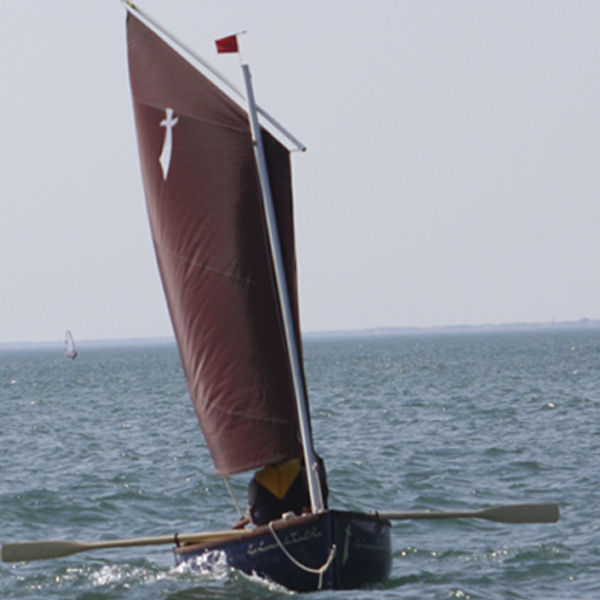
Oars or sails right of way?

According to the 'Boat owner's highway code', a joint publication of the RYA and PBO, 'oars usually give way to sail'. So that's clear then.

The thread has generally assumed skiffs etc
But what about the old fella in his rowing dinghy trying to get out to his mooring (me!!)
He has the same means of propulsion as the skiff but really is an entirely different proposition
For a start I only row at tenth of the speed
& before any one says "use the outboard"-i have a Seagull so i have to row
 
I could have sworn that I had read in the 'International regulations for prevention of collision at sea' at some stage that vessel driven by oar were considered power driven vessels. In light of what has been said so far, and the fact that I cannot lay my hands on a copy, I must have got that wrong, signs of an ageing mind I guess.

However, as a rowing boat, even a 1 manpower one, has the ability to go directly to windward why should a sailing vessel beating to windward have to give way to a vessel that can clearly go in whichever direction it wants albeit a manpowered one and not a mechanical horsepowered one.
 
Pete,

I think you're right and I read that somewhere too.

In reality I think the poster who said he'd ' give way out of courtesy unless there's no wind to manouvre ' was about right.
 
I guess he's just hedging his bets...

classic-sailing-and-rowing-open-boat-33103-184153.jpg


Pete
 
I could have sworn that I had read in the 'International regulations for prevention of collision at sea' at some stage that vessel driven by oar were considered power driven vessels.

Me too.

Can't help thinking that us looking for a ruling on this, may reflect the way America's NRA fears gun-controls in the US...any established ruling will make a precedent for further later regrettable enforcement. Let's keep it vague, and all steer clear... :)
 
I could have sworn that I had read in the 'International regulations for prevention of collision at sea' at some stage that vessel driven by oar were considered power driven vessels. In light of what has been said so far, and the fact that I cannot lay my hands on a copy, I must have got that wrong, signs of an ageing mind I guess.

Here they are: http://www.dft.gov.uk/mca/msn_1781-2.pdf . Preceded by a couple of pages of MCA waffle, but then it's the Regulations themselves and their appendices. I find them when required by googling MCA colregs, for which this is the first hit.

Incidentally, while the text should be the same wherever you get it, this version is the one that's passed into UK law by the Merchant Shipping (Distress Signals and Prevention of Collisions) Regulations 1996. This notice isn't the regulations themselves, but the regulations refer to it and make it law.

why should a sailing vessel beating to windward have to give way to a vessel that can clearly go in whichever direction it wants

There's a rowing club just across the river from me. Their boats are certainly not manoeuverable, so most of the time I'm quite happy to go round them. The one time they did get in my way is documented here: http://www.ybw.com/forums/showthread.php?243685-My-very-first-colregs-thread-rowers :)

(In summary, they did something a bit daft, I avoided them, no stress all round but I was curious as to the theory of the situation. Answer the same as always - the Colregs don't say, use common sense.)

Pete
 
But what about the old fella in his rowing dinghy trying to get out to his mooring (me!!)
He has the same means of propulsion as the skiff but really is an entirely different proposition
For a start I only row at tenth of the speed
& before any one says "use the outboard"-i have a Seagull so i have to row

I guess your speed means that you are restricted in your ability to manouvre which is why sailing vessels will keep out your way. In reality I don't think there is ever really a problem in this situation.
 
Here they are: http://www.dft.gov.uk/mca/msn_1781-2.pdf . Preceded by a couple of pages of MCA waffle, but then it's the Regulations themselves and their appendices. I find them when required by googling MCA colregs, for which this is the first hit.

Incidentally, while the text should be the same wherever you get it, this version is the one that's passed into UK law by the Merchant Shipping (Distress Signals and Prevention of Collisions) Regulations 1996. This notice isn't the regulations themselves, but the regulations refer to it and make it law.


There's a rowing club just across the river from me. Their boats are certainly not manoeuverable, so most of the time I'm quite happy to go round them. The one time they did get in my way is documented here: http://www.ybw.com/forums/showthread.php?243685-My-very-first-colregs-thread-rowers :)

(In summary, they did something a bit daft, I avoided them, no stress all round but I was curious as to the theory of the situation. Answer the same as always - the Colregs don't say, use common sense.)

Pete


I'm wondering if there have been a few amendments made at some point, clearly rule 3(b) (definitions) for power driven vessels only mentions those driven by machinery, whereas I was sure that it used to state including those under oars.

Rule 2(b) clears everything up anyway: (b) In construing and complying with these Rules due regard shall be had to all dangers of navigation
and collision and to any special circumstances, including the limitations of the vessels involved,
which may make a departure from these Rules necessary to avoid immediate danger.

Always pays to err on the side of caution . . . . . . . and in about 6 weeks time there'll be 130+ Pilot gigs charging around these parts for a long weekend which will make the sailing a bit interesting, think I'll try and avoid 'em altogether if possible
 
I have long-since planned to furnish my next boat (a sailing dinghy) with oars, even if they're not part of the class's standard equipage. Best to be ready for anything. :D
 
[Old fella in his rowing dinghy]

I guess your speed means that you are restricted in your ability to manouvre which is why sailing vessels will keep out your way.

Nope:

The term “vessel restricted in her ability to manoeuvre” means a vessel which from the nature of her work is restricted in her ability to manoeuvre as required by these Rules and is therefore unable to keep out of the way of another vessel. The term “vessels restricted in their ability to manoeuvre” shall include but not be limited to:
(i) a vessel engaged in laying, servicing or picking up a navigation mark, submarine cable or pipeline;
(ii) a vessel engaged in dredging, surveying or underwater operations;
(iii) a vessel engaged in replenishment or transferring persons, provisions or cargo while underway;
(iv) a vessel engaged in the launching or recovery of aircraft;
(v) a vessel engaged in mine clearance operations;
(vi) a vessel engaged in a towing operation such as severely restricts the towing vessel and her tow in their ability to deviate from their course.

Just being a slow or unwieldy vessel does not make you RAM.

People sail around a bloke in a dinghy because running him down is considered rude :)

Pete
 
I have long-since planned to furnish my next boat (a sailing dinghy) with oars, even if they're not part of the class's standard equipage. Best to be ready for anything. :D

Too right, paddling a dinghy singlehanded with the tiller held over by a knee is a distinctly inefficient short range exercise; I have a sculling rowlock on my Anderson 22 as Plan C for calms, after the main engine and then 2hp dinghy engine pack up or fuel is short!
 
No way
I love my seagull. It is 54 years old & is part of my sailing life
Just because it plays up now & again ( so does the wife!!) is no reason to ditch it ( or the wife)
Besides the row does me good - dodging all those b...y racing dinghies

With a seagull you don't have to row...


I'm assured that they make quite good anchors as well. :D
 
Well I wasn't expecting such an interesting debate,still thats as clear as mud, which we have plenty of round these parts.The channel is narrow so I will be constrained by my draught [cylinder ready to hoist]! See what the rowing folk make of that. Not to mention who has priority on the slip/pontoon. Should be an interesting summer-if we get one.Cheers.
 
The Port of London Authority considers RoBos to be power driven vessels. I used to race dinghies on the tidal Thames and we had constant aggro from the numpties who can't look where they're going.

On one memorable occasion a coxed four managed to impale an Enterprise straight through the transom flap. The Enerprise swung round on the tide and neatly snapped the bows off the four.

That's a simple one, the overtaking vessel should keep clear
 
This is a question I explored in some depth a while ago (including getting advice from RYA legal team).

The upshot is that if crossing paths with a vessel under oars, both vessels are responsible for taking action, and neither is a stand on vessel (neither has 'right of way').

I'll have a rummage to see if I can find chapter and verse, but in the meantime the short answers are

(1) A vessel under oars is covered by the col regs.

(2) A vessel under oars is most certainly not under power for the purposes of the col regs.

(3) The crossing rules for vessels in sight of one another (12, 14 to 17) of the col regs do not make specific provision for vesels under oars (that is, neither the vessel under oars nor another crossing vessel (oars, sail, power, fishing etc.) is the stand on vessel).

(4) All the other rules continue to apply to vessels under oars and other vessels in relation to them - responsibility; look-out; safe speed, risk of collision; action to avoid a collision; narrow channels; traffic separation zones; overtaking, 18d avoid impeding vessel signalling constrained by draught; vessels in restricted visibility. Parts of the lights, shapes and sound regs will apply to a vessel under oars.
 
Last edited:
Top