Not lurking just asking.

plumbob

Well-Known Member
Joined
18 Oct 2009
Messages
1,654
Location
Bucks
Visit site
My Birchwood 29 has 2 smallish Leyland Mermaid diesels of about 45 HP each. I have a newish Sterling charger wired to 2 banks of 120 ah x 2 each.
Got it so far?? Good. The charger shows a rate of about 0.4 amps and 13.8 volts when I get to the boat if the charger has been left on.
When I start up the ammeters go to about 20 amps for a couple of minutes then go to almost zero.
I can cruise for say 3 days and the pattern remains the same, obviously with no charger top up. Banks gradually drop down in charge.
That's what I hope this forum is for.
 
My Birchwood 29 has 2 smallish Leyland Mermaid diesels of about 45 HP each. I have a newish Sterling charger wired to 2 banks of 120 ah x 2 each.
Got it so far?? Good. The charger shows a rate of about 0.4 amps and 13.8 volts when I get to the boat if the charger has been left on.
When I start up the ammeters go to about 20 amps for a couple of minutes then go to almost zero.
I can cruise for say 3 days and the pattern remains the same, obviously with no charger top up. Banks gradually drop down in charge.
That's what I hope this forum is for.
Sounds about right to me - what was the question?
 
Ah good some discussion!! The question is why don't the engines keep the batteries up to the charge level they started out with after say 4 hours cruising a day and still the ammeters go back to almost zero.
Off we go again.
 
Ah good some discussion!! The question is why don't the engines keep the batteries up to the charge level they started out with after say 4 hours cruising a day and still the ammeters go back to almost zero.
Off we go again.
Firstly, analogue ammeters are notoriously unreliable so any reading can only be regarded as approximate. 4 hours running will most certainly not fully recharge the batteries but will replace most of the charge lost whilst moored. Your setup sounds fine but several days on shore charging will raise the charge level closer to fully charged which you cannot expect to achieve via the alternator.
Assume you will never charge much above 80% charge and that you ideally do not want to go below 50% to treat the batteries nicely. Your total nominal capacity is 480 amp/hours so you have about 150 A/H of "sweet" battery power when away from base and relying on the alternator. Lots of maths can be done to determine your actual draw in a typical 24 hours - the fridge will be the worst culprit and depending on its age could easily consume about 50A/H in 24 hours. An old fashioned 24watt 12 volt light bulb consumes 2 amps.
If you want to see a more accurate indication of voltage and amps you need a battery monitor with digital readout. I have an integrated Victron setup but I think Sterling also have something similar as do Adverc and others.
 
Thanks Tony. Think I will install the Nasa monitor just to confirm the voltage regulators are doing what they ought to be doing.
The new Waeco fridge is probably the main reason for the power usage as you say but since I fitted 2 computer fans, one draws air into the fridge unit and the other pulls out , it cuts in and out much less frequently.
 
vimage.jpg

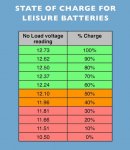
Note.. you may wish to copy the above table, print it out and keep on the boat for reference.
Note... this is the battery resting voltage, after say an hour after being charged or discharged. If the battery is being charged, even from a small solar panel it will affect the result.
Note :- other battery technologies have a different table.


When the batteries are in a fully charged state, they develop a surface charge and quite a lot of energy needs to come out of the batteries before the voltage drops low enough to allow the alternator to make a contribution.
A standard car type alternator without any fancy control will not fully charge a car battery, in a car it doesn't have to, you only start the car then all the energy requied comes from the alternator, except at low revs on a damp cold night.
What you need are a couple of digital panel mounted voltmeters, with a resolution so they can show say 12.56 V Two wire connection straight off the battery, via a fuse etc Ebay have these, quite cheap too.
On our boat we only have a 10 amp charge coil, which at cruising speed never gives more than 6 amps on an outboard engine, so I fitted a current shunt and a digital ammeter to each battery, we can tell what each battery is doing to the nearest 10 mA I know exactly the state of charge, and never go below 80% on either battery, see above table to show state of charge vs voltage The current shunt and digital ammeter need a bit more knowledge to fit for safety and minimum interference.
Richard
This was my first attachment, and it worked first time, that surprised me lol. Mind you, similar to other forums I frequent.
 
Last edited:
Top