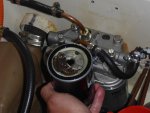
NOT changing the primary fuel filter every year?

Babylon

Well-Known Member
Joined
7 Jan 2008
Messages
4,398
Location
Solent
Visit site
Having just given my engine its annual service I was faced with the usual dilemma: should I change the primary fuel filter (with all the faff/bleading/spillage/clean-up) or - having done both fuel filters last year - just leave it alone?

The engine averages 65hrs a year, and I keep the 90 litre tank fully topped-up in winter and treated with bugocide. When I tapped-off a half pint of fuel from the little gloup-sump below the fuel-cock on the tank, there was as usual barely one 5ml teaspoonful of crud in the bottom of the beaker; also the glass bowl below the CAV filter was utterly clean.

Thinking about it... the 'one-size-fits-all' method of renewing the filter each year simply doesn't make sense. As a sailing yacht with a 25hp 'auxiliary' engine, I'm only pushing roughly 100-150 litres of fuel though it each year. A typical motor-boat with much larger engine(s) will be pushing hundreds, maybe thousands of times more fuel through its filters, yet will still only be looking to renew them once a year!

Unlike engine oil, which must be changed annually whatever the usage, surely its an issue of flow through the primary fuel filter rather than arbitrary time?
 
When your 5 miles or more offshore and the weather changes to a force 5/6 or above worrying if the fuel filters are
ok is the last thing you need to be worrying about.

Always changed mine every 12 month even when I also did less then 100 hrs a year as it's hardly rocket science to change them
 
I tend to agree that it's not really neccessary, providing you change the CAV ( secondary?) filter at least once a year and it's not showing any sign of being heavily bunged up I cant see the point of changing the primary filter more than once every two or three years. I change the CAV filter 2 or 3 times in a season, depending on useage. The diesel engineer who installed the CAV filter in my previous boat suggested this as a routine. CAV type filters are still less than £2 each, providing you buy 10 at a time.
 
I tend to agree that it's not really neccessary, providing you change the CAV ( secondary?) filter at least once a year and it's not showing any sign of being heavily bunged up I cant see the point of changing the primary filter more than once every two or three years. I change the CAV filter 2 or 3 times in a season, depending on useage. The diesel engineer who installed the CAV filter in my previous boat suggested this as a routine. CAV type filters are still less than £2 each, providing you buy 10 at a time.

I think the OP means the first, usually CAV, filter by 'primary'.?
If the sump shows the tank is clean, then it may not be necessary to change the CAV element very often.
But if the engine is drawing from the sump or just above it, the CAV may be collecting all the crud that's in the tank.
The bowl below the filter in the CV unit being clean does not tell us anything.

I have changed CAV filters in what looked like very clean systems and found a surprising amount of grot in the filter when it's cut open.
Maybe change it and cut it open, if it's clean then you might leave it a bit longer next time, provided the sump stays clean.
 
I found myself in exactly the same position as the OP.

Decided to change to a top-loading Racor system, where filter changes are much easier.
 
Unlike engine oil, which must be changed annually whatever the usage, surely its an issue of flow through the primary fuel filter rather than arbitrary time?

It's a combination of how much fuel you pulled through it and how dirty that fuel was, which can vary quite dramatically depending on where it was from, the state of your tank, whether you stirred up any sludge that might be in it, etc. As you say, calendar time is a pretty poor proxy for that.

The best solution is a vacuum gauge connected to the pipe run between filter and lift pump, which will directly show you how clogged the filter is. I leave my filters in place until the needle rises to the first mark on the gauge (afraid I don't remember what the actual units are!). I know from experience when we had a very dirty tank that the engine will run until the needle is at least round to the fifth mark, so there's plenty of headroom. I have a standby filter connected, so to reset to a clean one I only need to move one valve anyway.

I believe my gauge cost about £5, plus a few quid more on a brass T-piece and a couple of metres of narrow reinforced tubing to put it somewhere visible.

When your 5 miles or more offshore and the weather changes to a force 5/6 or above worrying if the fuel filters are ok is the last thing you need to be worrying about.

I agree, which is why it's very reassuring to be able to check the gauge and see no restriction. I generally check before doing things like starting onto one of those bum-puckering transits amongst the rocks in the Channel Islands. Referring to a calendar and hoping all the fuel you burned in the meantime was reasonably clean is better than nothing, I suppose :)

Pete
 
I found myself in exactly the same position as the OP.

Decided to change to a top-loading Racor system, where filter changes are much easier.

Saw one of these on a chum's boat yesterday. Not cheap at £193 plus £10 per filter https://www.asap-supplies.com/parker-racor-500fg-diesel-fuel-filter?nosto=nosto-page-product3 but looks jolly easy and considerably cleaner to do compared to my usual Exxon Valdez experience! Might pick one up from ASAP on Monday before heading off on our cruise, and swap over on a rainy day in port...?
 
Saw one of these on a chum's boat yesterday. Not cheap at £193 plus £10 per filter https://www.asap-supplies.com/parker-racor-500fg-diesel-fuel-filter?nosto=nosto-page-product3 but looks jolly easy and considerably cleaner to do compared to my usual Exxon Valdez experience! Might pick one up from ASAP on Monday before heading off on our cruise, and swap over on a rainy day in port...?

I like the look of these too. I wasn't aware of them when refitting Ariam, so went with Racor's screw-on type instead. These are still pretty easy to change, but do require a jug to drop the assembly into and catch the drips from the head. If starting again now I'd use the top-loaders.

Pete
 
CAV filters are a royal pain in the nether regions to change. After mine blocked just as I was approaching Portsmouth Harbour in a gusty 7, resulting in an "interesting" experience entering under sail, I went to my local car breakers and got a pair of spin-on filter bodies from a Volvo or Renault 1600 diesel which, coincidentally, take the same filters as the secondary filter on my VP2003. A bit of pipe and a some valves fro ASAP and I had a system where I could run on one filter and switch to a clean one in seconds. The whole lot was change from £50 and took a leisurely day to set up.

That was 10 years ago. Last winter, I changed them for the first time, but only because I was concerned about the amount of rust on the outside.
 
When I was involved in engineering and maintenance specifications for public buildings we moved to 'condition based maintenance' which said renew consumables based on their use - not a strict calendar period. My engine does considerably less hours than the service interval recommended for the primary filter which is a CAV type so no, I don't replace it every year. I do replace the secondary filter more often though and I have just bought a Racor spin on conversion for the CAV to make life easier.
 
Saw one of these on a chum's boat yesterday. Not cheap at £193 plus £10 per filter https://www.asap-supplies.com/parker-racor-500fg-diesel-fuel-filter?nosto=nosto-page-product3 but looks jolly easy and considerably cleaner to do compared to my usual Exxon Valdez experience! Might pick one up from ASAP on Monday before heading off on our cruise, and swap over on a rainy day in port...?

I picked up a brand new genuine FG500 for £120 with 10 micron filter a couple of years ago. I'm sure it was from ASAP during their post-Xmas sale.

You can also get much cheaper Chinese copies on eBay which I'm sure I've read seem to work OK and take the same filter elements.

I pulled up the filter a couple of years ago and it was clean so I pushed it back down and replaced the top. I drained a few mls out of the bottom valve into a jar first so there was zero spillage. Since then the glass bowl has remained crystal clear so I know the filter will be fine although I might change it again in a couple of years.

This year I just changed the secondary, on-engine filter. It was the first time I've ever changed it and it looked OK so that one will probably be left untouched for another 3 or 4 years.

I have two engines but my findings on both engines were the same.

Richard
 
Hi,

changed my primary filter recently after not changing it last year (as preowner talked about change in late 2015).
This led to installing a service port to our tank and cleaning it intensely....

Frank
 

Attachments

  • Pest1.jpg
    Pest1.jpg
    177 KB · Views: 2
Hi,

changed my primary filter recently after not changing it last year (as preowner talked about change in late 2015).
This led to installing a service port to our tank and cleaning it intensely....

Frank

May I suggest disposable gloves?
 
Question:

Why do we continue mentioning the 'primary' or the 'secondary' filter? Would it not be simpler, clearer and less prone to confusion if we were to refer to the "in-line filter" as distinct from the "on-engine filter"?
Perhaps it is just my old age...
 
Yeuch!! With that amount of gunk in one season it certainly makes sense to fit a service-port to be able to clean the tank itself.

But that's my point: don't expect the filter to work miracles in a fixed period of time. Start with a clean(able) tank, preferably with a small gunk-sump with a drainage-cock below it to regularly clear any water-borne gunk (which will always normally sink to the bottom). Then gauge the frequency of changing the filter based on volume of fuel passing through it rather than sticking rigorously to a religious-calendar.
 
May I suggest disposable gloves?

Agree. Buy a box of blue nitrile gloves for about a fiver and leave them on the boat.

Maybe I'm a prissy cissy pansy snowflake, but I personally loathe diesel getting anywhere it shouldn't. Beastly stuff, same with petrol and most other hydrocarbons. Apparently, before disposable gloves became the norm, motor engineers used to be prone to cancers around their privates, due to scratching - through their overalls etc - in that region.

Why do we continue mentioning the 'primary' or the 'secondary' filter? Would it not be simpler, clearer and less prone to confusion if we were to refer to the "in-line filter" as distinct from the "on-engine filter"?

Makes certain sense though: the primary is the first filter the fuel reaches from the tank, the secondary the second one.
 
........................The engine averages 65hrs a year,............................................. I'm only pushing roughly 100-150 litres of fuel though it each year.

Actually a lot more goes through the filter as diesel engines draw fuel from the tank and return unused fuel back to it, with the result that the filter does a lot more work than you might think. The comparison with a motor boat is valid, but the flip side is that the motor boat may well burn enough in a year to fill the tank several times over, which means that the yacht allows more time for bug to develop. In your case if the tank was full to start the year, and you refilled at the end, then over winter you still have 25 litres of year old fuel in the tank. Its this lack of complete turnover of fuel that explains why yachts can get diesel bug, but cars and lorries don't. Changing the filter annually is therefore good practice, as is adding an inhibitor.
 
Last edited:
Makes certain sense though: the primary is the first filter the fuel reaches from the tank, the secondary the second one.

Yet there is still room for misunderstanding (see posts #3 and 4), possibly because "primary" can also be understood as 'being of primary importance' and, by inference (especially by someone for whom English is not the 'primary' language) the one that is fitted by the makers as an original part of the engine.
 
Its this lack of complete turnover of fuel that explains why yachts can get diesel bug, but cars and lorries don't. Changing the filter annually is therefore good practice, as is adding an inhibitor.
Do you have any evidence to support that hypothesis?
 
Top