no water! - it isnt the impeller

Got it all working!!
The manifold was pretty gunked up so I put it in a bucket of brick cleaner for an hour. I still needed to be pretty firm with a screw driver and bit of wire but cleared the passages eventually. I'm just amazed any water was getting through last season.

Refitting was OK, except the push on connector to the horizontal pipe didn't deal so the whole lot had to come off again. It sealed well the second time round. At least it seemed to. I'll keep an eye on it.

Thanks for the tip with Rydlyme
http://www.ricoservices.co.uk/environmentallyfr.htm
I'll be doing this on an annual basis in the hope that I don't have to take the engine to bits again.

Is it low speed running that caused this?

From memory the water flow seemed OK last season.
So I guess it is possible this got blocked up over a relatively short period of time.

I did not winterise the engine either. Perhaps not flushing it out at then end of the season was a contributing factor

Thanks for the help guys.
 
From our experience with a similar blockage on a MD2020. The orifice closure in the exhaust elbow, primarily calcium carbonate but with carbon (so it looks like carbon) can reduce to a few mm before you will notice any loss of water flow - but below those few mm you will developed reduced engine revs - I never reached the point of no water flow. You can clean with acid, I guess that's what Rydlyme is? or brick cleaner - once - we never managed to do it twice as the acid is also attacking the steel - and we dissolved a neat hole in the exhaust elbow. Having 2 engines we have lots of time for practice.

The blockage is commonly attributed to carbon - but carbon is inert to acid, whereas calcium carbonate readily dissolves. Calcium occurs in vary concentrations (around the world) in seawater - so its always going to be a problem.

The blockage, with calcium carbonate, appears to be a reaction with the mixing of the, by now, hot cooling seawater and the exhaust gases - as that is the location it occurs. I don't quite see why running at low speed would make this worse - except the water flow would be faster at high speed (flushing the engine??). We do get calcium deposition in the water intake hose (note our water temperatures will be higher than yours, if its relevant), and I take it off occasional, crush the calcium inside and flush it out. I have never noticed deposition anywhere else. It does appear to be slightly more complex that simple hot seawater and exhaust gases as I detect that people who use stainless exhaust elbow claim better performance - but this might merit more investigation and may be false.

This is a common problem, blockage of the exhaust elbow, it is a common cause of threads every 6 months or so (but is more common on Volvo than other engines??).

Jonathan
 
Got it all working!!

Glad to hear it :encouragement:

Thanks for the tip with Rydlyme
http://www.ricoservices.co.uk/environmentallyfr.htm
I'll be doing this on an annual basis in the hope that I don't have to take the engine to bits again.

I'm doing mine this weekend, as a matter of course. I don't think it needs to be an annual job, although it certainly wouldn't do any harm.

Is it low speed running that caused this?

As with Jonathan, i can't see how engine speed is relevant.

I did not winterise the engine either. Perhaps not flushing it out at then end of the season was a contributing factor

Also doubtful. If the boat is out of the water for Winter i would nonetheless flush it, or you have pockets of saltwater sitting in the engine, causing corrosion.
 
Hook a small bilge pump, or pond pump up to the coolant system in such a way that the pump is submerged in a bucket of Rydlyme, pumping it through the raw water pump outlet pipe, through the engine and back to the bucket, from the pipe that goes to the exhaust, so it circulates the Rydlyme around and around the engine. Leave it running for 2 or 3 hours. As this won't do the elbow you will need to manually clean it, soak it in the bucket whilst it's pumping, or replace it.

Do you have to do something with the thermostat when you do this?
 
I have a 35 year old Volvo 110 S drive and one problem I experienced was blockage in the water channels in the leg presumably from marine growth. This should be easy to check by taking the feed pipe to the strainer off the (closed) tap then open the tap. The tap should be well below the waterline and sea water should spurt out. My solution was to replace the hose insert a funnel and pour muriatic acid down into the leg interior and leave for an hour. This did the trick. I realise the potential for corrosion but we were in a remote area (Alaska) and you do what you have to in the circumstances. The only alternative involves removal and dissemble of the S drive to clean out the waterways. If this is not the problem then take a look at the exhaust bend where the sea water injection into the exhaust occurs and ensure that is not blocked. My engine was originally raw water cooled but after ten years in the tropics the engine interior waterways were completely blocked and the engine required complete stripping to clear the water ways in the heads and round the cylinder liners after pressing out the old liners. I then installed a Martec fresh water heat exchanger and all is well.
 
Yes. Remove it or you will only circulate the Rydlyme through the bypass.

Also fully drain the engine cooling system before you start.

If I have this right the stat feeds water to the bypass on start up. One does not want a cool engine to be cooled. Once it is warm the stat should redirect water through the engine.

As you can see from the pictures posted earlier the inside of the thermostat casing looks like some kind of sulphurous cave. I half expected to see stalagmites. I can only assume the thermostat spring assembly has completely corroded. It does not seem to affect the running of the engine though. It isn't over heating so I assume it is stuck in the engine feed rather than bypass. It's on the list. But not at the top.
 
Yard advice is to just manually clean the holes. The pipe diameter widens in the engine so hopefully should be OK just cleanibg up the pinch points
My first post....

It's probably too simple but have you verified that marine growth is not blocking the saildrive inlet, it does happen.
 
Interesting point. The engine is running but I'm drying out this weekend to change the oil. If I get time I'll try running a bit of brick cleaner through the water way.

Try a piece of dowel rod about 5/8” up the water way which is in the nose of the leg you may find a mussel farm in there and clean the slits as well though the large hole is the main inlet
 
I ran the engine fairly hard this weekend. Reasonable water flow out the exhaust at first but once the engine gets warm a lot of steam comes out and less water. This is why I think it is steam rather than u burnt fuel. No alarms going off but I've never ever heard the overheat alarm so I'm not certain it works. Wire was Connected and sensor looks OK though.

So... When I took the cooling manifold off to. Clean the channels I noticed there was no thermostat. I'm pretty certain the hole was either gunged up or deliberately sealed by the previous owner. I'm wondering whether me cleaning the Stat casing has opened up the hole that let's the water bypass the engine. Unfortunately I wasn't very sure of what I was looking at when I had it in bits so didn't clock whether the hole was no longer sealed.

I was running the engine at just under 2k revs under load for about an hour. The running sound didn't change. Am I doing damage?

The next steps for me are to take the stat casing off to see whether the diverter hole is now open.

I'd like to seal it up to test my theory. Any suggestions?

I will get a new stat but if that isn't the problem I'd rather not blow the budget.
After all the engine has started and run OK for two years without one.
Or is that a bit complacent?

Thanks

S
 
Generally speaking, an engine without a thermostat will run too cool (which, like running too hot, is not good for the engine) unless something else has been blocked either deliberately or by crud. You might be able to get a thermostat from someone like ASAP for less than £25 so it is worth replacing.

I think the best idea is to clear out all the waterways and fit the thermostat so the engine is restored to its design conditions. Trying to analyse faults when the engine is not under these conditions is not ideal.

Richard
 
I ran the engine fairly hard this weekend. Reasonable water flow out the exhaust at first but once the engine gets warm a lot of steam comes out and less water. This is why I think it is steam rather than u burnt fuel. No alarms going off but I've never ever heard the overheat alarm so I'm not certain it works. Wire was Connected and sensor looks OK though.

So... When I took the cooling manifold off to. Clean the channels I noticed there was no thermostat. I'm pretty certain the hole was either gunged up or deliberately sealed by the previous owner. I'm wondering whether me cleaning the Stat casing has opened up the hole that let's the water bypass the engine. Unfortunately I wasn't very sure of what I was looking at when I had it in bits so didn't clock whether the hole was no longer sealed.

I was running the engine at just under 2k revs under load for about an hour. The running sound didn't change. Am I doing damage?

The next steps for me are to take the stat casing off to see whether the diverter hole is now open.

I'd like to seal it up to test my theory. Any suggestions?

I will get a new stat but if that isn't the problem I'd rather not blow the budget.
After all the engine has started and run OK for two years without one.
Or is that a bit complacent?

Thanks

S

If there is steam coming out then it is overheating. Somewhere there is inadequate water flow. I do not really understand why the water flow is decreasing when the engine becomes warm :confused:

Id check out the operation of the overheat warning. Check that the circuit, bulb and buzzer are OK by shorting the sensor. Check the sensor in hot water, comparing the temp at which it closes with the spec figure if you can discover what that is. You cannot tell if its OK by looking at it!

Id unblock the bypass in the thermostat cover even if I did not immediately fit a new thermostat.
With some engines you should not run without a thermostat because that also controls an internal bypass but AFAICS that does not apply to the MD7A. Without out one it should simply run cool.

I've lost track of everything you've done.... did you check/ unblock the water injection into the exhaust outlet bend
 
Last edited:
The early md6 had a water passage in the manifold below the thermostat which in later engines including the 7 is plugged with the water going through an external pipe but the seal ring is still essential
There have been instances of this hole being unblocked
 
fit a new thermostat.

I have ordered one.


did you check/ unblock the water injection into the exhaust outlet bend
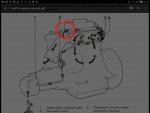
I cleared the holes in the cooling block but did not check the actual exhaust. Do you mean here?

Screenshot_20180423-231821_1.jpg


Next time I'm open the boat I will...
Check the exhaust
Fit the thermostat
Run acid cleaner through the engine on a loop

Thanks Vic and everyone else. It is very much appreciated.

S
 
Top