No eye bath in Cat C first aid kit

Sailingsaves

Well-Known Member
Joined
26 Feb 2013
Messages
2,079
Visit site
Just in case this helps anyone.

I HAD to buy a cat C first aid kit when I had a boat.

I kept it when boat had to go.

Needed an eye bath quickly the other day to find there was not one in cat C first aid kit.

There was one in the old £5 Moss first aid kit. Great first aid kit.

Moral of story, make your own kit for use and store the expensive cat C (sealed) if your boat requires one.
 
After doing a few mild First Aid courses I realised one has to make up ones' own First Aid kit according to the sort of sailing and area planned.

One thing I was upset about was repeatedly being shown CPR breathing tubes in demonstrations, " Oh Boots will supply them ", then when asking in Boots I may have as well been enquiring about a Martian Space Hook judging by the response I got...

Still don't have one in my kit, though I appreciate it's largely to avoid dodgy things which I wouldn't expect with crew but there's always the unexpected and I'd like to be able to help without worrying.
 
They may have been talking about the old Brooks Airway and I've only ever seen one and not in the last 30 years. There are various cpr face shields available from the Laerdal Pocket Mask to plastic/mesh cloth types of which I have one in my wallet. If you don't want to do all that "kissing business", stick to the chest compressions.

As for eye baths, some bottled water does the trick.
 
One thing I was upset about was repeatedly being shown CPR breathing tubes in demonstrations, " Oh Boots will supply them ", then when asking in Boots I may have as well been enquiring about a Martian Space Hook judging by the response I got...

Still don't have one in my kit, though I appreciate it's largely to avoid dodgy things which I wouldn't expect with crew but there's always the unexpected and I'd like to be able to help without worrying.

"Breathing tubes" as in Guedal airways? I think I'd want more than a couple of demonstrations before I tried to shove one of those down someone's throat.

Or are we talking about those one-way-valve face masks? Seemed to be very popular when I learned to dive, but I hadn't really come across them since. Then when I bought an MCA cat C pack to start off Ariam's first aid kit (as the OP says, best to use this as a base and add other stuff rather than regard it as a sealed magic bag) I found one in there.

I'm sure you could find one on eBay nowadays.

Pete
 
Funnily enough, I don't fancy getting crucial First Aid kit from E-Bay !

The thing I wa shown on a few courses was a short tube with a mouthpiece, maybe a one-way valve incorporated; I asked for the name of the thing but as mentioned it did me no good at Boots.

It was about 15 & 18 years ago now I think about it, ie I should do another course as I know theories & practices change.

At one course my club organised the wily nurse got the prettiest girl in the club to be a CPR & ' ' kiss of life ' subject; sadly I got trampled in the rush.
 
Funnily enough, I don't fancy getting crucial First Aid kit from E-Bay !

Why not - lots of perfectly reputable companies use it as a storefront these days. And a pocket mask is hardly "crucial", as demonstrated by the fact that you don't currently have one (and I doubt I would have bought one if it didn't come in the kit).

The thing I wa shown on a few courses was a short tube with a mouthpiece, maybe a one-way valve incorporated;

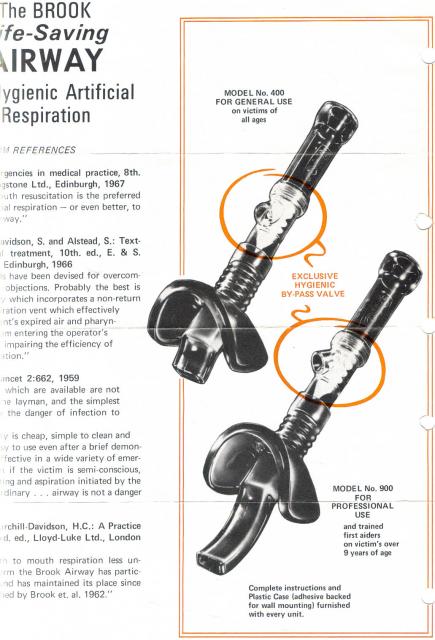
I googled the Brook Airway after Colin suggested it above; I'd never heard of it before but it seems to match your description.

Perhaps tellingly, the page I came up with to see what it was, was from a kind of online museum of obsolete ambulance kit!

EDIT: This is one of the pictures from that museum:

brook_2_JHWood.jpg


Perhaps I just have a dirty mind, but it looks somewhat dildonic to me...

Pete
 
Last edited:
PRV,

the thing you show is vaguely similar but not the same as the more compact thing I saw demonstrated.

Anyway, what is the modern answer to breathing into people without catching something nasty, apart from the ' just stick to chest compressions ' which I doubt will save some people ?
 
It was about 15 & 18 years ago now I think about it, ie I should do another course as I know theories & practices change.

You think they have changed a little in this time. I have been doing First aid/ medical courses regularly for nearly years (I just counted that's scary). One thing I do no is every time I do a course the human body evolves and there is new advice guidelines etc...

Anyway, what is the modern answer to breathing into people without catching something nasty, apart from the ' just stick to chest compressions ' which I doubt will save some people ?

There are various cpr face shields available from the Laerdal Pocket Mask to plastic/mesh cloth types of which I have one in my wallet. If you don't want to do all that "kissing business", stick to the chest compressions.
 
A Cat C kit is never intended to contain everything or to be the primary/only first aid kit on a boat.

My understanding is that it is a sealed kit with a known range of items to be used when seeking medical assistance over the VHF - a doctor will know what you have available and advise accordingly - that's why it is sealed and why it should only be unsealed under medical supervision.
 
one of these maybe ?
2763-canule-de-guedel-z.jpg

Definitely not for amateur use those - even trained paramedics sometimes get inserting them wrong.

The gold standard is the Laerdal or similar mask, but a plastic bag with a small hole will do if you really don't fancy snogging the victim and you've nothing better.

Plain chest compressions are Ok for a "normal" cardiac arrest - heart attack or whatever, but for drowning or choking victims, starting with rescue breaths is still the standard protocol and they need to be started ASAP, not after you've spent 10 minutes rummaging through a locker for your first aid kit.
 
Last edited:
one of these maybe ?
2763-canule-de-guedel-z.jpg

They're Guedal oropharyngeal airways, used to keep the airway clear of the tongue etc., while using a bag and mask for inflations and making it easier if the head isn't hyperextended properly. Useful for an unconscious casualty who is breathing but unable to maintain their own airway while you're on the phone/vhf. Different kit for different jobs. If you want to protect yourself while doing mouth to mouth, there are other proprietary stuff available.

I just googled CPR shield and it came up with a bewildering range of stuff, all of which will probably work fine.
 
At one course my club organised the wily nurse got the prettiest girl in the club to be a CPR & ' ' kiss of life ' subject; sadly I got trampled in the rush.

I can't find my specs, and read your comment as "willy nurse" i.e. one who specialises in willies.
No wonder there was a rush.
 
Definitely not for amateur use those - even trained paramedics sometimes get inserting them wrong.


[...]

starting with rescue breaths is still the standard protocol and they need to be started ASAP, not after you've spent 10 minutes rummaging through a locker for your first aid kit.


I was just puzzled as that thing was shown on the early '70s Glenans sailing manual -when it was in two volumes, only drawings and no pictures- it was onboard mandatory kit at that time I suppose, not any more today. IIRC it was called "Ambu" (?).

Anyway, no way I would try to use what looks like a torture instrument, and as you say it would most likely be under a load of other stuff when time must be spent to revive the person.

The only thing I kept *really* readily available (in the fridge) was the allergy emergency injection (epinephrine?), at a period where we were in places with lots of unknown insects. Happily passed its "best before date" without being used :)
 
A Cat C kit is never intended to contain everything or to be the primary/only first aid kit on a boat.

It certainly gives the impression that it is, at least for boats that remain near shore.

The official contents include simple things like plasters for small cuts - if there was any intention for this to be the "special" kit alongside a more mundane self-assembled set, surely boring old plasters would be left up to you?

The only reason most charter boats have an "everyday" and a "sealed" kit is convenience. The law requires them to always carry the complete list of Cat C items (note that those items don't have to be bought together as a kit - they just need to be on board and stowed appropriately). If the charterers are helping themselves to the plasters for a cut finger, or the paracetamol for a hangover, then making sure the boat always goes out with the full list will be an annoying chore. So you have a tupperware box for the plasters and aspirins, and ask them to stay out of the sealed kit unless needed.

My understanding is that it is a sealed kit with a known range of items to be used when seeking medical assistance over the VHF - a doctor will know what you have available and advise accordingly - that's why it is sealed and why it should only be unsealed under medical supervision.

Some of that thinking certainly applies to the bigger kits for commercial shipping and offshore charter - by having a standard set of equipment and drugs the doctor can better advise what to do in case of serious trouble. Though in fact I'd suggest it's more important in relation to the Ship Captain's Medical Guide - a live doctor can ask what you have and make substitutions if required, but the book can only practically be written by assuming a fixed set of stuff.

Even offshore, though, there's no requirement to keep the kit sealed and unused. Indeed, the Ship Captain's Medical Guide tells you to administer various antibiotics and minor drugs without contacting a doctor first. The kit has to be complete (if your vessel is one that's required to carry it) at the start of a voyage, but thereafter it is expected that you will use it as required. In the case of major accident or illness this may mean RADIO MEDICAL ADVICE (as the book prints it :) ), for less serious stuff it will not. Nobody called a doctor before bending me over Stavros's wardroom table with my trousers down to sew up a gash in the top of my thigh :).

In the case of a Cat C kit on a yacht, the idea of the known range of items solemnly kept inviolate for Doctor's use seems a little silly. Apart from the angina spray, it's basically a rather lightly stocked bathroom medicine cabinet:

Stugeron,
Immodium,
Paracetamol,
Ibuprofen,
Antiseptic wipes,
Savlon,
Mouth-to-mouth mask and disposable gloves,
A clean plastic bag to put a burned hand in,
Scissors and safety pins,
And a stack of bandages, plasters, and steri-strips.

Pete
 
My daughter who is a St Johns girl carries a small pouch that is a combination mask and breather. I have no idea how it works but its small, plastic, doesn't seem to have a tube but lets you give mouth to mouth without the risk of catching an infection. She is home at the weekend, I will try to find out more.
 
Just in case this helps anyone.

I HAD to buy a cat C first aid kit when I had a boat.

I kept it when boat had to go.

Needed an eye bath quickly the other day to find there was not one in cat C first aid kit.

There was one in the old £5 Moss first aid kit. Great first aid kit.

Moral of story, make your own kit for use and store the expensive cat C (sealed) if your boat requires one.

why would it? no much call for one on a boat I would have thought.
 
why would it? no much call for one on a boat I would have thought.

?

For the sake of 20 pence worth of plastic.

Diesel, petrol, pepper, deo spray in eye. I can think of plenty of things on boat that I would like to wash out of my eye. Cat C kits are poor value for money.
 
The only reason most charter boats have an "everyday" and a "sealed" kit is convenience. The law requires them to always carry the complete list of Cat C items (note that those items don't have to be bought together as a kit - they just need to be on board and stowed appropriately). If the charterers are helping themselves to the plasters for a cut finger, or the paracetamol for a hangover, then making sure the boat always goes out with the full list will be an annoying chore. So you have a tupperware box for the plasters and aspirins, and ask them to stay out of the sealed kit unless needed.

Just to add to the above.
Often the reason for carrying a sealed first aid kit relates to the Liferaft Grab Bag.

Liferafts on vessels identified in 1.4 should be of either DTp approved type or
Offshore Racing Council (ORC) type. Liferafts should be equipped with “SOLAS
B PACK” or, if ORC standard liferafts are fitted each liferaft should be provided
with a “grab bag” containing the following equipment:-
.1 second sea anchor and line;
.2 a first aid kit;
.3 one daylight signalling mirror;
.4 one signalling whistle;
.5 one radar reflector;
So if you keep a sealed first aid kit in the liferaft grab bag you can have whatever other kit you want for day to day use.
 
Top