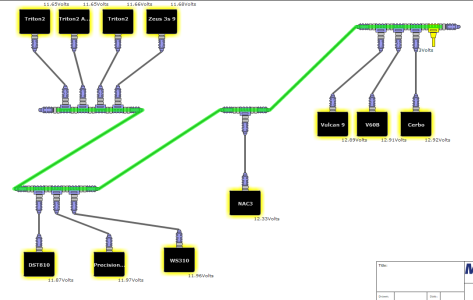
NMEA 2k voltage

lustyd

Well-Known Member
Joined
27 Jul 2010
Messages
14,207
Visit site
Just faffing with the network today and while we’re still in spec, we do have voltage drop that seems excessive. The whole backbone is less than 20m, probably more like 15m using Garmin cables. Drop cables are all very short. Annoyingly the power feed is at one end and the instruments are at the other which is probably the main issue.

Has anyone else checked the voltage on their network and can comment on what would be normal? I don’t really fancy a full troubleshooting exercise and would really prefer not to move the power input as it would require a lot of boat yoga and another long power cable run.

We’ve not had any real issues but the low voltage alarm has tripped twice this year when we had all the things running at once under sail.
 
You could try taking all the connectors apart and putting contact cleaner on them. That made a small difference on mine, though our main issue was overall voltage drop, not just the N2K network. I got 10% more from it.
 
That’s interesting, perhaps it’s normal to have such a drop. The cores are certainly very thin in consumer cables.
 
Can you move the power feed? That would allow you to use a thicker cable to get the 12v closer to the instruments.

It's against specification, but I bet it's fine to power the bus in more than one place.
 
Actisense used to have, and may still have, a free NMEA design tool for PC, which showed you what voltage to expect at each instrument, based on 12volts at the power feed point, cable lengths and power requirements of each individual device. I used it to design my system, and it quickly showed the need to put the input close to the main instrument group.
 
In theory I can move the feed to the binnacle, yes. That would mean all instruments switch with the main plotter (or I have to run more cable). That’s 6mm wire so would be plenty beefy enough but potentially moves the low voltage to the other end. My preference was to be able to switch on just the instruments to watch wind and depth from below without the main plotter being on.

All good info so far, thanks. It’s good to gather these thoughts to consider all options before taking action.
 
Can you move the power feed? That would allow you to use a thicker cable to get the 12v closer to the instruments.

It's against specification, but I bet it's fine to power the bus in more than one place.
Powering the bus from more than one insertion point is against spec' to prevent ground loops, which can cause problems. If a network needs more power you can split the power between segments of the network, often done by fitting special power tees. The tee has two pairs of power wires, one pair powers the network to the left of the tee, the other pair powers everything to the right of the tee. You could also break into a section of backbone cable, separating the power wires from the data wires, cutting them and powering the network as with the tee.
 
Just faffing with the network today and while we’re still in spec, we do have voltage drop that seems excessive. The whole backbone is less than 20m, probably more like 15m using Garmin cables. Drop cables are all very short. Annoyingly the power feed is at one end and the instruments are at the other which is probably the main issue.

Has anyone else checked the voltage on their network and can comment on what would be normal? I don’t really fancy a full troubleshooting exercise and would really prefer not to move the power input as it would require a lot of boat yoga and another long power cable run.

We’ve not had any real issues but the low voltage alarm has tripped twice this year when we had all the things running at once under sail.
Do you power direct from the lithium battery or via a DC/DC? With us being 24v, we use a DC/DC supply to create the 12v to the backbone. We have never had power issues and we have a similar length backbone with some long spur cables
 
Do you power direct from the lithium battery or via a DC/DC? With us being 24v, we use a DC/DC supply to create the 12v to the backbone. We have never had power issues and we have a similar length backbone with some long spur cables
That’s why I suggested cleaning the joints. I was, because of other 21year old wiring issues, only putting 11.5v in, and that last 10% of loss pushed it over the edge when the sun wasn’t shining and solar not upping the voltage. My connectors were visually good, clearly not as good as they could be.
 
Actisense used to have, and may still have, a free NMEA design tool for PC
Couldn't find one from Actisense, but did find Maretron's which may have been what you were thinking of. I drew out the network and added all the components and it confirmed essentially the exact voltage I'm seeing, which is very reassuring. I virtually moved the insertion to the other end and dropped the supply voltage by 0.5V (guesswork to account for longer cable) and everything gets a much better voltage accross the board. Needless to say, I'm going to bite the bullet and move the insertion point. Initially I'll just pop it on the plotter feed and then decide later if I want to bother with a separate cable, which would be a pain to install.
Really pleased with this, using a bit of science and a tool has made this so much simpler.
 
Do you power direct from the lithium battery or via a DC/DC? With us being 24v, we use a DC/DC supply to create the 12v to the backbone. We have never had power issues and we have a similar length backbone with some long spur cables
Straight from battery at 13.somethingV. I was seeing 11.somthingV at the other end, which the tool confirmed was expected for micro cable (in hindsight I might have sought out bigger backbone cable as well). Moving the insertion to the helm entirely corrects this.
That’s why I suggested cleaning the joints. I was, because of other 21year old wiring issues, only putting 11.5v in, and that last 10% of loss pushed it over the edge
Ours is only 4 years old and we were putting in 13V or so from lithium, which I guess was lower when sailing and pulling power for the radar, autopilot etc. too. I was surprised how much drop was expected on the network, especially given how much smaller ours is than the spec allows. The Maretron tool is fantastic for modelling this, I should have done it at the start.
 
Do you power direct from the lithium battery or via a DC/DC? With us being 24v, we use a DC/DC supply to create the 12v to the backbone. We have never had power issues and we have a similar length backbone with some long spur cables
The other advantage of a DC to DC converter is that they can be set to a stable, higher but still acceptable voltage such as 13.8V, but Lustyd realises the obvious solution is to move the 12V injection to a point closer to where the voltage drop at both ends of the cable is minimised. This is normally not difficult.
 
The other advantage of a DC to DC converter is that they can be set to a stable, higher but still acceptable voltage such as 13.8V, but Lustyd realises the obvious solution is to move the 12V injection to a point closer to where the voltage drop at both ends of the cable is minimised. This is normally not difficult.
That's an interesting one. Having put several devices like this on the boat I would now do anything to avoid more. They all add a little bit of interference (because they work identically to radio transmitters!), so while the electricity might be better other things start to degrade. The Orion DC-DC famously ruins both the tachometer and VHF/AIS. I agree with the theory, but where another solution exists I think the other solution is generally more desirable.
 
That's an interesting one. Having put several devices like this on the boat I would now do anything to avoid more. They all add a little bit of interference (because they work identically to radio transmitters!),
A good point. There is always a risk of VHF interference with any voltage conversion. In practice, I have never encountered a problem, and we try to power most of our devices such as screens, computers, etc directly from DC rather than from AC as it is more electrically efficient.

This lack of interference may be because with a 24V system, we are using buck rather than buck/boost converters.

Interference with the voltage conversion, on and off, is easy to compare.
 
Last edited:
Each consumer has a LEN (Load Equivalency Number) which is a multiple of 50mA and defines how much a device consumes from the network. A value of 1 (50mA) is the Trasciever of a device with its own power supply, 3 (150mA) is typical for a small instrument display powered from the bus. Every device will have a LEN in its spec sheet. Best practice is to count up the LEN values in the network and put the power cable connection in the middle with equal LEN counts on each side.

Powering your NMEA 2000 network
 
Yes the software accounted for the LEN values.
The idea that the power can just be in the middle is madness on any real boat in my opinion. If you’re running additional power along half the length of the network it’s easier and cheaper to use bigger backbone cable.
 
Top