NMEA 0183 networking...noob assistance please!

KevinV

Well-Known Member
Joined
12 Oct 2021
Messages
4,539
Visit site
I've used a few instruments, and fixed a loose wire or two over the years, and done cat5/6 networking, but never designed an nmea0183 network from (almost ) scratch.
I'm on a limited budget, so am working from the (currently unnetworked) 0183 instruments I do have and adding in a bit, rather than replacing everything with much simpler nmea2000; I simply can't afford it.

I think I'm almost there on the wiring diagram, which I'll post in due course, but right now I'm just a little unclear and would appreciate clarification.

Connecting "talker" TX+ that has no TX-, I understand one connects the TX+ to the "listener" RX+, correct?
If TX doesn't say + or - I think it must be +, correct?
The talker presumably has an internal connection from (what would be) TX- to supply-, correct?
What do you do with RX-? I presume connect to supply-? (creating a connection TX- to RX- via the supply-), but I thought I'd better check

Please keep answers straightforward, my head's already spinning and I'm drowning in acronyms!
 
What make / model are they, and what are hoping to achieve with joining them up? The end goal will be very helpful to shape any advise you receive.
I was hoping to postpone that until I have the diagram done, because there are more questions to ask at that point - I'm really just wanting, if possible, to clarify my understanding of first principles, erm, first
 
Sorry, that sounded a bit obtuse, I'm mostly trying to not confuse myself, or have the thread drift before I have the answer to the question I have now :)

I have nasa clipper - log, depth, course instruments, with remote sensor for the course. Also serviceable navman7100 dsc vhf.
First requirement is GPS sensor +repeater, to give me cog/sog

Ideally, AIS transiever, and WiFi to tablet for navigation backup (I rather like paper and pencil plotting)

The Em-trak 924 would give GPS, AIS and WiFi, plus 0183 multiplexing and vhf/AIS splitter in one package - so this seems the obvious thing to do. From what I can see it is possible to achieve all functions separately, but at no substantial discount without losing UK based back-up.

That's my thinking so far :)
 
Connecting "talker" TX+ that has no TX-, I understand one connects the TX+ to the "listener" RX+, correct?
If TX doesn't say + or - I think it must be +, correct?
The talker presumably has an internal connection from (what would be) TX- to supply-, correct?
What do you do with RX-? I presume connect to supply-? (creating a connection TX- to RX- via the supply-), but I thought I'd better check
Pretty much.

if you’re anywhere near the average forum age familiar with computer networking you’ll be familiar with the concept of “differential” vs “single ended” signals.

Modern nmea -0183 is differential, ie signal is the difference between tx+ and tx- but you also encounter single ended devices where the signal is the difference between “tx” and ground. So use the talker’s power negative to connect to rx-.

Other than that, the rules are reasonably straightforward: don’t connect multiple talkers to one receiver. You can connect one talker to multiple receivers: the number varies according to the power of the devices but up to at least 3 is generally ok. Avoid loops with devices which forward their inputs
 
Pretty much.

if you’re anywhere near the average forum age familiar with computer networking you’ll be familiar with the concept of “differential” vs “single ended” signals.

Modern nmea -0183 is differential, ie signal is the difference between tx+ and tx- but you also encounter single ended devices where the signal is the difference between “tx” and ground. So use the talker’s power negative to connect to rx-.

Other than that, the rules are reasonably straightforward: don’t connect multiple talkers to one receiver. You can connect one talker to multiple receivers: the number varies according to the power of the devices but up to at least 3 is generally ok. Avoid loops with devices which forward their inputs

Excellent explanation, thank you - I hadn't encountered differential v single ended - still wet behind the ears compared to the average I guess!

Shipmodul, who produce multiplexers of various kinds, have a very clear description here of how to connect 0183 devices.

Brilliant link, I was wondering if it was possible to mix listener types on one TX line - turns out it is, which tidies up the wiring a bit.

Thanks both, I'll post my proposed diagram when I've put in those last details :)
 
So @northwind @laika @Hoolie (and anyone else who cares to pipe up), with these givens:

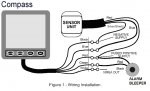
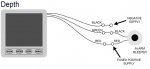
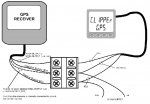
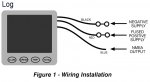
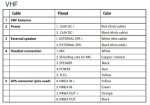
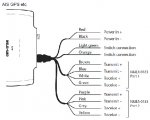
compass wiring.jpgdepth wiring.jpgdepth wiring.jpggps repeater wiring sized70.jpglog wiring.jpgvhf wiring.jpgAIS wiring sized80.jpg


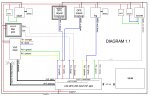
I've come up with this:
wiring diagram1.1 sized50.jpg
It looks remarkably simple now it's done - I think I've adhered to all the rules, but would rather hear now that I've boobed, instead of finding out the hard (expensive!) way.

Any and all feedback gratefully received.
 
So @northwind @laika @Hoolie (and anyone else who cares to pipe up), with these givens:

View attachment 125087View attachment 125088View attachment 125088View attachment 125089View attachment 125090View attachment 125091View attachment 125086


I've come up with this:
View attachment 125094
It looks remarkably simple now it's done - I think I've adhered to all the rules, but would rather hear now that I've boobed, instead of finding out the hard (expensive!) way.

Any and all feedback gratefully received.

There's a lot to look at there.

You will need to set port 1 on the Emtrak to 4800, easy done with the config software. The yellow and green AIS wires will need to go somewhere, if the GPS repeaters have no data - connections they'll need to go to 12v negative (same place as the neg power cable will be good.

I don't think i'd connect the log and course to the AIS and omit the depth (assuming the depth device has 0183 out). Any data input to the AIS 0183 ports will be multiplexed and sent over wifi, along with GPS and AIS, depth might be more useful on the tablet than, for instance, the log?
 
There's a lot to look at there.

You will need to set port 1 on the Emtrak to 4800, easy done with the config software. The yellow and green AIS wires will need to go somewhere, if the GPS repeaters have no data - connections they'll need to go to 12v negative (same place as the neg power cable will be good.

I don't think i'd connect the log and course to the AIS and omit the depth (assuming the depth device has 0183 out). Any data input to the AIS 0183 ports will be multiplexed and sent over wifi, along with GPS and AIS, depth might be more useful on the tablet than, for instance, the log?
OP is using NASA clipper, so no nmea out on depth.
 
There's a lot to look at there.

You will need to set port 1 on the Emtrak to 4800, easy done with the config software. The yellow and green AIS wires will need to go somewhere, if the GPS repeaters have no data - connections they'll need to go to 12v negative (same place as the neg power cable will be good.

I don't think i'd connect the log and course to the AIS and omit the depth (assuming the depth device has 0183 out). Any data input to the AIS 0183 ports will be multiplexed and sent over wifi, along with GPS and AIS, depth might be more useful on the tablet than, for instance, the log?

Thank you so much for the input - I know it was a lot to ask!

Thanks for clarifying the RX- side of things, I had misread the the guidance in @Hoolie 's post, which reads "Do not connect the B terminal to a power ground//close to the multiplexer but feed a ground wire to the instrument and connect it there to the instrument ground" - I'd got the first part of that sentence cemented in my brain before finishing the sentence.

Re the GPS repeaters, do you mean that in addition to the RX- on the VHF I should tie it into supply- too?

Agree completely about depth being desirable, but as @northwind says, the clipper unit doesn't have an nmea 0183 output wire. It DOES have an optional propietary lead to a repeater unit, so I have emailed them asking what protocol it uses - you never know, I might be lucky. Then there would just be the small matter of having run out of RX ports and having to figure a multiplexer into the arrangementso_O.
 
T
Thank you so much for the input - I know it was a lot to ask!

Thanks for clarifying the RX- side of things, I had misread the the guidance in @Hoolie 's post, which reads "Do not connect the B terminal to a power ground//close to the multiplexer but feed a ground wire to the instrument and connect it there to the instrument ground" - I'd got the first part of that sentence cemented in my brain before finishing the sentence.

Re the GPS repeaters, do you mean that in addition to the RX- on the VHF I should tie it into supply- too?

Agree completely about depth being desirable, but as @northwind says, the clipper unit doesn't have an nmea 0183 output wire. It DOES have an optional propietary lead to a repeater unit, so I have emailed them asking what protocol it uses - you never know, I might be lucky. Then there would just be the small matter of having run out of RX ports and having to figure a multiplexer into the arrangementso_O.
The port on the back of the NASA depth only outputs an i2c logic sentence, if you are handy with electronics it is possible to read this and convert it.. See here for example
De:NASA Clipper Range – OpenSeaMap-dev
 
Thank you so much for the input - I know it was a lot to ask!

Thanks for clarifying the RX- side of things, I had misread the the guidance in @Hoolie 's post, which reads "Do not connect the B terminal to a power ground//close to the multiplexer but feed a ground wire to the instrument and connect it there to the instrument ground" - I'd got the first part of that sentence cemented in my brain before finishing the sentence.

In my experience it doesn't make any difference if the two "negative" data wires are connected near the AIS or the GPS repeaters.

Re the GPS repeaters, do you mean that in addition to the RX- on the VHF I should tie it into supply- too?

No, the VHF is correct as it is shown.

Agree completely about depth being desirable, but as @northwind says, the clipper unit doesn't have an nmea 0183 output wire. It DOES have an optional propietary lead to a repeater unit, so I have emailed them asking what protocol it uses - you never know, I might be lucky. Then there would just be the small matter of having run out of RX ports and having to figure a multiplexer into the arrangementso_O.

Yes. i missed where you said it was NASA in a later post.
 
The port on the back of the NASA depth only outputs an i2c logic sentence, if you are handy with electronics it is possible to read this and convert it.. See here for example
De:NASA Clipper Range – OpenSeaMap-dev

Wow, some people really are very clever - I can understand what it says, but how do people work it out from scratch?

I'm only about 2ft draft, I think a piece of bamboo off the bow with a bell on the end might be more my kind of inventive!
 
Top