Nicholson 26 compression post

aslabend

Well-Known Member
Joined
11 Feb 2009
Messages
1,288
Location
New Forest
Visit site
Anyone ever had to take theirs out?
Mine failed yesterday at the base due to corrosion dropping the mast by about half an inch (which was quite exciting at the time). It seems to have 4 bolts at the base and the must cup has about 8 bolts at the top. I know I'll have to take some floor up and jacking the coach house roof up should allow me to get the now shortened old post out but i'm hoping someone has experience on getting it back in once repaired/remade. Anyone helpful advice would be much appreciated.
 
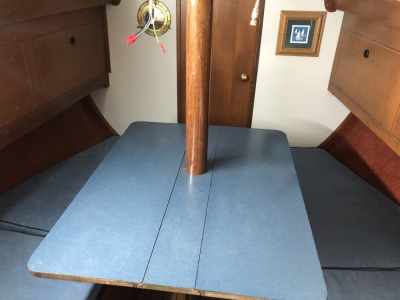
I replaced mine a few years ago. Balked at the quotes I was getting for a length of pipe so made one out of mahogany. I built it using the epoxy and birdsmouth spar technique. Being hollow I could run cables up it for saloon and masthead lights.
A broad oak pad at the top to spread the load and a jacking screw at the bottom. I also fitted a collar at the top to ensure it couldn’t slip sideways if someone fell against it.

1687361873315.png
 
You speak of replacing/repairing the post, but depending on the nature and extent of the failure, and the overall arrangement, it may be preferable or easier to build up the base on which the (reduced length) post sits, or to insert an additional or deeper 'spacer' between the top of the post and the mast bracket.
 
You speak of replacing/repairing the post, but depending on the nature and extent of the failure, and the overall arrangement, it may be preferable or easier to build up the base on which the (reduced length) post sits, or to insert an additional or deeper 'spacer' between the top of the post and the mast bracket.
The reduced length is because the bottom of the post has disintegrated but then it is half a century old.
Thanks for the replys though as the mention of jacking screw in the first and spacers in the second has got thinking that there are ways of making the job easier. I was worrying about getting the new post made to the correct length but maybe I can make it extendable or shim it up to fit which will make putting it in so much simpler.
 
Last edited:
The reduced length is because the bottom of the post has disintegrated but then it is half a century old.
Thanks for the replys though as the mention of jacking screw in the first and spacers in the second has got thinking that there are ways of making the job easier. I was worrying about getting the new post made to the correct length but maybe I can make it extendable or shim it up to fit which will make putting it in so much simpler.
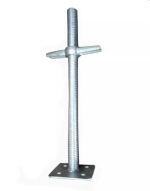
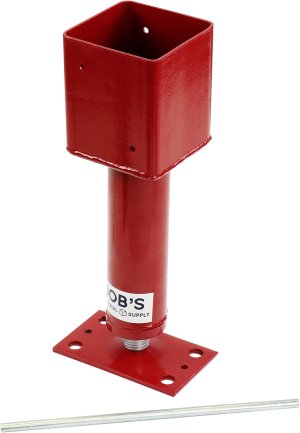
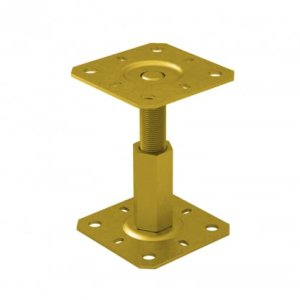
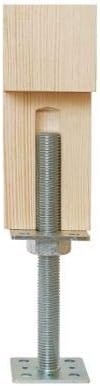
Length of square steel tube with an adjustable foot, put in place, adjust the height, then clad in wood, being square makes it easier to clad

Shorter version of: Adjustable foot.png Post Adjuster.jpgPost Base Adjuster.jpgPost Adjuster in Place.jpg
 
Last edited:
….the mention of jacking screw in the first and spacers in the second has got thinking that there are ways of making the job easier.
Not familiar with the Nicholson 26, but I had a similar problem with the wooden compression post in my 29 foot sailing boat.
Decided to cut off the bottom 30mm or so that had become a bit soft from absorbing bilge water.
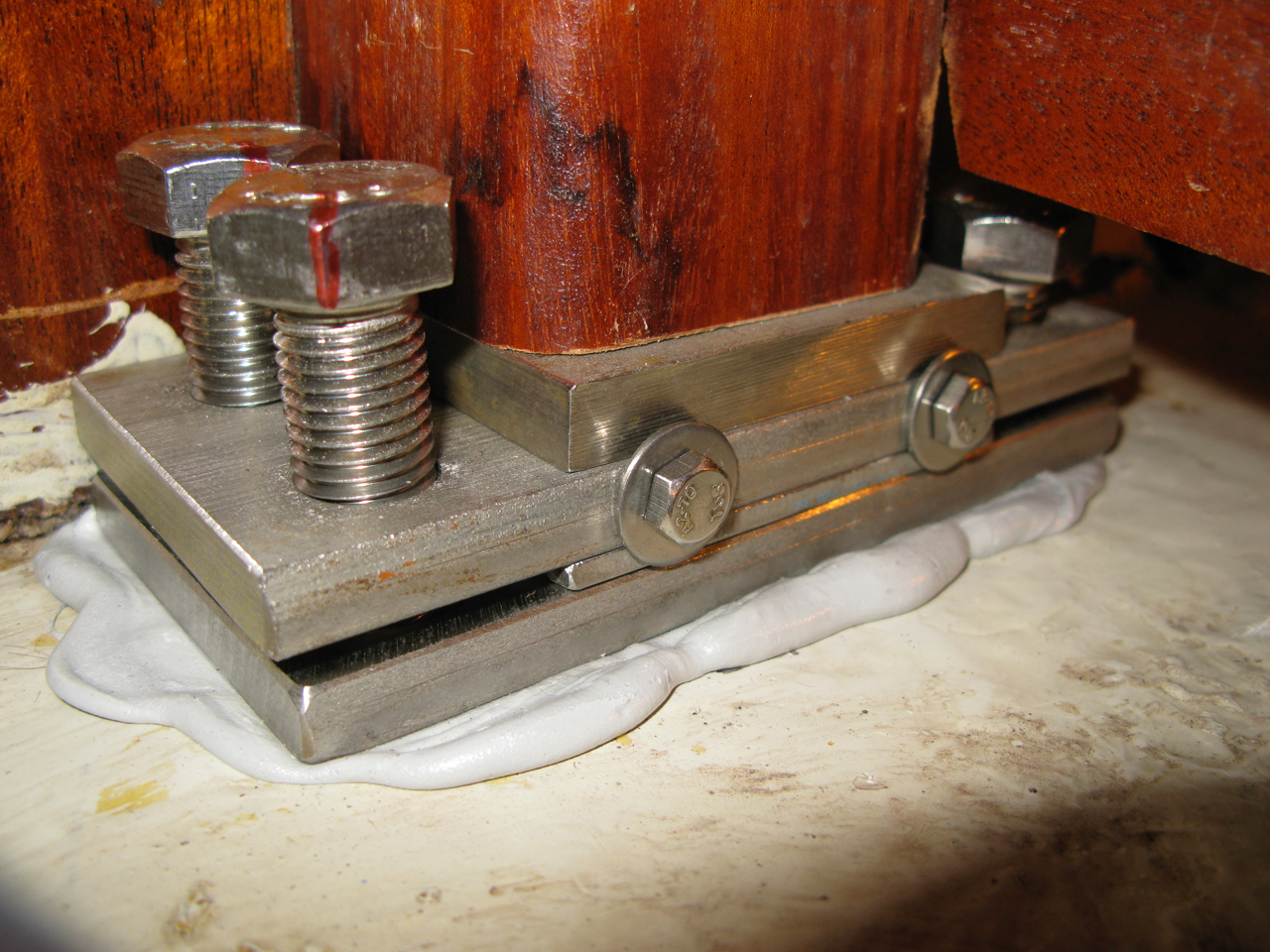
My post is attached to the main bulk head, so I needed to jack up this whole structure a bit before inserting the stainless steel spacers. The solution I came upp with can be seen in this photo. The thicker plates are about 10mm, the jacking screws, two on either side, are M16.
I would be somewhat reluctant to let a single threaded bolt take the entire compression load, as suggested above. My bolts are only used for the jacking (done with mast down), the load is then taken by the spacers.
mast%20support%20jack.jpg
 
Thanks Babayaga, I agree with you about being reluctant about letting a single thread take the load.
Your solution is ingenious but is it just "free floating" held in place by friction or is there a mechanical fixing to the floor and between the wooden post and the plates.

If anyone is interested, progress so far.
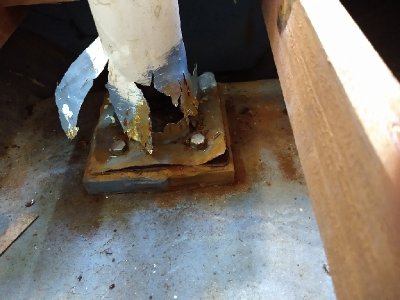
Floors up and here's the base of the post. It feels like it corroded from the inside out as those splayed outer bits are still quite tough
to bend.

IMG_20230622_161327695.png
 
I agree with you about being reluctant about letting a single thread take the load.
Your solution is ingenious but is it just "free floating" held in place by friction or is there a mechanical fixing to the floor and between the wooden post and the plates.
It is fixed to the GRP floor only by epoxy putty (what looks like chewing gum in the photo). This was more intended to even out the mating surfaces and to avoid any hard spots. In practice, the spacer/jack up unit is held in place and together by the considerable downward force.
One difference is that my post is glued and screwed to the bulk head, so it cannot wander off.
 
Hi, I've just come across this thread as I have the same problem. I also have a Nic26, this summer my boat filled up (with sea and rain water) while I was away. During the clean up operation, I noted a lot of corrosion around the base of the compression post. The post had been painted with multipile coats of paint over the years, this was now peeling off and underneath bits of corroded metal. I should say my post is still doing its job, as far as I can tell it hasn't dropped any and my mast rig hasn't been detensioned.
At the thinnest part of the corrosion, I was able to punch a 5mm shaft slot screwdriver through one side of the post. For now the rest of the corroded part still seems thick and strong enough to support my mast, but I do need to find a solution to prevent further corrosion. Maybe sacrifical anode screwed into the post at the base? Obviously I would detension the rig before carrying out any remedial work. The boat is now on the hard for the winter, I'd like prevention measure in place for next season. Any thoughts anyone?
 
In response to Tranona, my understanding is that galvanic corrosion can occur in a single piece of iron, one part becoming anode and remainder cathode. As long as both immersed in same bit of water (electrolyte) with a supply of oxygen you have the conditions for galvanic cell. The idea of joining a more reactive metal close to the site of corrosion and immersed in same water turns the added metal (usually zinc) into the anode.
Off course if i could keep this area dry, i wouldn't have a problem, but even if i add an automatic bilge pump to deal with my leaky stern gland, i still have condensation. Water collects in this space from the whole f'ard cabin and heads. Ive heard of (livaboards i think) who employ low power fans to keep their boat interior dry and free of mildew.
 
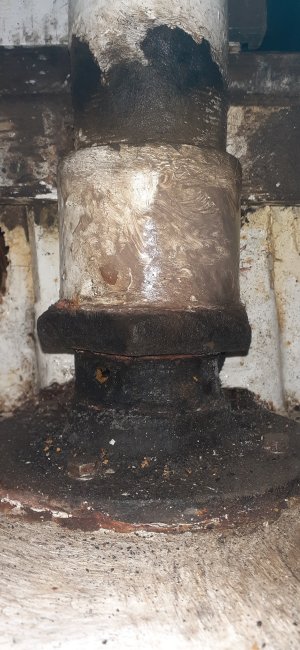
For anyone still interested in this post, Ive taken pics of compression post of my Nic 26. Note near the base is an adjustable flange, presumably to screw down to get the correct amount of compression when installed. I say adjustable but Ive never tried to move it in my 14 years of ownership. Note also the small hole at base of post LH side as you look. Until recently the post and base plate had several layers of paint. For the parts you see still painted, they resisted my attacks with a wire brush.
 

Attachments

  • 20231112_155620.jpg
    20231112_155620.jpg
    1.5 MB · Views: 17
I'd replace it like-for-like but have it remade in stainless steel, fabrication costs being what they are getting it in mild steel and then having it galvanised won't save much. The alternative being the wooden post as @Porthandbuoy has done.
 
Could you use a scaffold pole? they are already galvanized. I know of someone who used one to replace his rotten wooden post. Just welded a plate either end and bolted it in. He also sheathed it in wood to disguise the pole
 
In response to Tranona, my understanding is that galvanic corrosion can occur in a single piece of iron, one part becoming anode and remainder cathode. As long as both immersed in same bit of water (electrolyte) with a supply of oxygen you have the conditions for galvanic cell. The idea of joining a more reactive metal close to the site of corrosion and immersed in same water turns the added metal (usually zinc) into the anode.
Off course if i could keep this area dry, i wouldn't have a problem, but even if i add an automatic bilge pump to deal with my leaky stern gland, i still have condensation. Water collects in this space from the whole f'ard cabin and heads. Ive heard of (livaboards i think) who employ low power fans to keep their boat interior dry and free of mildew.
I think you are confusing this with crevice corrosion in stainless steel - which also cannot be prevented with an anode. If that post is mild steel what you are seeing straightforward rust. while it is possible for iron castings to contain traces of metals other than iron that may have a different potential the amounts are likely to be very small. The only way of preventing corrosion in the mild steel tube (if that is what it is) is to isolate it from the water, or better still remove the water as you suggested.

This is possible on an old boat. First task is to deal with all leaks, particularly getting rid of the traditional stern gland by replacing with a modern drip free one. Second prevent any leaks of freshwater from above. Then remove all fabrics which will have accumulated salt deposits over the years plus any other items that might hold water such as cardboard boxes, books, charts etc. Empty the bilges of water and leave everything open by removing such things as hatches and locker doors. When the boat is essentially back to a bare shell, run a dehumidifier and a tube heater to bring the temperature up in the winter and the humidity down. Wash all fabrics to remove salt before putting back.

This is what I did with the leaky boat I bought 2 years ago. Dealt with all the leaks in the first year, replaced all the fabrics, got rid of all the junk and fitted a non drip stern gland. Ran the dehumidifier and tube heater all last winter with the boat in the water and now completely dry.
 
....... First task is to deal with all leaks, particularly getting rid of the traditional stern gland by replacing with a modern drip free one. Second prevent any leaks of freshwater from above. Then remove all fabrics which will have accumulated salt deposits over the years plus any other items that might hold water such as cardboard boxes, books, charts etc. Empty the bilges of water and leave everything open by removing such things as hatches and locker doors. When the boat is essentially back to a bare shell, run a dehumidifier and a tube heater to bring the temperature up in the winter and the humidity down. Wash all fabrics to remove salt before putting back.

This is what I did with the leaky boat I bought 2 years ago. Dealt with all the leaks in the first year, replaced all the fabrics, got rid of all the junk and fitted a non drip stern gland. Ran the dehumidifier and tube heater all last winter with the boat in the water and now completely dry.

There shouldn't be any water sloshing around the base of the post on a Nic 26 as it has a deep sump under the engine in the aft of the keel. Mine had a cable for the masthead lights run through the post up from below floor level out near the top and into a cable gland on the coach house roof. I think mine rusted because the gland leaked and salt water ran into the post and just sat at the bottom.

nialw70
My old post was coated in a tough plastic which, if yours is original, might be why you cant wire brush it. It made the post stay nice in the cabin but had hidden the corrosion at the base on mine.
 
There shouldn't be any water sloshing around the base of the post on a Nic 26 as it has a deep sump under the engine in the aft of the keel. Mine had a cable for the masthead lights run through the post up from below floor level out near the top and into a cable gland on the coach house roof. I think mine rusted because the gland leaked and salt water ran into the post and just sat at the bottom.

nialw70
My old post was coated in a tough plastic which, if yours is original, might be why you cant wire brush it. It made the post stay nice in the cabin but had hidden the corrosion at the base on mine.

That's what happened to mine. Rusted from the inside out.
 
Is it possible to have a drain hole at the bottom?
I put one in my new post right at the base. the old one had a hole for the cable but it was an inch above the base so not much use. I also squirted in a couple of pints of owatrol oil and let it coat the inside before draining of the excess. I figured that if the inside started to rust badly I'd see stain coming out the base. In theory nothing should get in now as it's sealed at the top but there are mounting holes for the table so not completely sealed.
 
Top