Newbie Trawler Question???

Isn't fuel consumption a matter of the work performed and the efficiency in the engine and driveline?

Inspired by millions of years of refinement, the most efficient shape in water must be a fish.

Inspired by that, the easiest hull to move though water should be a sailboat, especially the racing designs. They are able to move relatively fast at the lowest power (multihulls are in a class of their own). Look at the water behind a sailboat moving forward: It barely curls the surface!
2381_1.jpg


So an optimized sailing huill with a modern design engine and a proper driveline should be best of all. If you remove the sail you can remove the keel and minmize the drag.

From there any alterations on the move to mobo design shall bring compromises.

On the larger vessel side, nobody are more cautious about fuel than those who generate a profit, ie. the commercial ships. And they are long, implement bulbs on the bow to increase waterline and trim the trailing waves, and have rounded sterns to minimize drag. And they know to keep speed low.. Money talks.

Planing hulls have the benefit of lifting the hull out of the water. Since the density of water is some 800 times that of air, this provides for less resistance to overcome once the power to build the hydrostatic lift has been generated. And this is why consumption/distance improves at speeds where the planing hull is 'in air' and at low speed, when it pushes slowly forward at speed not building a large drag behind it.

I think.
 
I'd be curious to hear from LateStarter (or any other engines guru) about the effects of running for hours a big diesel at idle and with extremely low load, though.
Me too. I do undertake a few passages in Croatia at D speed when I feel like it but I usually give the engines a blast at P speed for a few minutes during the passage just to work them under load

PS Had a fantastic meal at Triton in Zaklopatica Bay:)
 
Either ways, that's an impressive result indeed.
I'm actually skeptical that anyone in real world would be able to make a long passage at tick-over with a planing boat, for various reasons, but your point that a P hull can be more economical than a full D hull of similar length (which typically means much higher weight/draft/wet surface/drag, of course) is valid.

I'd be curious to hear from LateStarter (or any other engines guru) about the effects of running for hours a big diesel at idle and with extremely low load, though.

Hello

I too would like to know.
Also - whats the different problems with modern electronic diesels (if ny ?), and earlier diesels. If Tick-over is not sound for the engine, how much must the engine work to reach a min level.

I know that on big ships slowsteaming is a very important issue nowadays. Many big ships have had extra modifications to their engines - socalled slowsteaming kits installed.

A containership of 4500 TEU is aprox 60-65.000 Mtons DWAT, and capable of ard 23-25 knots. Servicespeed is ard 21 knots. Such ships have been trading down to 19 knots. Now such ships are to trade even slower, and thats when the slowsteaming kits became nescessary. Plse accept that I can not disclose any names, but the fuel saving for such a ship is aprox 500 tons for a roundtrip of aprox 1500 miles !

Bulkcarriers normally did 13-15 knots. Now speed has been reduced to 11-12 knots, but to do so enginemanufactorers require vessels to run slow for a maximum of e.g. 48 hrs and then run for a specific time (e.g. 4-6 hrs) under 'full' power.

NB engines of this size vessels are normalyl two stroke diesels !

???
 
Planing hulls have the benefit of lifting the hull out of the water.
Nope, they don't, if you think about it.
In this context, we're talking of P hulls cruising at D speed, hence through the water, rather than above.
For any given weight (rather than length), a P hull is bound to be less efficient at D speed, if compared to a pure D hull.
 
Glad to hear that, but... No piccies? :eek: :D

PS: did you also try the anchorages which I suggested?

We're still on the boat actually. Unfortunately, a bora was forecast for the next evening for 2 days after our dinner at Triton and our guests preferred to be moored somewhere where there are things to do on land and I preferred to be attached to something concrete so we made for Korcula ACI marina where we are right now. So, sadly we only had 1 night on Lastovo. I will post some pics when I get back to the UK
 
Nope, they don't, if you think about it.
In this context, we're talking of P hulls cruising at D speed, hence through the water, rather than above.
For any given weight (rather than length), a P hull is bound to be less efficient at D speed, if compared to a pure D hull.
I certainly don't disagree with much of what you have said previously on this subject but this seems to be a generalisation that doesn't stack up - to me,anyway.
OK,discount the like-for-like waterline length at D speed comparison if you will and just consider like-for-like weight then. This will typically result in the usually heavier D boat having a shorter length in the water than the P boat and potentially being slower & requiring more revs/fuel to maintain a similar speed. So,why is the D boat bound to be more efficient and just what is a PURE D hull?
I hope you don't mind me throwing this in but thought the pot could do with a stir.
 
OK,discount the like-for-like waterline length at D speed comparison if you will and just consider like-for-like weight then. This will typically result in the usually heavier D boat having a shorter length in the water than the P boat and potentially being slower & requiring more revs/fuel to maintain a similar speed. So,why is the D boat bound to be more efficient and just what is a PURE D hull?
It wouldn't be more efficient, in your example.
By shortening the LWL of the D boat, you bring it back to "real world", where D boats are heavier than P boats for any given length.
Which is correct, of course, but when I said "For any given weight (rather than length)", I wasn't actually meaning that length is irrelevant, just that weight (which in turn affects the wet surface and the drag) is also a key factor.
In other words, if you should design the most efficient hull for cruising at D speed, for any given combination of LWL and weight, it's a D hull which you would want to have.
A pure D hull, in fact. And even if I accept that "pure" ain't exactly a scientific term, there are indeed some factors which are typical of D hulls and you never find on any P or even SD hulls: round section/chines, canoe stern, deepest part of the hull approximately amidship, rather than astern.

I recently had the opportunity to see in flesh the catamaran which circumnavigated on solar power. It's a machine strictly built to maximise the efficiency, so obviously they could have shaped the hulls in whatever way they wanted, including some sort of V shaped, planing-alike form.
Look for what they went, instead: much more sailboat-inspired, innit?
Note that they even went for surface props, which are typically used only in extremely fast planing boats, to minimise drag even on a 10kts full D boat...! :eek:

Section_AA_HD.jpg


Front_HD.jpg
 
Last edited:
It wouldn't be more efficient, in your example.
By shortening the LWL of the D boat, you bring it back to "real world", where D boats are heavier than P boats for any given length.
Which is correct, of course, but when I said "For any given weight (rather than length)", I wasn't actually meaning that length is irrelevant, just that weight (which in turn affects the wet surface and the drag) is also a key factor.
In other words, if you should design the most efficient hull for cruising at D speed, for any given combination of LWL and weight, it's a D hull which you would want to have.
A pure D hull, in fact. And even if I accept that "pure" ain't exactly a scientific term, there are indeed some factors which are typical of D hulls and you never find on any P or even SD hulls: round section/chines, canoe stern, deepest part of the hull approximately amidship, rather than astern.

I recently had the opportunity to see in flesh the catamaran which circumnavigated on solar power. It's a machine strictly built to maximise the efficiency, so obviously they could have shaped the hulls in whatever way they wanted, including some sort of V shaped, planing-alike form.
Look for what they went, instead: much more sailboat-inspired, innit?
Note that they even went for surface props, which are typically used only in extremely fast planing boats, to minimise drag even on a 10kts full D boat...! :eek:


I think what you must have meant was that if a D hull is the same length AND weight as a P hull then the D hull will operate more economically at D speeds. Fair enough,however,as you yourself say,in real situations this doesn't tend to be the case due to the design requirements being driven by such factors as cargo capacity,personnel accomodation,handling etc.,of course.Resultingly,within whichever category of hull type there are many varying profiles and,therefore levels of efficiency,especially as hull design for many manufacturers still appears to be a somewhat imprecise science.
IMHO,your example Turanor,though a very interesting take on a hybrid design and a point well made is not,due to the need for its two sponsons to have sufficient buoyancy and strength to carry such a comparatively high weight of accomodation and solar panels above them,necessarily the ultimate in efficiency,though.
For that,one could do worse than lash two much thinner and lighter sponsons together with just enough buoyancy to hang one or two hairy outboards off them............now we're talking 200mph with just the props in the water!!!
(at least the props would be in D mode ...well,maybe some of the time).
 
Having read through the seven pages of this thread I'm mildly surprised that displacement (as in weight), LWL, planing v Disp hull form, etc. have all been brought into the equation but nobody has mentioned propellors or their efficiency.

Trawlers (as in true traditional fishing trawlers) and similar true displacement vessels gain their efficiency by the correct mating of hull shape, displacement, etc. etc. to a matched drivetrain i.e. Engine, gearbox, and propellor all perfectly matched to give maximum efficiency within a fairly narrow power and torque band for the engine.

Thus they will operate at a virtual steady 'chug' swinging a large (pitch & dia) prop to extract maximum fuel efficiency (utilising the engine torque curve) without overload.

Later developments will see the same set up with a variable pitch prop to enable max drivetrain efficiency in different sea conditions i.e. run at max pitch in calm conditions and back off to reduce load in rough seas (As the Scandinavian commercial fleet do).

There is no way that a prop designed for low speed efficiency can also give maximum performance and max efficiency at both extremes (and vice-versa). Sure, there are many good compromises, but a prop / drivetrain designed for a specific displacement / speed will always win out over an 'all rounder'.

All IMHO
 
Last edited:
IMHO,your example Turanor,though a very interesting take on a hybrid design and a point well made is not,due to the need for its two sponsons to have sufficient buoyancy and strength to carry such a comparatively high weight of accomodation and solar panels above them,necessarily the ultimate in efficiency,though.

Why not? They could have achieved the required buoyancy also with V shaped planing hulls, surely. And with the same weight and LWL.
I can't see any reason for designing them as full D hulls, other than being the most efficient hydrodinamic shape for D speeds.

Re. 200mph machines, of course they are in a completely different league, where the efficiency at D speed doesn't matter one iota.
As doesn't comfort, stability, sea keeping, etc.
 

Hi,

I saw this old conversation, the subject of "Trawler" and fuel consumption, sorry when I open it after a long time.

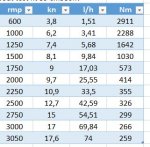
My long-term average is 0.74 liters / nautical miles (6nm/UK gal). The boat is NT 37 SD hull, LWL is 37'4 "travel weight about +13000kg.

The picture shows the Exel table where the directions give the parameters, these naturally vary depending on the wind and wave conditions.These values ​​are measured by Cummins smart craft computer and speed gps, wind about 4 Beaufot to bow and wave about 0.5 meters
lh.JPG

NBs
 
Last edited:
Top