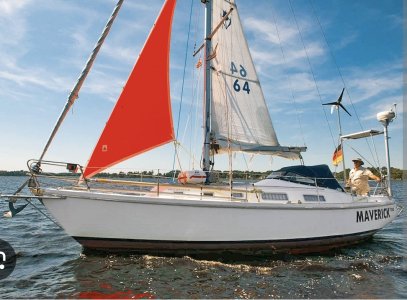
new Storm Jib

Cheeky Girl

Well-Known Member
Joined
23 Feb 2004
Messages
298
Location
Stirling, Scotland
Visit site
Hi
Looking to add a Storm Jib to the boat.

The easiest way seems to be one that goes up the forestay over the existing rolled up Genoa.

Has anyone had any experience of this type of Jib?

Cheers
 
Hi
Looking to add a Storm Jib to the boat.

The easiest way seems to be one that goes up the forestay over the existing rolled up Genoa.

Has anyone had any experience of this type of Jib?

Cheers
On the My Hanse forum one of our forumites (Johan Hackman) with a Hanse 34 bought a storm sail that went around the furled self tacking jib. He tested it in light wind & found it almost impossible to hoist & advised other Hanse owners against purchasing such an item
 
I have had only few occasions when I have needed or used a storm jib. My thoughts are:

if at all possible conduct your passage so the storm jib is set well before you need it (hours). Then, in the probable initial slow rate of progress, make a meal, rest and get the the yacht and crew ready for the bad weather. One senario is to get it ready before leaving port/anchorage. At the same early stage get your first and 2nd reefs in the mainsail and make sure the third line is correctly roved in ready.

The windage of a fully furled genoa is considerable. This is another reason to plan ahead, if possible take it off at or before you need to put the first roll in it. If the main is not yet reefed then it might help with reducing power in the flogging genoa or if fast broad reaching the apparent wind might be lower.

If you want to go upwind then luff tension needed. If you need to put another reef in the mainsail then being able to sail upwind slowly on solely a small jib makes it possible to reef the main using normal methods.

If set flying, like a staysail, then it probably needs to be on furler drum (like a small code 0 furler). The tack point needs to be strong and where halyard meets the mast there might need to be runners going aft ready attached to the mast for this purpose. Otherwise the mast could pump in the middle.

My experience of a proper storm jib is it set very well and calmed down the ship nicely. Same applies to a heavy weather jib or working jib when it is needed.

If it hard to hoist a storm jib then it could be even more difficult to get it down at the time when you reach your upwind refuge or if you just want to sail with three reefs in the mainsail.

I am no expert and have limited experience of F8 (once) and high end F7 a few times. But there are my thoughts.
 
I have set a hanked storm jib in very extreme conditions deep sea. Whilst the "over a rolled genoa" ones might satisfy coding requirements for charter and sailing school boats to HAVE a storm jib, I do not believe they are practical. Perhaps someone could test setting one when moored in sustained 40-50 knots+ wind. I doubt you would ever get it up properly.
 
I rig them quite regularly on comp crew courses. All pretty straightforward when safely tied up alongside a pontoon

View attachment 194940
I wonder what the purpose of having such an item on a sailing school boat is and why would you demonstrate it to unwary novices? Hopefully you followed up your demonstration by discussing the ideal conditions and what it might be like in far more challenging conditions or even when the vessel was actually at sea.
Personally I think it's very poor and misleading at best. No criticism of Skylark as he is just doing what the course requires but it's not real world stuff.
 
Hi
Looking to add a Storm Jib to the boat.

The easiest way seems to be one that goes up the forestay over the existing rolled up Genoa.

Has anyone had any experience of this type of Jib?

Cheers
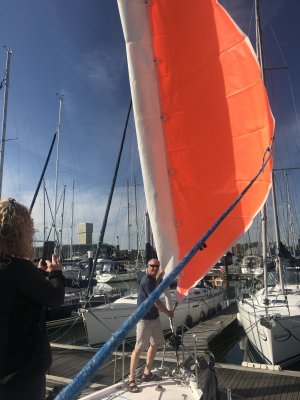
Is there are way you can go "cutter" rig and rig it well inside the forestay. Say a quarter of the way to the mast?

EDIT: Like this:
 

Attachments

  • Screenshot_20250618_080826_Chrome~2.jpg
    Screenshot_20250618_080826_Chrome~2.jpg
    191.9 KB · Views: 7
I must confess I'm not seeing the value of the sleeve/wrap around, just hoist it and tension the halyard.

Is the concern chafing?
 
I wonder just how long whatever it is that secures the wrap will last, but I don't think that it really matters as they would never be hoist in serious conditions, far too difficult.
 
A friend sailed an Albin Vega crossed the Atlantic etc occasionally in bad weather .He just rolled out a bit of jib much safer than facing about on the fore deck.
 
Yes the sail is too big,
This was the sail that I could get my hands on at the time and in the cold of winter it was a project to keep me busy.
Not a serious attempt at recreating a storm job.
However, I now have the yankee with a wire luff which is smaller although no way near the weight of a storm jib.
I have modified the sleeve.
It was pain to thread the linking line and it got stuck going over the furled sheets that are wrapped around the sail.
I can now hank on and hoist pretty well as fast and as easy as with a jib on a forestay.
I feel that this sail sets a little better than the furled genoa.
If I ever you this sail it will be on days when a jib of this size is suitable. Autumn and winter sailing here in Japan.
Meanwhile next winter I will attack the yankee and see how that turns out.

gary
 
How about 2 identical sails joined at the luff wrapped around the furled genoa?
They would have a fixing at the foot & head. So to hoist, just wrap one half around the front & then join the 2 clews together.
As the sail is hoisted it should centralise itself properly. As there are 2 sails the friction & hassle of fixing of the tube tried earlier will not exist.
 
How about 2 identical sails joined at the luff wrapped around the furled genoa?
They would have a fixing at the foot & head. So to hoist, just wrap one half around the front & then join the 2 clews together.
As the sail is hoisted it should centralise itself properly. As there are 2 sails the friction & hassle of fixing of the tube tried earlier will not exist.
The object of a storm sail is to reduce the amount of canvas and to move it further aft closer to the COE. It is not and won't take you to windward in a small boat as I guess people are talking about with these contraptions as Wandsworth said they are far better of using a small amount of whatever foresail they have on the boat, further more I doubt they are talking about real storm conditions maybe what they consider to be heavy weather for a small boat perhaps 30kts and again they are talking about coastal sailing not where a storm sail will find use. They would be better off having a smaller well made foresail that they could hoist at the start of their journey.
 
The object of a storm sail is to reduce the amount of canvas and to move it further aft closer to the COE. It is not and won't take you to windward in a small boat
I will challenge that
My Stella had a storm sail hanked on the forestay( i still have it, plus the one that came with my second Stella, in my garage.) they are like handkerchiefs. But many a Stella has gone to windward, or spent hours hove too, with them. One of the 2 F9's in my life involved hoisting it & heaving too for some time then as it eased sailing up wind in horrendous seas. I have raced quite successfully in F7-8 with my first one & they will take a Stella up wind I can vouch for that. So can quite a few of the early Stella sailors, who would refuse to stop if it meant winning a race.
 
I will challenge that
My Stella had a storm sail hanked on the forestay( i still have it, plus the one that came with my second Stella, in my garage.) they are like handkerchiefs. But many a Stella has gone to windward, or spent hours hove too, with them. One of the 2 F9's in my life involved hoisting it & heaving too for some time then as it eased sailing up wind in horrendous seas. I have raced quite successfully in F7-8 with my first one & they will take a Stella up wind I can vouch for that. So can quite a few of the early Stella sailors, who would refuse to stop if it meant winning a race.
Heaving to is not sailing to windward.
 
Top