
New Safety Device Concept for university project, need your opinions.

joedavies

New Member
Joined
9 Nov 2014
Messages
10
Visit site
Hi Everyone,

The concept is an autonomous buoyancy device, it tackles the stigma behind people not wanting to wear a life jacket. It can be used by any recreational boater but also in harbours and even on ferries.

  • The user wears a small water activated device (device A)
  • There is an autonomous buoyancy device (device B) that sits on the side of the boat.
  • If the user falls in device A calls for device B.
  • Device B deploys from the boat and propels towards the victim in the water.
  • The user has buoyancy.

The concept and scenario can be viewed below.
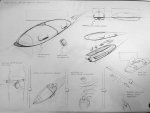
IMG_1080.jpg

I am in need of recreational boaters opinions on what type of wearable product device A should be, and what style people would prefer if it was mounted on your boat ?

To give your opinion, please click on the survey link.

https://www.surveymonkey.com/s/FYGBGVH

Thank you !
 
Interesting idea but not sure it could be a viable alternative to a lifejacket. I did the survey for you and one thing I would say is that no-one will want something attached to the hull of their boat as shown in the illustrations. Maybe on the guardrail would be okay.
 
I did the survey for you. It could be mounted on the stern out of the weather and rather than taking life saving buoyancy to the casualty it could supply additional equipment like a dan buoy or similar to aid recovery. Equipment that you would not carry on your person usually.
Just a thought.
 
It does seema rather expensive solution to a non problem.

I don't think there is a stigma attached to wearing an LJ, its more people cant be arsed. The same way people don't wear kill chords - often they forget.

This system still relies on people remembering/bothering to wear something. Perhaps a suggestion to incorporate the tech into clothing with a manufacturer such as Henri Loyd or Musto might be more plausible. There are already similar systems (raymarine do a lifeTag system) which alerts the other crew on board to a MOB and plots the casualties position on the navigation screens while emitting an audible alert. So if you are crewed they will react making your device unnecessary. If you are aiming at single handed mariners why not develop a system that integrates with NAV/Autopilot systems to slow/stop the vessel and manoeuvre to a stand off position allowing the casualty to recover themselves.
 
Hi Everyone,

The concept is an autonomous buoyancy device, it tackles the stigma behind people not wanting to wear a life jacket. It can be used by any recreational boater but also in harbours and even on ferries.

  • The user wears a small water activated device (device A)
  • There is an autonomous buoyancy device (device B) that sits on the side of the boat.
  • If the user falls in device A calls for device B.
  • Device B deploys from the boat and propels towards the victim in the water.
  • The user has buoyancy.

The concept and scenario can be viewed below.

View attachment 50621

I am in need of recreational boaters opinions on what type of wearable product device A should be, and what style people would prefer if it was mounted on your boat ?

To give your opinion, please click on the survey link.

https://www.surveymonkey.com/s/FYGBGVH

Thank you !

you are more likely to fall off the marina pontoon, the quay or your dinghy than the boat. So what is the point of your device?
 
I did your survey.
tbh I can't imagine this being used as designed, however this is a really cool project and if you could get it working, solving the problems of getting an autonomous device to manouver safely to a casualty I think the technology could definitely find a use.
I would think more commercial than recreational, for example sending a lifeboat to someone falling over board from a large tanker or container ship, where they are unable to stop or manouver quickly. Then you could use something like a large basket to lift the casualty out of the water if they were unconscious.
Or even passenger ferries, if you could hook it up to some infrared cameras to watch for passengers falling overboard.
 
Well said. Silly solution looking at the wrong problem.

A tad harsh. Its a concept/project for University and as such needs to contain a degree of individual thinking, which it does. Marketing would come much later down the line by which time the concept might well have spawned other new ideas, from which might develop something that would not be deemed "silly solution looking at the wrong problem"
 
I did your survey.
tbh I can't imagine this being used as designed, however this is a really cool project and if you could get it working, solving the problems of getting an autonomous device to manouver safely to a casualty I think the technology could definitely find a use.
I would think more commercial than recreational, for example sending a lifeboat to someone falling over board from a large tanker or container ship, where they are unable to stop or manouver quickly. Then you could use something like a large basket to lift the casualty out of the water if they were unconscious.
Or even passenger ferries, if you could hook it up to some infrared cameras to watch for passengers falling overboard.

I think the big ship suggestion is excellent and actually has merit. I can see on a large ship at night for example where an autonomous recovery system would be worth investigating. They have more money too and it might remove some size constraints
 
I think the big ship suggestion is excellent and actually has merit. I can see on a large ship at night for example where an autonomous recovery system would be worth investigating. They have more money too and it might remove some size constraints

+1

Still not convinced it's truly viable, but if it makes sense anywhere then this is the place. Deck crew can be ordered to carry the transmitter, the ship can't quickly change course, so the current approach is to lower a rescue boat -

Rescue%20boat.jpg


...but how quickly can a typical crew get the thing manned and in the water after an unexpected alert at any time of day or night? Ten minutes wouldn't surprise me, and that's a long way at 20 knots to go back and look for someone who isn't wearing a lifejacket (because you don't on ships) nor (at night) a light.

I don't think this replaces the rescue boat, but the instant response and the light and beacon that would be built into the autonomous float (with homing receiver in the rescue boat) would give much better results.

Against it, how often do crew fall off commercial ships at sea? Not very often, I suspect. I can only think of one example, two men washed overboard while re-stowing mooring gear that had come loose on deck in heavy weather, and the ship had slowed right down, everyone was watching them, and they had lifejackets on, so it's not clear that this system would have helped in that case. (The failure, as an aside, was that they rigged lifelines to the men's harnesses using inadequate rope, which broke.)

Pete
 
All concepts/projects from uni should be encouraged, without a concept and uni project being encouraged we would not have the internet. Apparently silly ideas often spawn revelations that revolutionize the world.
 
I'm also unsure about any stigma attached to life jacket wearing. There's a lot of folks who deliberately choose not to use them ( eg my bil, ex crab boat crew) and others that don't consider their safety needs at all.

I do think there could be a high end market but only if the device is small enough that it's barely noticed by the wearer.

Anyway, interesting project.
 
Top