
New rudder build question

Andy Kirkpatrick

New Member
Joined
26 May 2025
Messages
13
Visit site
Hi

I'm currently working on building a new skeg and rudder for a 1969 bilge keel Hurley 22 bilge. I could just copy what's already there, but seeing as it's a 50 year old design, I wondered if I could make it more contemporary, mostly by giving the rudder, which is like a brick, more of an aerofoil profile. I sketched something based on a Spitfire's wing, and made the skeg bigger and more profiled, but I now can see the bottom edge of the rudder is much shorter, with the longest chord around the middle. I'm not a marine architect, and the hull speed is only 5 or so knots, so maybe I'm just overthinking it?

I live on the West Coast of Ireland, so I want something West Coast proof.

Any advice would be appreciated.

Thanks
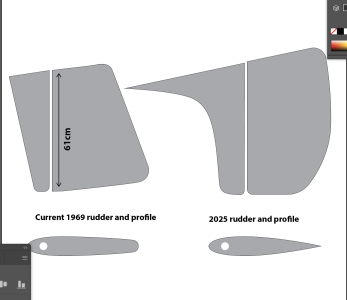


Screenshot 2025-07-09 at 10.02.53.png
 
I am not an expert but I have built new rudders for a couple of boats. What I would say is that having a "balanced rudder" ie with some of the area forward of the pivot improves the rudder feel no end, particularly if your boat is prone to weather helm.
 
That is not possible with a full skeg hung rudder. A shorter skeg would allow some balance area low down, but introduces more complexity in designing the lower bearing.

Worth reading up on NACA aerofoil profiles before shaping the rudder.
 
Last edited:
That is not possible with a full skeg hung rudder. A shorter skeg would allow some balance area low down, but introduces more complexity in designing the lower bearing.

Worth reading up on NACA aerofoil profiles before shaping the rudder.
Yes, I'd like to create a more balanced rudder, but being a bilge keel, I'm not sure I could make it strong enough when left high and dry.
 
I rebuilt a skeg and rudder using an airfoil profile from steel and filled the hollow steel rudder with old engine oil. The auxiliary rudder for my self steering gear was constructed from stainless steel again filled with oil engine rudder.

I included a breakaway shear pin in the shaft that would shear if I hit any hard ground so prevent any damage to the and quick replacement. shear pin.

If the rudder is aupported by the skeg this may not be possible

Why I wend for steel is the number of rudders of GRP that had water ingress due to the join between the shaft and the GRP shell requiring a rudder rebuild.

I do have steel fabricating experience and welding experience which helps me


I rebuilt a skeg and rudder using an airfoil profile from steel and filled the hollow steel rudder with old engine oil. The auxiliary rudder for my self steering gear was constructed from stainless steel again filled with oil engine rudder.

I included a breakaway shear pin in the shaft that would shear if I hit any hard ground so prevent any damage to the and quick replacement. shear pin.

If the rudder is aupported by the skeg this may not be possible

Why I wend for steel is the number of rudders of GRP that had water ingress due to the join between the shaft and the GRP shell requiring a rudder rebuild.

I do have steel fabricating experience and welding experience which helps me


Thanks. Filling with oil is an interesting idea. 316 SS has become so expensive these days, it'd be cheaper to make one out of carbon fibre. I do need to learn to do basic welding, though, but I don't think I'd trust anything I'd make, especially not a rudder! I'm planning on making both from a horizontal sandwich of 25mm plywood, threaded onto a 25mm SS bar, so I can really nail the shape.
 
Carbon fiber is a way to go if you also use carbon for the rubber shaft as the carbon fiber will stick to carbon fiber it's the join with a stainless shaft if the issue in MHO
 
Funny things rudders
Unless the OP has experienced unfavourable characteristics under sail that might benefit from a tweak or two I would urge copying exactly the profile and weight of what worked before

At the very very least, ask of other owners whst they would think in the feel of the rudder through the tiller , after sailing 100s or 1000s of miles over years and years.

If it ain’t broke ( design-wise) don’t….? 😄
 
Funny things rudders
Unless the OP has experienced unfavourable characteristics under sail that might benefit from a tweak or two I would urge copying exactly the profile and weight of what worked before

At the very very least, ask of other owners whst they would think in the feel of the rudder through the tiller , after sailing 100s or 1000s of miles over years and years.

If it ain’t broke ( design-wise) don’t….? 😄
Agreed, but I know from expierience that often "good enough is" when it comes to most things we buy, that often the things we buy are made to a price point the manufacturer believes we'll pay (even a McLaren sports car). For example, I bought a Palm kayak trolley a while back, and soon discoverred it was in no way up to the job, with all the metal parts rusting, some to nothing, and the rubber tires perishing and going flat (maybe salt effected the valves). What it needed was 316 fastners and pins, and solid rubber tires, all of which I fitted, but cost me a further €70. Palm could have made a great trolley, but few would have bought one, they'd just get the Chinese one that was €70 cheaper, like I did. I think the best part about working on your own boat is you can give each piece some value added, be that as simple as replacing rotten plywood with G10 backing plates, or giving your rudder some contemoer flair (when the rudder was built, the number one car in the UK was the Austin/Morris : ). But I do agree with you.
 
Yes, I'd like to create a more balanced rudder, but being a bilge keel, I'm not sure I could make it strong enough when left high and dry.
My 24’ BK boat has a partial skeg and semi balanced rudder.
On flat ground it sits solely on the keels and the rudder is about 2” above floor level, but it often touches bottom when I dry out somewhere if the ground is uneven or the keels settle in.
It’s handled drying out in some testing conditions in West Wales, even one episode of bunny hopping on the sand in swell for a couple of hours over the bottom of the tide.
 
Last edited:
I suppose you won’t devalue a Hurley 22 (which is a lovely boat) by changing its rudder design, but I would also suppose you won’t add much value in terms of performance either. Having just replaced the rudder on a now older Hanse, the costs off the shelf are surely >50% of the value of a Hurley 22. If it needs a new rudder then it needs one no question. But will it much change the enjoyment of sailing it by redesigning it?
 
I suppose you won’t devalue a Hurley 22 (which is a lovely boat) by changing its rudder design, but I would also suppose you won’t add much value in terms of performance either. Having just replaced the rudder on a now older Hanse, the costs off the shelf are surely >50% of the value of a Hurley 22. If it needs a new rudder then it needs one no question. But will it much change the enjoyment of sailing it by redesigning it?
I agree, it's not worth spending thousands on a boat worth hundreds, but the plan is to make the rudder and skeg myself, which is one of thoes projects that - like many boat projects - which are a pain to do, and take up so much time, but in the end, you'd pay to do them (and you do!). I've pretty much stripped the boat of everything but the fiberglass, and it's more of an exercise in putting her back together better than I found her, and hopefully, sail her as well! I always thought it was interesting how people used to say they knew every inch of a boat, car, plane, every nut and bolt, well, I guess now I will (it's remarkable how much junk hardware there is on an old boat).
 
Top