New mast ordered - need new wires - V x A = W

MINESAPINT2

Well-Known Member
Joined
23 Nov 2007
Messages
172
Visit site
12V x ? = 25W

? = 2A

I guess therefore I will be OK with Oceanflex marine grade (tinned) 1.5mm 21A 6.1mm overall diameter. Cable run +/- 15m.

Look forward to replies

Thanks

Mike
 
12V x ? = 25W

? = 2A

I guess therefore I will be OK with Oceanflex marine grade (tinned) 1.5mm 21A 6.1mm overall diameter. Cable run +/- 15m.

Look forward to replies

Thanks

Mike
I always run 2.5mm for mast lights. The cost difference is minimal, the cable is more robust and suffers much less voltage drop.
 
Last edited:
A lot of people seem to think "it's only 12V the wiring does not have to be thick, it won't be much power"

WRONG.

You don't need thick cable because it is in danger of burning out, you need thick cable because when you only have 12V to start with, you don't want much voltage drop at all otherwise whatever you are connecting might not be happy if it only gets 11V due to voltage drop in the cable.
 
The total cable run is the sum of the positive and negative wires. So a 10m mast will have a 20m cable run.

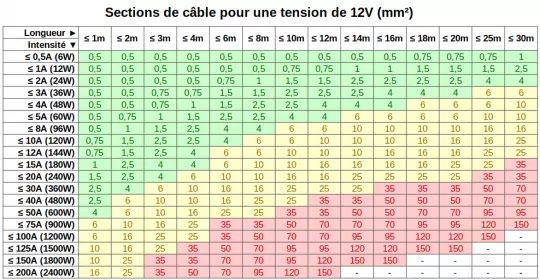
Generally aim for a voltage drop of less than 3% over the wires - this table gives the required wire sizes for the load that will meet this requirement.

Use well insulated tinned copper wire with a high strand count as you can't rely on it staying static inside the mast - high strand counts are more tolerant to being flexed repeatedly.

(Sorry it's in French).

1756723001707.png.
 
The Oceanflex 1.5mm cross section stranded has a published resistance of 0.013 ohms per metre at 20C.

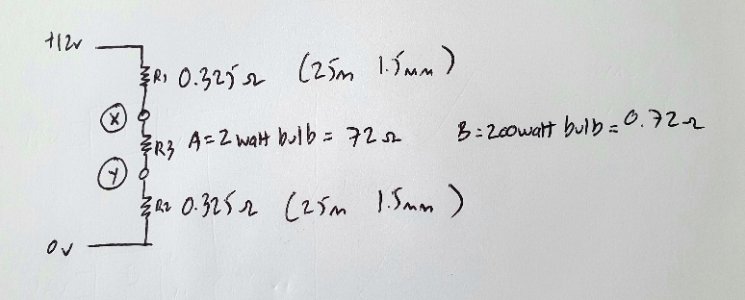
If you think of your circuit as a resistance ladder, you can calculate the losses for the load you wish to place at the end. Assuming 12v, a 2 watt bulb will be 72ohms (V squared divided by R). A 200 watt bulb will be 0.72 ohms.

Stick each bulb in turn at the end of your 25m cable (resistance 0.325 ohms per leg, shown as R1 and R2 in the diagram). The circuit will look like this:

cable.jpg

With the 2 watt bulb, the voltage across it (measured at X and Y) will be 11.89v (the wire forms negligible resistance compared to the bulb within the complete circuit).

Stick a 200 watt bulb there (R3 = 0.72 ohms) and the voltage across it will be 6.3 volts because the cable now forms some 50% of the total resistance of the circuit. The 0.72 ohm bulb will only dissipate 55 watts (because power follows the square law, half the voltage equals a quarter of the power). Same reason your 120/240v travel kettle takes an hour to boil plugged into a 110v supply.

The workings all assume linear consumption by purely resistive loads.

As others said, use decent cable and like Paul, my habit is a norm of 1.5mm stranded unless there is any reason to use thicker conductors.

Using your 25w bulb and 15m cable run, the volts drop with 1.5mm cable will be 0.47v (call it half a volt) and with 2.5mm cable, 0.29v, just under a third of a volt. Both so little as to be negligible in this application.
 
Last edited:
With LED lights, 1.5mm will be fine, with those wattages I would definitely suggest 2.5mm with your 15mtr cable run.

As Paul said, the cost is negligable and the wire is more robust, so much so that I put in 2.5mm for our new lights even though we are fitting LED. One less problem down the line, and ours is a cruising boat not a racer.
 
Thanks all,

2.5mm it is then.

Needed to sort this out to tell the guy who is making my new wooden mast what the OD of the wires is so he can correctly size the conduits.

I did recently replace the bulb in my stern light with LED. I will replace the others before the new mast arrives.

Mike
 
2 amps per hour, that's a lot. I have a small lamp takes 2AA batteries goes on for ever. The brightness is adjustable. I hang it at eye level off the boom to be sure it's not mistaken for a low star on the horizon.
 
Just looking for my replacement LED bulbs.

Masthead combined tricolour/anchor is Aqua Signal 40.

I imagined I would just buy 2 white LED bulbs and fit them but apparently this does not work. For the tricolour you need a special tricolour LED - I thought the colours were sorted out by the tricolour lens!. If you fit a white LED bulb into the tricolour the green sector will be blue?.

Have I just been LED down an AI rabbit hole?

Thanks

Mike
 
Just looking for my replacement LED bulbs.

Masthead combined tricolour/anchor is Aqua Signal 40.

I imagined I would just buy 2 white LED bulbs and fit them but apparently this does not work. For the tricolour you need a special tricolour LED - I thought the colours were sorted out by the tricolour lens!. If you fit a white LED bulb into the tricolour the green sector will be blue?.

Have I just been LED down an AI rabbit hole?

Thanks

Mike
Boatlamps Bi & Tri-Colour LED Lamp Fixtures do nice LED replacement bulbs and they are coloured, etc. I used them on my navigation lights and they had good colour and also separation of the colours.

You might get them cheaper else where but I've had no problem with electrical interference, especially as the tri light is close to the VHF aerial.
 
Just looking for my replacement LED bulbs.

Masthead combined tricolour/anchor is Aqua Signal 40.

I imagined I would just buy 2 white LED bulbs and fit them but apparently this does not work. For the tricolour you need a special tricolour LED - I thought the colours were sorted out by the tricolour lens!. If you fit a white LED bulb into the tricolour the green sector will be blue?.

Have I just been LED down an AI rabbit hole?

Thanks

Mike
Paint one side of the bulb with 2 coats of green nail varnish or similar. Being Led it does not get hot so does not peel.
 
Paint one side of the bulb with 2 coats of green nail varnish or similar. Being Led it does not get hot so does not peel.
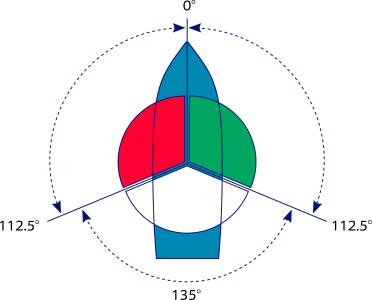
A white LED isn't "full spectrum" so adding a green filter might not be as effective as you think. How would you also manage the visibility arc of the lamp?

navigation-lights-3x.png
 
The total cable run is the sum of the positive and negative wires. So a 10m mast will have a 20m cable run.

Plus likely quite a few metres from the battery, via the switch panel and by whatever route to the mast foot. And then back again.


If you fit a white LED bulb into the tricolour the green sector will be blue?.

Yes, or at least very blue-ish, and really not acceptable.

As others have advised, buy a multi-coloured LED made for the job and designed to fit your particular brand of tri-colour fitting. The bulb holders are oriented in different direction in different brands. That didn't matter for a single white filament, but it certainly does when you are fitting a multi-coloured LED bulb.

Also when installing the LED bulb do check that it is actually facing the right way. I bought an LED tricolour bulb, marked for my specific brand, from a major reputable chandlery. I put it in the bulb holder while I had the mast down for rigging work, and checked that it worked using wander leads. I then replaced the cover with the lens. It was only by chance, when some other issue arose, that I happened to turn on the tricolour again, and found that the bulb was facing the wrong way, so that the green and red LEDs were shining through the aft white section of the lens, and vice versa)! The mast had to go back up with the old incandescent bulb I'd intended to replace in the tricolour, and is still there to this day. When I returned to the chandlery and pointed out this fundamental fault with the bulb, the were unsurprised and said they'd had several returned like that! :oops:

The other issue with putting an LED bulb in a tricolour designed for an incandescent bulb is that the cut-off between the different light sectors will be blurred and they'll overlap (because the LED is an area light source, not the point source the lens was designed for). Most seem willing to live with this deviation from the ColRegs spec.
 
The other issue with putting an LED bulb in a tricolour designed for an incandescent bulb is that the cut-off between the different light sectors will be blurred and they'll overlap (because the LED is an area light source, not the point source the lens was designed for). Most seem willing to live with this deviation from the ColRegs spec.
The colour separation on my tri light didn’t seem to have any blurring and the same for the bi light on the pulpit using the led bulb from boatlamps.
 
Top