
New lithium ion solar 12v wiring help

Feeling346 Sailor

New Member
Joined
21 Jan 2020
Messages
8
Location
River Crouch
Visit site
Hi all,

thanks for taking the time to help!

i have bought the following (at expense) for my 34ft sail boat;
2x 100ah lithium batteries
solar charge controller (with recommended panels)
BMV712 Battery monitor
cyrix ct
new starter battery

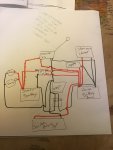
i don’t want to wire it up incorrectly and balls it all up, so have drawn up a wiring diagram
please let me know where I gone wrong.

many thanks
 

Attachments

  • EE0646DC-E55F-48B8-968F-8F6A3327C34C.jpeg
    EE0646DC-E55F-48B8-968F-8F6A3327C34C.jpeg
    847.8 KB · Views: 44
3 additional questions

does the BMV-712, +B1 Cable need to go to the cyrix 85 and not the house battery?
does the solar and other charger need to go to the cyrix 87 And not the house battery?
would it be better for the negative from the chargers to go directly to the negative bus rather than the battery?
 
Welcome to the forums

Why the dual circuit isolator in the negative wiring?
Why no isolators (and an emergency crossover switch) in the battery positives)

Why no battery fuses

There should be a push button or spring return switch, and a small fuse, in the start assist connection (85) on the Cyrix ( Paul Rainbow usually recommends not using the start assist function but rather to fit an emergency crossover switch)
Read the instructions for installing the Cyrix-ct.
There should be at least one fuse in the main positive connections to the Cyrix to protect it from over overload....... Mnay people would opt for a fuse in each leg close to the battery to protect the wiring as well as the Cyrix

Look at the installtion instructions for the battery monitor ( what's the significance of the dotted wiring ?)
Remember there must be no other connection to the house battery negative other than the monitor shunt . All other negative connections ( including the starter battery) must be made to the other end of the shunt so that all current flowing into or out of the house battery must go through the shunt but current to and from the starter battery does not.

Hopefully others will pick up on this thread.. Back on Tuesday
 
Last edited:
Hi all,

thanks for taking the time to help!

i have bought the following (at expense) for my 34ft sail boat;
2x 100ah lithium batteries
solar charge controller (with recommended panels)
BMV712 Battery monitor
cyrix ct
new starter battery

i don’t want to wire it up incorrectly and balls it all up, so have drawn up a wiring diagram
please let me know where I gone wrong.

many thanks
How are you switching off your alternator when the lithium battery is fully charged?
 
This looks to me like you hope to use LiFePO4 (LFP) batteries in a lead acid system. That could get very expensive if you are not very careful. I think it would be a good idea to read the following long articles to give you a sense of the requirements of LFP before going further. As well as cost you will need to bear in mind that a sudden disconnect of batteries while at sea is a different order of risk from the same happening if you park up your RV.

These seem to be the most cited and respected articles online. Start with this one and take your time - there is a lot to take in.
LiFePO4 Batteries On Boats

These next go more deeply into the different aspects of the topic and also repay careful study - Lithium battery systems | Nordkyn Design

While there is interest on this forum not too many members have got started with LFP systems. A much more focussed resource is the "Lithium batteries in a boat" Facebook Group. This has 4.5K members many of whom have been using LFP systems for some time. They are very good at answering questions. Rod, the author of the first article above is a member.

Drop in LFP batteries are sold with an internal battery management system that will disconnect the battery in the event of high voltage, low voltage, high temperature and - sometimes low temperature. This offers protection against catastrophic damage by shutting down the battery. This will save your batteries but cause other problems.

As you read, try to find answers to the following questions.

If your batteries suddenly disconnect while motoring, how will you protect your alternator from a high voltage spike?

If your batteries suddenly disconnect because of low voltage how will you get any charge in them?

If they disconnect because of high voltage then what will happen to your other expensive electronic nav equipment if there is no battery in the system?

How will you keep your LFP and start battery both charged given they have different chemistries and therefore different charging needs?

How will you ensure that all your charging sources (alternator, mains, solar etc) do not overcharge? (Lead acid chargers take their batteries into float. Floating LFP is a very bad idea.)

How will you manage to safely charge at low temperatures without causing damage?

In short, you need an LFP system to replace a lead acid system, not an LFP battery to replace a lead acid battery.
 
Welcome to the forums

Why the dual circuit isolator in the negative wiring?
Why no isolators (and an emergency crossover switch) in the battery positives)

Why no battery fuses

There should be a push button or spring return switch, and a small fuse, in the start assist connection (85) on the Cyrix ( Paul Rainbow usually recommends not using the start assist function but rather to fit an emergency crossover switch)
Read the instructions for installing the Cyrix-ct.
There should be at least one fuse in the main positive connections to the Cyrix to protect it from over overload....... Mnay people would opt for a fuse in each leg close to the battery to protect the wiring as well as the Cyrix

Look at the installtion instructions for the battery monitor ( what's the significance of the dotted wiring ?)
Remember there must be no other connection to the house battery negative other than the monitor shunt . All other negative connections ( including the starter battery) must be made to the other end of the shunt so that all current flowing into or out of the house battery must go through the shunt but current to and from the starter battery does not.

Hopefully others will pick up on this thread.. Back on Tuesday

i didn’t draw in any fuses but don’t worry I will put them in, in all the recommended places in the instructions.

I used the isolator in the negative end of the circuit as it was easier, if this isn’t correct then I will put to the Positive but I (probably wrongly) assumed a broken circuit is a broken circuit.

The reason I come looking for help is because the different installation instructions for all the items clash and contradict eachother in places. The dotted wiring is a supplied line with fuse, the instructions are unclear but as it has multiple uses in the instructions I think it is some kind of control/information cable. That’s my question as to if it needs to go to the cyrix to tell when to stop the alternator.

noted as to the negative connections on the house bank, makes sense but why does the starter need to go to the other end of the shunt?

In one place I read that the alternator and all charging needs to be fed into the 87 terminal on the cyrix and in another place they go directly to the battery
 
Last edited:
This looks to me like you hope to use LiFePO4 (LFP) batteries in a lead acid system. That could get very expensive if you are not very careful. I think it would be a good idea to read the following long articles to give you a sense of the requirements of LFP before going further. As well as cost you will need to bear in mind that a sudden disconnect of batteries while at sea is a different order of risk from the same happening if you park up your RV.

These seem to be the most cited and respected articles online. Start with this one and take your time - there is a lot to take in.
LiFePO4 Batteries On Boats

These next go more deeply into the different aspects of the topic and also repay careful study - Lithium battery systems | Nordkyn Design

While there is interest on this forum not too many members have got started with LFP systems. A much more focussed resource is the "Lithium batteries in a boat" Facebook Group. This has 4.5K members many of whom have been using LFP systems for some time. They are very good at answering questions. Rod, the author of the first article above is a member.

Drop in LFP batteries are sold with an internal battery management system that will disconnect the battery in the event of high voltage, low voltage, high temperature and - sometimes low temperature. This offers protection against catastrophic damage by shutting down the battery. This will save your batteries but cause other problems.

As you read, try to find answers to the following questions.

If your batteries suddenly disconnect while motoring, how will you protect your alternator from a high voltage spike?

If your batteries suddenly disconnect because of low voltage how will you get any charge in them?

If they disconnect because of high voltage then what will happen to your other expensive electronic nav equipment if there is no battery in the system?

How will you keep your LFP and start battery both charged given they have different chemistries and therefore different charging needs?

How will you ensure that all your charging sources (alternator, mains, solar etc) do not overcharge? (Lead acid chargers take their batteries into float. Floating LFP is a very bad idea.)

How will you manage to safely charge at low temperatures without causing damage?

In short, you need an LFP system to replace a lead acid system, not an LFP battery to replace a lead acid battery.

all the items were ordered from a company who after I told them what i need and gave them a list of power requirements specked for me and the whole system is designed to be a litham system and not led asid.

thanks for the links, finding good non contradicting information is hard!
 
all the items were ordered from a company who after I told them what i need and gave them a list of power requirements specked for me and the whole system is designed to be a litham system and not led asid.

thanks for the links, finding good non contradicting information is hard!

Plenty of companies are making it sound too easy. Do take your time over this. As an example, check what this article (referenced above) says about the use of VSRs in mixed LFP and lead acid systems. Spoiler alert: the phrase 'next to useless' makes an appearance. http://nordkyndesign.com/electrical-design-for-a-marine-lithium-battery-bank/

Which company are you purchasing from BTW?
 
Plenty of companies are making it sound too easy. Do take your time over this. As an example, check what this article (referenced above) says about the use of VSRs in mixed LFP and lead acid systems. Spoiler alert: the phrase 'next to useless' makes an appearance. http://nordkyndesign.com/electrical-design-for-a-marine-lithium-battery-bank/

Which company are you purchasing from BTW?

im not going to give up the company yet, but they were supposed to provide me with a wiring diagram.
 
A quick postscript to my last. There's quite a long and informed thread on the use of the Cyrix Li CT over on the Lithium Batteries in Boats Facebook group. Even if you get a coherent looking wiring diagram from your supplier I would still post it over there to get some informed feedback of that and your whole system. Do your other charging sources (mains and solar) have good LFP settings or, better still, fully user-customisable options?
 
A quick postscript to my last. There's quite a long and informed thread on the use of the Cyrix Li CT over on the Lithium Batteries in Boats Facebook group. Even if you get a coherent looking wiring diagram from your supplier I would still post it over there to get some informed feedback of that and your whole system. Do your other charging sources (mains and solar) have good LFP settings or, better still, fully user-customisable options?

the solar has lithium setting but the shore charger should be treated as an alternator
 
Top