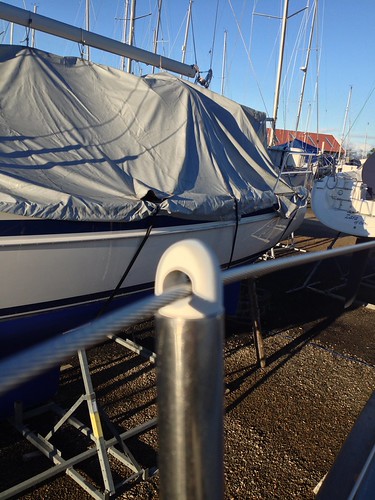
New lifelines - plastic covered or not?

I am assuming you mean dyneema with an outer covering
Uncovered dynema would suffer from uv degradation.

Seems that Dyneema has a high resistance to UV damage:

http://eurofibers.com/en/fibers/dyneema

And using it for guardrails/uv resistance:

http://www.colligomarine.com/docs/respecttherope/RTRDyn1.pdf

I am looking at using SK75 which at 5mm has almost twice the breaking strain of 7x7 and approximately the same cost once terminations of the wire are added. Looking at about £90 for 40m 5mm Dyneema with thimbles etc on top but no manufacturing/swaging costs required.
 
Not in every case. On some boats, probably older GRP boats, the plastic cap is fitted into the tube and the wire passes through the plastic caps only. I have looked closely at my own and other yachts when trying to find replacement caps.

Gosh, there are some dodgy bits on some boats!
 
Surveyors don't like covered lifelines for the reasons already given. Owners don't like surveyors saying so in their surveys - so stick to uncovered wire.
 
Contemplating replacing the stainless steel guard wires on the boat - they are now 10 yrs old. The current ones have the white plastic covering.

Should I have the same again, or get ones without the plastic cover? :confused:


Ps - I think I already know the answer...........;)

another alternative...depending on the age of your standing rigging..
Replace your cap shrouds and redeploy the outgoing ones as lifelines.
 
Knowing the anti cover arguments, I still went for covered. the original was as old as the boat and held up well, looked good and easy on wet hands/good grip, didn't cut into the stanchions or transmit acoustically through the hull when fenders or hands tugged it..Each to their own I guess:)
 
'Bare' wire with a loose fitting tube over it is another option.
10mm pushfit type water pipe is cheap and the genoa slides over it well.
 
Last year ,I replaced one top guardwire with Dyneema, tensioned with a "carters" knot. Soon I will do the rest,as it has stood the test of UV here( tested to destruction this week by towing a car uphill---no problem). It is easy to adjust ,easy on the hands,no end fittings required,except at the "gate" where the pelican hook has been replaced. I may even consider replacing my standing rigging with Dyneema when the time comes. After all ,hemp rope did the job for rather a long time!
 
no plastic covering

I replaced my plastic covered guard rail wires last year with thicker stainless wire rope. The reason I replaced it was because the plastic was brittle and dirty and the lines were old. I stripped the plastic off and the wire looked in good condition. One down side of the plain wire is that it cuts into the plastic stanchion caps, the plastic coated wire didn't do this.

I still have the old lines so maybe I will dig them out and look at them a bit more critically.

We did exactly the same last year on the advice of the surveyor but found the wire was corroding and some strands were broken.
We used small lengths of loose fitting plastic tubing to stop the wire cutting the stanchions and secured the tubes with small wraps of clear silicon self amalgamating tape.
Did away with bottle screws which would be too time consuming to undo in an emergency and now the ends at the cockpit are fixed with rope.
 
On some boats, probably older GRP boats, the plastic cap is fitted into the tube and the wire passes through the plastic caps only. I have looked closely at my own and other yachts when trying to find replacement caps.
That is why I wonder... When somebody is actually thrown against stanchions, not uncommonly they bend out - or rip the mounts from decks, with piece of deck too if on weak a boat :D
So the line, and only the line, is what keeps you, and the line better had something to be attached to...
Seems that Dyneema has a high resistance to UV damage
I am looking at using SK75 which at 5mm has almost twice the breaking strain of 7x7 and approximately the same cost once terminations of the wire are added. Looking at about £90 for 40m 5mm Dyneema with thimbles etc on top but no manufacturing/swaging costs required.
No intention to sound too old-fasion, but then what is the elastic limit of Dyneema in comparison to steel, and how resistant it is against being cut at stanchions and mounts when pulled wit a tons of load perpendicularly? (rule of thumb was that for force in a line loaded from the side - load in line would be 10 times more, actually may even be 30x ) Climbing lines, that are to catch a falling man straight along the line are usually some tons proof. Rail should be stronger.

Just a thought :)
 
Rival41C Plastic Stanchion Cap

That is why I wonder... When somebody is actually thrown against stanchions .... the line better had something to be attached to...

8387938254_29818ee283.jpg
 
Top