
New fuel system?

GHA

Well-Known Member
Joined
26 Jun 2013
Messages
12,552
Location
Hopefully somewhere warm
Visit site
fuel system.jpg

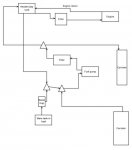
I'm looking at installing a day tank, any comments on the above first stab at a design? Triangles are 2 way valves. So going into the electric fuel pump can either be the existing tank, a can or the day tank. Output goes to the day tank or a can. Probably fit a float switch at the top of the header tank to turn off the fuel pump when its full.

Any thoughts?

TIA
 
A day/ header tank system can be useful if you have a very flat bottomed fuel tank. It can be fed by a pump which will pick up and feed day tank and not be concerned by sucking air if the pick up in main tank becomes uncovered. You can have a float switch to control the electric pump and even another float switch to warn if day tank gets low.
What is really desirable however for all fuel tanks is a deep vee or cone shaped bottom so that sludge water etc can gather there. There should be a drain valve right at the bottom and a pick up tube some way off the bottom. This gives a sludge capacity of about 1% of tank capacity min. So min 1% not usable. You should often drain fuel from the bottom drain to check for water and any sign of bacteria growth. (on aircraft this is done before every flight). Drain the fuel into a clear jar and hopefully you will see if there is any water in it. A bit tricky if it is all water. Continue to drain until fuel is clear.
So I would suggest this design for the day tank at least. good luck olewill
 
View attachment 36439

I'm looking at installing a day tank, any comments on the above first stab at a design? Triangles are 2 way valves. So going into the electric fuel pump can either be the existing tank, a can or the day tank. Output goes to the day tank or a can. Probably fit a float switch at the top of the header tank to turn off the fuel pump when its full.

Any thoughts?

TIA


Why do it
 
Why do it
Many reasons, new engine specs say it can't lift from the existing tank many feet below built into the keel, God knows what it's like down there, elderly steel boat and can't even get the bolts off to have a look, must have another go before the engine goes in. Bluewater cruising boat so dodgy fuel will happen sooner or later, I want to get it as clean as poss before it goes into the engine even if that means going through a filter a few times. Added benefit will be being able to fill from cans at sea easily. And relatively easy to clean out the day tank with rags. All round worth the effort.
 
Many reasons, new engine specs say it can't lift from the existing tank many feet below built into the keel, God knows what it's like down there, elderly steel boat and can't even get the bolts off to have a look, must have another go before the engine goes in. Bluewater cruising boat so dodgy fuel will happen sooner or later, I want to get it as clean as poss before it goes into the engine even if that means going through a filter a few times. Added benefit will be being able to fill from cans at sea easily. And relatively easy to clean out the day tank with rags. All round worth the effort.
Ta
 
First question.
how big an engine?
2nd
How big a boat?
3rd fuel capacity?

can't see the point on a boat like mine witha little dinky yanmar.
On my uncles twin 60hp thorny croft with 2 100 gal fuel tanks. probabaly worth while.

What are the canisters? why
Dont see the point of direct line with no fuel pump, water trap or filter, from fuel tank to day tank.
All fuel going to a day tank or header tank should be filtered.
Kiss.

Fuel fill line to main fuel tank. gravity feed
If more than one fuel tank conect with a crossover line. to keep levels same with isolation valve.

One fuel line with isolation valve for each main tank, water trap, pump, filter to day tank
another line from day tank through filter to engine. gravity feed or fuel pump.

If you want redundancy.
have dual filters in single line, with change over valve, so you can change or clean filters.
have change over valve to two seperate fuel pumps
 
First question.
how big an engine?
35

2nd
How big a boat?
3rd fuel capacity?
33', tank built into keel is about 40 gallons. might go for 80L day tank.


What are the canisters? why
Diesel cans, easy refueling offshore, and might as well be able to drain the tank into a can for the sake of a another y valve, you never know when someone might need a bit.


Dont see the point of direct line with no fuel pump, water trap or filter, from fuel tank to day tank.
All fuel going to a day tank or header tank should be filtered.
Kiss.

errrr, it is, and a water trap. plus the ability to pump out of the day tank through a filter then back in again. Did you see the little arrows on the schematic representing flow direction?
 
Sketch is just a schematic but good point. So what sort of lift pimp? Maybe something a bit quicker than a Morris minor fuel pump:)

I used a vane pump, but Jabsco type (with suitable impeller) would do. I used a clockwork timer switch for the pump, because otherwise I would forget that it was on. Overflow back from day tank to main tank, is another way of protecting against forgetfulness. I didn't have a float switch.

Agree with William_H that water / dirt drain in the bottom of the day tank is well worth doing.

Work on those bolts and get the inspection cover(s) off before doing anything else. While you have easy access, arrange a suction pipe from the bottom of the main tank, to which you can attach a pump to clear out water and sludge in the future.
 
Last edited:
Agree with William_H that water / dirt drain in the bottom of the day tank is well worth doing.

Work on those bolts and get the inspection cover(s) off before doing anything else. While you have easy access, arrange a suction pipe from the bottom of the main tank, to which you can attach a pump to clear out water and sludge in the future.

+1 to both points.
There's no reason that the drain on the day tank can't be via an internal pipe exiting at the top, if this is more practical to install/use.
 
So down to practicalities - where to get the bits.

Not sure about racor / cav 296 filters, bit due to cost and a bit due to worldwide availability.

Any suggestions where to go for pipe and fittings / valves?

Ta
 
So down to practicalities - where to get the bits.

Not sure about racor / cav 296 filters, bit due to cost and a bit due to worldwide availability.

Any suggestions where to go for pipe and fittings / valves?

Ta

ASAP, Aquafax, or your local pipework stockist.
 
Sketch is just a schematic but good point. So what sort of lift pimp? Maybe something a bit quicker than a Morris minor fuel pump:)

The one I use I got from eBay was for a Kubuto engine and supplies a 50hp engine with no problems. About £17, 3 years ago.
 
Not really, 3 valves and you can pump form anything to anything.
Maybe not very well drawn.

looks to me like an air leak just waiting to happen. Whats wrong with twin parallel filters and a seperate large capacity clear water dirt seperator before the filters? If muck is coming out of the tank you will see it. Ditto water. it seems to me that you are trying to treat the symptoms rather than cure the problem. if there is doubt about the tank sort it it out. Nobody ever solved a problem by making a very elaborate cure for the symptoms.
 
looks to me like an air leak just waiting to happen. Whats wrong with twin parallel filters and a seperate large capacity clear water dirt seperator before the filters? If muck is coming out of the tank you will see it. Ditto water. it seems to me that you are trying to treat the symptoms rather than cure the problem. if there is doubt about the tank sort it it out. Nobody ever solved a problem by making a very elaborate cure for the symptoms.
As said earlier the new engine fuel pump isn't man enough to lift the fuel from 5' below the engine and I don't want to have to rely on an electric pump constantly, main tank is part of the keel. Also dirty fuel is going to happen sooner or later, it's a cruising boat so having a 2 stage filtering system seems prudent.
 
May I suggest twin filters in parallel with isolating valves for your last stage - maybe even for the day tank feed as well? It's a physical law as immutable as gravity that a blockage will always happen when you really want the engine not to die, and twin filters mean it can be bypassed in a moment and filters changed with the engine still running.

Unless you're an expert who can reliable change a CAV filter without mixing up the O rings, in the dark and a vicious cross sea, while the crew's screaming that the rocks are getting closer, consider spin-on filters. I got a Volvo/Renault pair from a car breakers for not a lot. If you're concerned about availability, consider something from Toyota - the Corolla series is probably the most widely sold car in the world.
 
Top