
new feathering prop, paint or not?

Unfortunately down on the East Coast we suffer from very high fouling. I've used lanolin melted on, and polished... I might as well have whistled at the barnacles and pointed them at the prop.

Is there anywhere in the UK where there is not high fouling?
It occurs to me from conversations with other that everytime a paint manufacturer is approached about failure or poor performance of the product they have 2 replies:-
1) You applied it wrongly
or
2) you are in a high fouling area ( regardless of where you keep the boat)
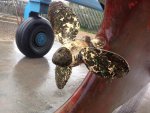
 
Not true when I bought my Autoprop, they recommended "silicon based antifoul" or a copper free antifoul. I wasted £150 on having Propspeed applied. It was so bad that they gave me a free application the next season.

Back to Trilux, although last season it didn't adhere so well, so I'm trying the Seajet triple pack for the epoxy primer...

"Not true they told me" or "not true they feel it should be antifouled"
I ask because I am a friend of the MD & he has repeated the assertion several times not to apply antifoul paint
I will take it up with him again when we meet at easter

& from what you say, your attempts have failed some what.
So are you sure you interpreted the conversation you had with them properly?
 
You mention spraying, can you get Trilux in a spray can? If so how may coats would you apply? Does it need any sort of undercoat/primer?

Yes, try searching on Trilux prop-o-drev. I believe you should use a primer, but I haven't. I just open the blades of the prop and spray a thin coat on. Usually put on two or three coats.

I wouldn't want to put it on too thick as I guess that would increase the chances of it flaking, not to mention running when still wet. It's quite a gloop when cold hence my previous comment about warming it up - a tip I got from a boat builder.

I also use it on the prop shaft and rope cutter.
 
"Not true they told me" or "not true they feel it should be antifouled"
I ask because I am a friend of the MD & he has repeated the assertion several times not to apply antifoul paint
I will take it up with him again when we meet at easter

& from what you say, your attempts have failed some what.
So are you sure you interpreted the conversation you had with them properly?

Extract from the H5 manual:

Will my Autoprop still work correctly even with heavy fouling? The performance of the Autoprop will be impaired by marine growth just as any conventional propeller. With heavy fouling, thrust diminishes, and there is a reduction in the maximum engine revolutions attainable. However, the Autoprop will still pitch correctly. In areas of high fouling, smoothly coating the Autoprop with a high quality marine antifouling may help to reduce the amount of growth, being careful of course not to allow any antifouling to enter the bearings.

Full manual here: http://www.autoprop.info/Fitting_Servicing/Owners_manuals/H5 ball bearing owners manual.pdf
 
I fitted a Featherstream this time last year and applied 3 coats of Velox antifoul over the Velox primer. Followed the instructions exactly including sanding with 80 grit paper and cleaning with acetone prior to applying the primer.

At the end of the season most of the white antifoul had come off leaving the primer showing. In a few places the primer had also come off and there was metal showing. So not too impressed with Velox.

IMG_1212.jpg
 
Extract from the H5 manual:

Will my Autoprop still work correctly even with heavy fouling? The performance of the Autoprop will be impaired by marine growth just as any conventional propeller. With heavy fouling, thrust diminishes, and there is a reduction in the maximum engine revolutions attainable. However, the Autoprop will still pitch correctly. In areas of high fouling, smoothly coating the Autoprop with a high quality marine antifouling may help to reduce the amount of growth, being careful of course not to allow any antifouling to enter the bearings.

Full manual here: http://www.autoprop.info/Fitting_Servicing/Owners_manuals/H5 ball bearing owners manual.pdf

You have to read between the lines. They are not saying put antifoul on in lower risk areas which suggests the advice I was given is still valid. IE do not put it on. Has it occurred to you that they are not actually coming out in favour of paint. I also point out that the term "may" is used. This suggests it is only a "possible" for high fouling- so perhaps they feel that it "may" offset the disadvantages I mentioned above
I will take it up with the MD at easter but I bet he still advises not to apply paint if possible.
 
The photo of my Autoprop shown in post #3 is either the third or fourth season that I have used Velox with great success. I bought the Autoprop in about 2000 and it has been antifouled ever since. Eroding A/F was not much use, as the photos in this link show, taken in 2005 https://coxengineering.sharepoint.com/Pages/Pbracket.aspx but the prop itself is in perfect condition, taken back to bare metal regularly.
 
Top