new coolant for MAN engines

BartW

Well-Known Member
Joined
9 Oct 2007
Messages
5,236
Location
Belgium
www.amptec.be
Last summer when partially draining coolant on one engine,
I noticed that the originally red (cat?) coolant was fairly brownish (iron rust)
There was a substantial amount of brown stuff that sank to the bottom of the bucket with the coolant.

In winter I need to replace another hose from the cooling cirquit,
I’m considering to drain the cooling cirquit on both engines completely, flush it with plain water,
And then put new coolant.

What product to look for, preferably available here near Cagliari / south Sardegna

I also need to buy 80l of new engine oil,
would coolant be available from a engine oil supplier ?
 
Our boat was hangered for nearly 3 years and recommissioned summer 14 with the green type .

https://www.penriteoil.com.au/assets/pdf/tech/Nov2015/Coolants.pdf

It’s never changed colour always been bright green .However last Nov I sucked out the contents of the header tanks and refilled about 10L with fresh .Easy job for winter piece of mind .
They hold about 30 L each so about a 1/3 rd replenished. Idea is to maintain the time dependent anti corrosive element.
I suspect it depletes with time ? I,ll be doing this every year from now on .
Costs about €4 / L on draft from our yard ,they fill your container.

There are several drain plugs about and it looks messy with the potential of air locks when refilling , to drain all the systems at one hit ,hence the partial replenishment every year rational.
How ever the link above suggest longer life expectancy.

I would consult your manual on which type as mixing both A and B can lead to gel and coagulation- not good .
If changing then give them a good water flush in between types .

Also check the earth strap is properly connected to the ( church lightening conductor appearance ) copper strap that runs to the transom anode .The transom anodes do the donkey work with MAN engines protecting components in contact with seawater against corossion ,as long as there’s continuity between the anodes and the seawater via the coolers with block etc .

There’s no hidden away pencil anodes in the coolers with MAN,s just huge transom anodes easily viewable.

With fresh coolant and annual transom anodes that’s all you can do to protect from corrosion.
 
Colour is irrelevant and it is about the type and specification of the anti freeze used and this would be your first port of call; very few, if any engine manufacturers manufacture their own anti freeze as it is bought in by the engine manufacturers in large quantities. You will find many anti freeze manufacturers who can supply anti freeze to your specifications, and Portofino makes an excellent point about coagulation and one which needs serious notice taking of it.

I would be very concerned about the condition of your cooling system if it is rusty and contains particles as anti freeze is a slight misnomer as its primary function is to prevent corrosion of the engine internals and reduce the reaction of different materials to each other, its secondary function is to prevent the cooling system freezing up.

I would proceed as follows: drain the cooling system and fill with neat water, run the engines until they are hot and drain the water, repeat this until the water comes out clean and free of debris, then fill the cooling system with water and a cooling system cleaner and follow the instructions for its use, drain and fill with clean water to flush any remaining cleaner from any voids in the engine and then fill with anti freeze and water, if you have a water filter then use only filtered water, or if distilled or deionised water is readily available then use this instead of water.
 
Colour is irrelevant and it is about the type and specification of the anti freeze used and this would be your first port of call; very few, if any engine manufacturers manufacture their own anti freeze as it is bought in by the engine manufacturers in large quantities. You will find many anti freeze manufacturers who can supply anti freeze to your specifications, and Portofino makes an excellent point about coagulation and one which needs serious notice taking of it.

I would be very concerned about the condition of your cooling system if it is rusty and contains particles as anti freeze is a slight misnomer as its primary function is to prevent corrosion of the engine internals and reduce the reaction of different materials to each other, its secondary function is to prevent the cooling system freezing up.

I would proceed as follows: drain the cooling system and fill with neat water, run the engines until they are hot and drain the water, repeat this until the water comes out clean and free of debris, then fill the cooling system with water and a cooling system cleaner and follow the instructions for its use, drain and fill with clean water to flush any remaining cleaner from any voids in the engine and then fill with anti freeze and water, if you have a water filter then use only filtered water, or if distilled or deionised water is readily available then use this instead of water.
Colour may be relevant if it indicates the type of coolant. Oat coolant (the organic one) is incompatible with the old type stuff, and they are usually different colours, hence your valid point about coagulation.
 
Colour is not relevant as only the specifications are relevant, most manufacturers specify the colour they want their anti freeze dying and the only choices they have from a manufacturers colours are the colours they do, or they have to specify their own colour and pay the additional cost for a batch dyed to their specific colour.

Basic fact, anti freeze produced by one manufacturer was red if it went into a Car Plan branded container, green if it went to a certain car manufacturer, and yellow if it went into Halfords branded container, it was all the same anti freeze, made in the same factory, identical specifications, and the only difference was at the packaging stages as the different dyes were added before it went into different packaging.
 
Thought the link I posted in #1 was pretty clear - oh hum forums eh :)
Idea was save another unnecessary row .

Assassins correct above .

Ps revisit the link page 1 top rhs


[Hint - Coolant Colour:
Just because a coolant is coloured doesn’t mean it’s an Anti-Freeze Anti-Boil product.
The colour in coolant is a dye and should never be used to distinguish the type of coolant. Coolants are generally clearly labeled Type “A” or Type “B”.]

Bart just needs to know what type he’s got A or B , if wanting to top up or as said completely flush.which sounds a better idea and get to the bottom of why it’s turning colour ?
Ideally it shouldn’t.
Makes sense eventually to use the same stuff supplied locally to save humping it about ,just make sure it meets MAN spec ,which I think most do anyhow .
 
Last edited:
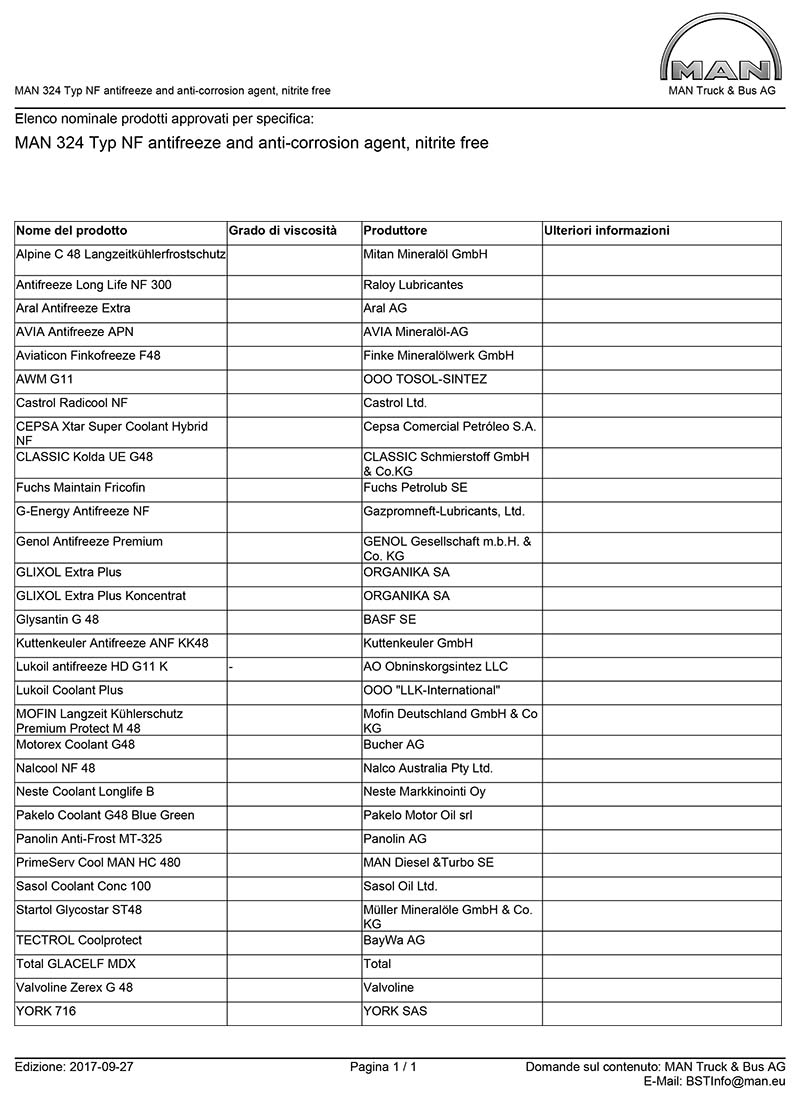
Hi B, below is the list of approved cooling liquids that I got from a MAN engineer, as alredy discussed.
Headers are in IT, but essentially the first column shows the coolant names, and the second their producers.
I was told that "324 Typ NF" (whereas NF stands for nitrite free) is the MAN spec valid for all pre-common rail turbo CAC 284X engines, so that's bound to apply also to yours.
Not sure about pre-CR 6L engines, as PF has in his boat, otoh.
It could be that the chap who gave me the list only mentioned the 284X series because he knew it's what I've got on my boat, but the spec is actually valid also for pre-CR 2876 engines... I can't be positive about it, though.

Ref. where to source this stuff (and also oils) in S Sard, I'm afraid I didn't look into that yet.
But let's keep in touch!
c7riqhk8_o.jpg
 
Found this old thread as it is change coolant time for me on my 2003 MAN V10s.

The original manuals that came with the engines list coolant with Nitrite, specification M 324 N (Nitrite).

Google tells me that the nitrite stops pitting of the cylinder liners.

The list of European products available in 2003 are not available in Australia in 2021.

Coolant manufacturers are saying that nitrite was the old way of doing things.

Here is a link to Castrol explaining the 'problem'.

What are others on here doing as I could spend the next six months 'researching' and over thinking this?
 
Found this old thread as it is change coolant time for me on my 2003 MAN V10s.
The original manuals that came with the engines list coolant with Nitrite, specification M 324 N (Nitrite).
R U sure?
If you have a 2003 V10, it's bound to be a D2840LE403, which is a pre-common rail engine, as is my D2848LE403.
For which, my understanding is that MAN specification for coolant used to be M324, period.
Then my manual goes on explaining that both type "N" and the "NF" are fine, as long as they are never mixed.
It even specifies that a full replacement is neccessary, if and when switching from M324 "N" to "NF" or vv, but there is no need to flush the whole circuit.
Which suggests that there is some incompatibility, but it's not so crucial to avoid the slightest contact between the two types...
 
Yes they are D2840LE403 but I must have missed the part that we can use both.

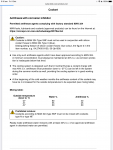
A more recent MAN document found online suggests M324 N, NF or SNF can be used. SNF cannot be used on engines with silicone coolant hoses (blue), and the warning now is about mixing N or NF with SNF.

A2F3350E-1FE5-41AB-B977-8C6A38F2BEC6.png

That makes my life much easier and I will probably go to NF.

There is 80 litres of coolant per engine, so I need 66 litres of coolant. That’s a lot of coolant!

I am planning on draining the coolant completely anyway as I have no idea of what is currently in the engine and for how long.

Even though the engines are running fine I am cleaning and inspecting the salt water side of the engines which will include changing the impeller, replacing the thermostats, replacing the coolant caps, cleaning the heat exchangers and cooler.

Thanks for the help.
 
There is 80 litres of coolant per engine, so I need 66 litres of coolant. That’s a lot of coolant!
80L/engine is correct for the V10 also according to my manual (whereas the V8 takes 63L and the V12 96L).

A minor warning, though:
I guess you calculated the coolant quantity assuming 60% water and 40% coolant, since your external temperature is never anywhere as cold as -27°C.
If so, that's actually 64 liters in total rather than 66, but that's not the point I'd like to make.
I was suggested by more than one MAN engineer to use a 50/50 split regardless of whether the higher antifreeze protection is needed or not.
According to them, that's the optimal dilution also for the best protection from corrosion of the closed circuit.
TBH, I never bought the idea that 50/50 can make a big difference vs. 60/40 in terms of corrotion inhibition, but it's a cheap insurance, all considered.
In fact, I did go for 50/50 on my boat even if where I'm based we never see the wrong side of zero degrees!

Consider also that you might need a bit more than 80L in the engine whose coolant circulates also inside the fresh water heater.
If the boat builder did use that possibility, of course - some don't.
 
There is also a specific 'sillicate free' antifreeze. The sillicate is carried in suspension in many antifreeze products and assists in keeping passages within the system clear, a good thing.

However, many modern hi-tec engines use ceramic face seals in the water pumps.

Sillicate antifreeze wears these sealing faces fairly rapidly.

Our local Honda motorcycle dealer has been using the wrong stuff for years and has recently been caught out. Several large payouts for premature water pump replacement on the newer Fireblades for example.
 
80L/engine is correct for the V10 also according to my manual (whereas the V8 takes 63L and the V12 96L).

A minor warning, though:
I guess you calculated the coolant quantity assuming 60% water and 40% coolant, since your external temperature is never anywhere as cold as -27°C.
If so, that's actually 64 liters in total rather than 66, but that's not the point I'd like to make.
I was suggested by more than one MAN engineer to use a 50/50 split regardless of whether the higher antifreeze protection is needed or not.
According to them, that's the optimal dilution also for the best protection from corrosion of the closed circuit.
TBH, I never bought the idea that 50/50 can make a big difference vs. 60/40 in terms of corrotion inhibition, but it's a cheap insurance, all considered.
In fact, I did go for 50/50 on my boat even if where I'm based we never see the wrong side of zero degrees!

Consider also that you might need a bit more than 80L in the engine whose coolant circulates also inside the fresh water heater.
If the boat builder did use that possibility, of course - some don't.
I agree on the 50/50, that’s what I have done with every car and boat I have ever had. I have just ordered 80L of coolant and 80L of distilled water.
 
Top